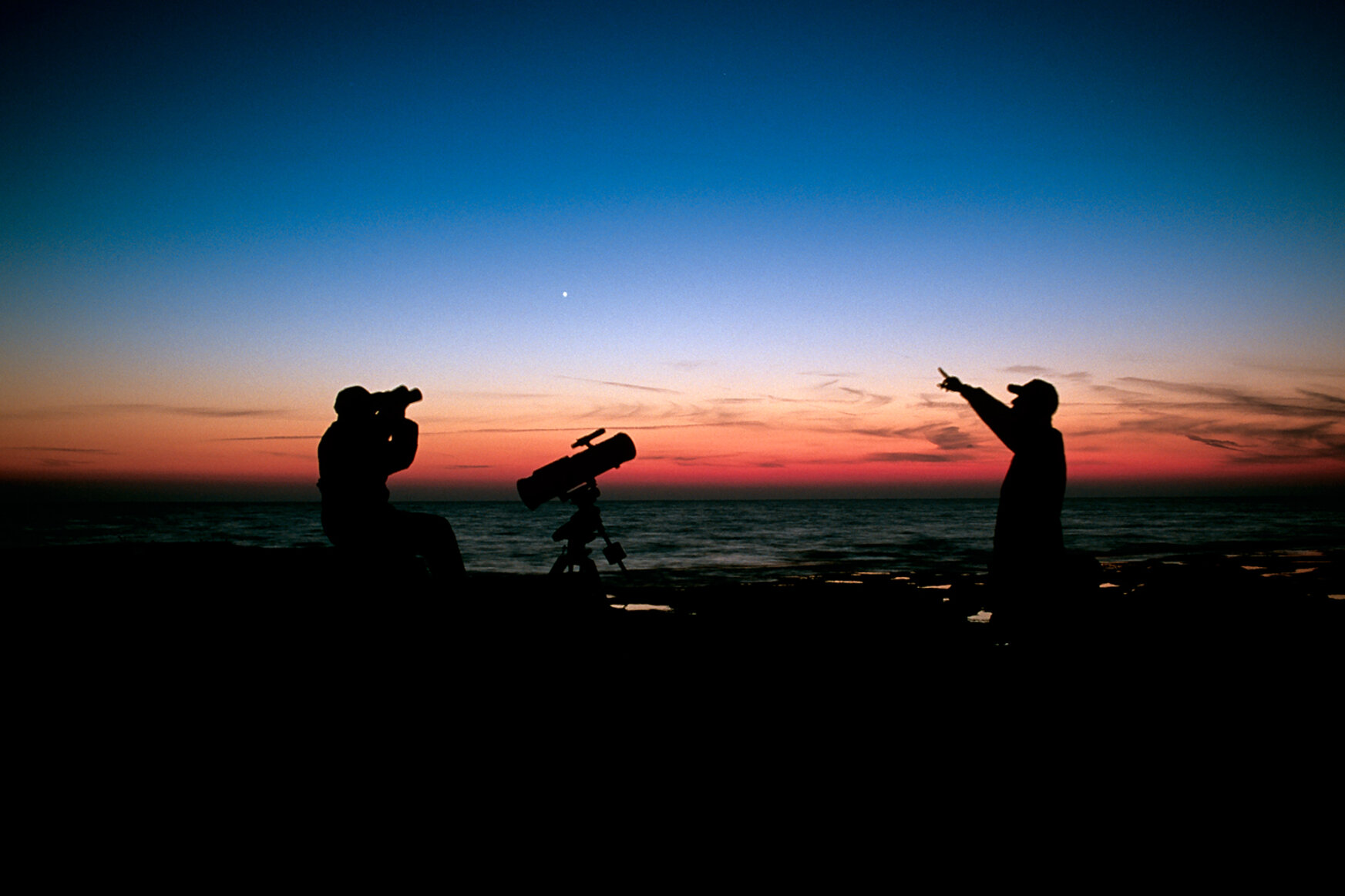


One of the biggest disputes about modern photography revolves around the varied range of meanings tied to its very definition. For some it represents an art form, for others simply a physical process linked to the interception of photons. In particular, in scientific photography, thus in astrophotography, the concept of art finds very little room, in favor of those who reduce it to a mere receptive process of photons. But we believe this pragmatic view is too reductive and simplistic; therefore, just as there is an affinity between the concept of “true” in science and realism in photography, we will try to show that there is also a cultural link between Ansel Adams’s landscapes, Helmut Newton’s woman, and nebulae, or planets captured with telescopes.
Let us now try to explore both points of view.
To support the thesis that interprets astrophotography as scientific expression, we must reshape the definition of art and inflect its meanings within physical laws.
Art, in the common sense, is the ability to express an emotion beyond the principles of nature, the so‑called physical "laws"; but, on the other hand, it can easily be shown that nothing exists beyond such laws. So we could provocatively state that astrophotography is not an expression of art for the simple reason that art does not exist.
Take, for example, human thought, which should be the engine of art. Thought is nothing other than an electrical signal of 70 mV (millivolts) that propagates as a depolarization across the cell membrane from one nerve cell to the next (with the mediation of a neurotransmitter at cellular junctions) in the most superficial part, the cortex, of the mammalian brain and specifically of humans.
As is evident, thought, and therefore what we call "art", can be reduced to physical laws and does not stand apart from them.
Interpretation, the winning weapon of art critics, is a discussion about the sense of "taste" and perceived feelings. To interpret means to explain why a painting or a photo satisfies us, that is, makes us release those molecules, like endorphins, that give us a sense of well‑being when we look at it. Once again, a biophysical kind of explanation.
Sometimes there is even some doubt as to whether a photo is a representation of reality. In astronomical photography, the photo of a galaxy certainly does not represent the object as it is at the instant of the shot, something we are not allowed to know. It is exactly what we fool ourselves into knowing as it was at the moment its photons detached from it to begin the long journey toward us. While the photo is in our hands, the galaxy has certainly turned into something else.
Other times what we call "reality" simply does not exist, or at least is not what is commonly meant. Take, for example, the photo of any subatomic particle taken by any detector at CERN or at Fermilab. The image will show a line interpreted as the particle’s passage. The easy, but wrong, deduction is that the particle as a physical entity passed through there: it is "material", we can almost grasp it. Well, this is not the truth, or at least it is only part of it. It is in fact known that elementary particles are described by a mathematical function (psi) that expresses the probability of finding the particle at a certain point, in a certain state.
The same "fleetingness" applies to particle paths because of the uncertainty principle: if we knew a particle’s velocity with sufficient precision, we would know nothing about its position, and vice versa. In conclusion, a particle can travel an infinite series of possible paths. And it does so, at least until it is measured. Here is the trace in the photo! In fact, the physical act of measurement makes the particle decide which road to take. Therefore it is not legitimate to speak of representation of reality and of the realism of an image, since for a particle the possible realities are infinite, just as the possible states of the wave function ψ are infinite.
It follows that astrophotography is not the representation of a reality, but only of probable real events. At this point one could conclude that it cannot even constitute an art form.
To support the opposite thesis, according to which astrophotography is an expression of art, we consider the concept of truth in scientific observations and truth in realist photography. For this we consider it essential to make an excursus on the history of photography applied to science.
The telescope and the microscope are two optical instruments that allowed humans to look out onto new worlds where photography found space as a “pencil of nature”, able to fix observations onto a medium.
Photography, from its birth in the second decade of the 1800s, was welcomed with enthusiasm in the scientific field, and especially in the astronomical one, although it had highlighted problems linked to the representation of reality and to the faithfulness of objective transcription. Scientists who used photography in their observations considered the image obtained through lenses on a par with a mathematical description. For this reason they applied photographic technique with the intent of reproducing reality, but to transform a scientific observation into a physical image it was necessary to “build” it and “develop” it. It follows that images had to be manipulated, but the procedures, as in pictorial art, created only analogies and resemblances between the image obtained and reality.
Even today, at times, we are amazed when the concept of reality in photography is discussed. Not everyone, in fact, is clear that no reproduced photograph is reality; no print made from file, negative or slide, and no image we see in videos is reality. The painter Magritte wrote “This is not a pipe” under a pipe painted very realistically, and in the same way we could write “This is not the Moon” under the photo of the Moon taken in the simplest and most realistic way possible (Taken from a reflection by Carlo Delli and Marco Meniero).


