

Pearlescent clouds
Pearlescent clouds, also called nacreous clouds, are formations that show astonishing colours that slowly change shape and hue. They are about 20 km high and belong to the stratosphere; however, they can also form at lower levels down to 12 km in altitude. They are made of pure frozen water, or of thin crystals, and have an average temperature of -85 degrees Celsius. They can easily be seen as orographic clouds that follow the profile of mountain peaks, or volcanoes.

Iridescence and coronas
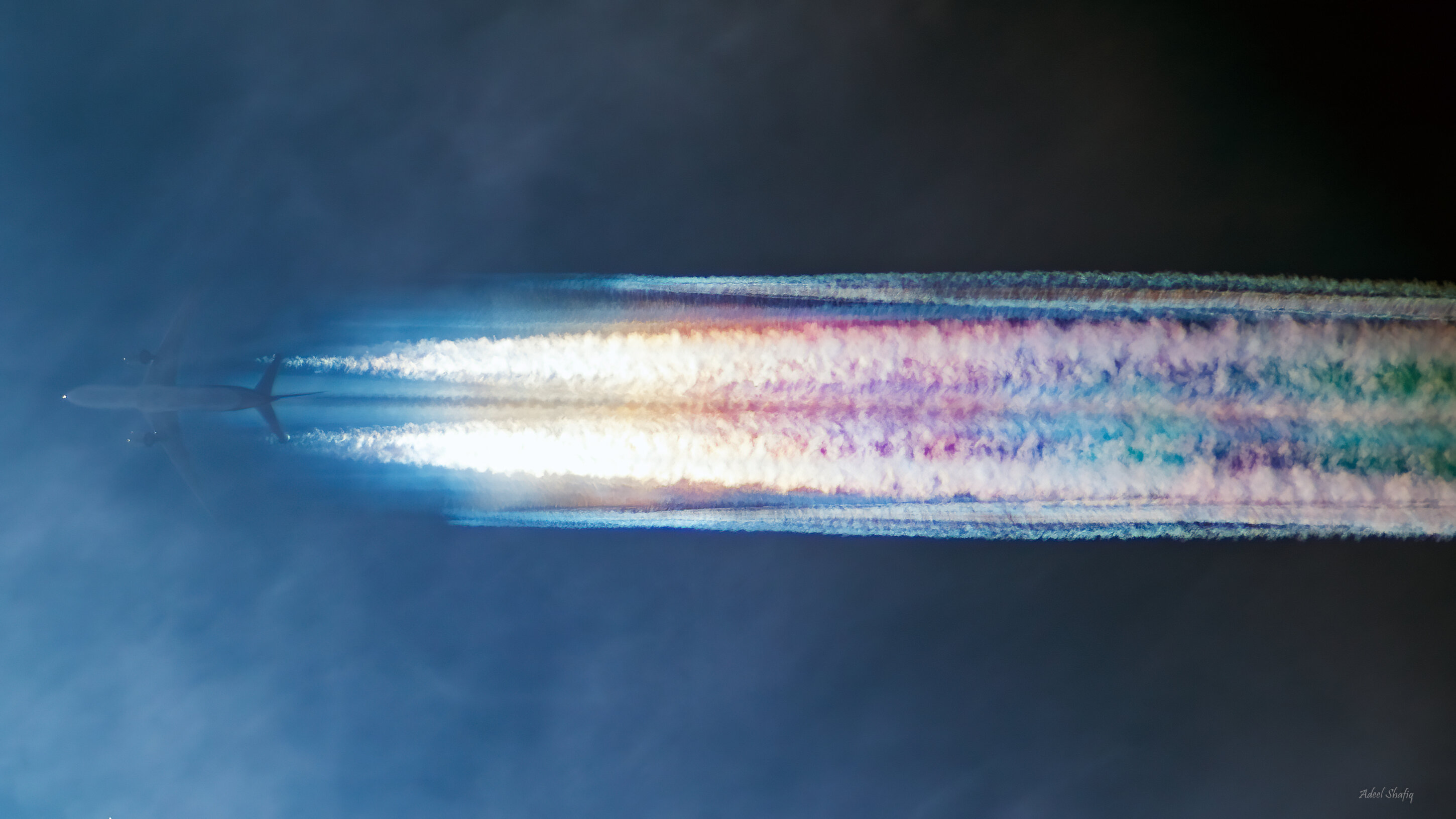
The colour depends on the diffraction of very tiny particles that are only slightly larger than the wavelength of the light they diffract. Light is deflected several times and the colours range from blue to green and from yellow to red. The exact angle between which the maximum and minimum of light intensity vary depends both on the size of the atmospheric particle and on the wavelength. The particle shape is not decisive in the diffraction process, but it is important that the cloud contains both ice and water droplets. For example, if all particles had the same shape, the diffraction angle would depend only on the wavelength of light and it would be split into rings. For a corona to appear, the sizes of the droplets and the ice crystals must be similar: if this does not happen, you will get an iridescence.
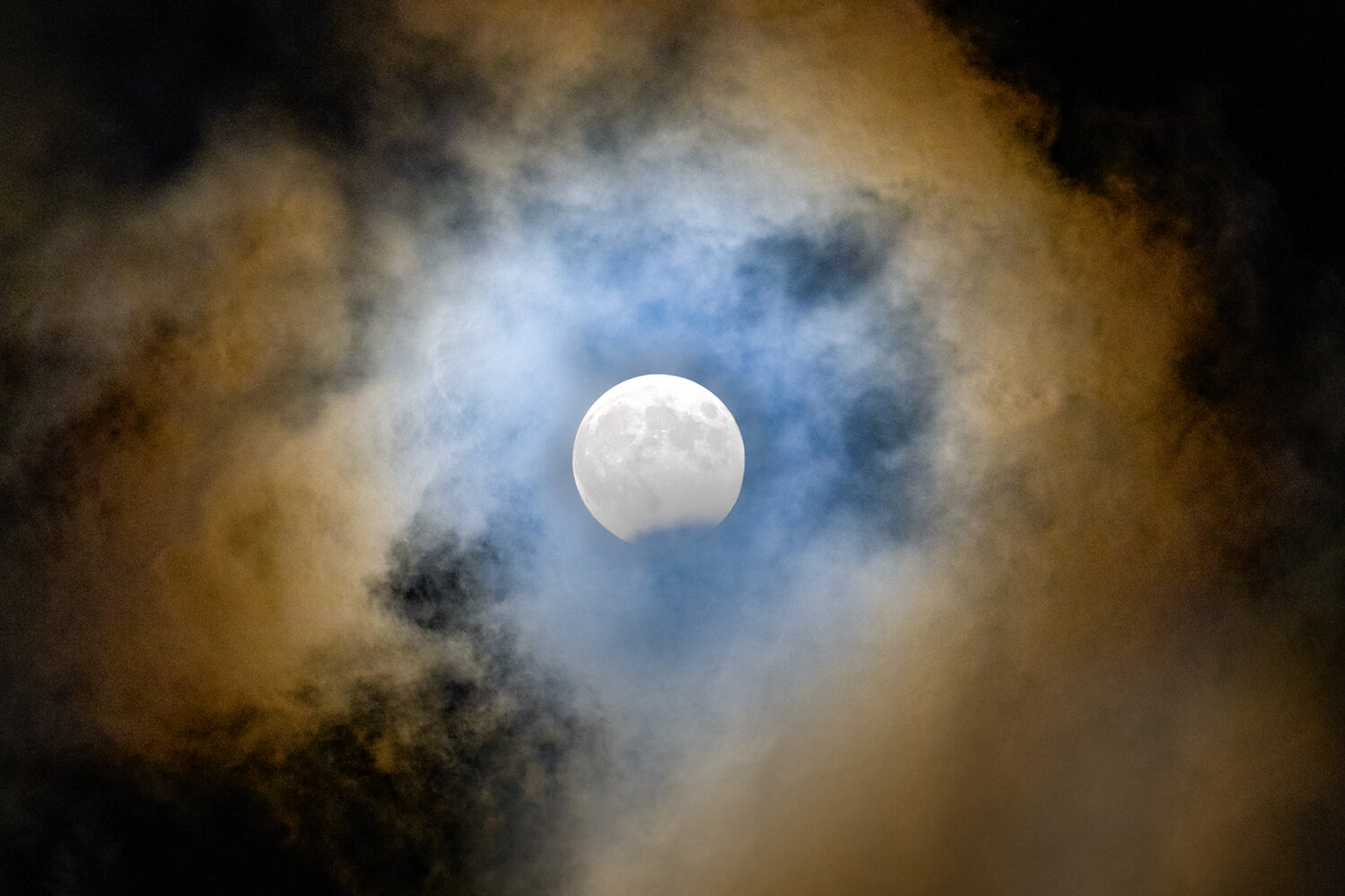
The corona has a spherical shape around the celestial body, while iridescences are irregular and often frayed. These rings would be seen as coronas around the Moon or the Sun or, in rare cases, around a body with negative apparent magnitude (Jupiter, Venus, Sirius...). Clouds made of tiny water droplets and ice crystals can form coronas. They consist of a series of coloured circles overlapping each other or separated, with a radius ranging from a few arcminutes to about 10°-13°. Higher-order rings can also be seen with varying saturation. They can turn into iridescences with irregular colouring if the rings fray; in these cases the phenomenon can be seen up to 45° from the Sun. The rings take on the colours of the spectrum with red on the outside, unlike halos which have red on the inside. The clouds that generate coronas must be thin and semi-transparent, as altostratus, altocumulus, lenticular clouds and cirrus, and aircraft contrails can be. Generally, the water droplets and crystals must be similar in size, and this happens more easily in newly formed clouds. These photometeors can form in any season and in any place and are very frequent as iridescences at the ends of lenticular clouds in high mountains. There are also rare cases of formation due to pollen grains.
Solar coronas are very common, but hard to spot because the Sun’s light can dazzle the observer; often the use of good dark glasses (grey-blue tinted lenses are recommended) makes viewing easier; polarised lenses do not improve visibility because the effect of polarisation shows up only with the Sun at least 60 degrees from the phenomenon.
Iridescences


Coronas


Bibliografia nei testi consigliati