

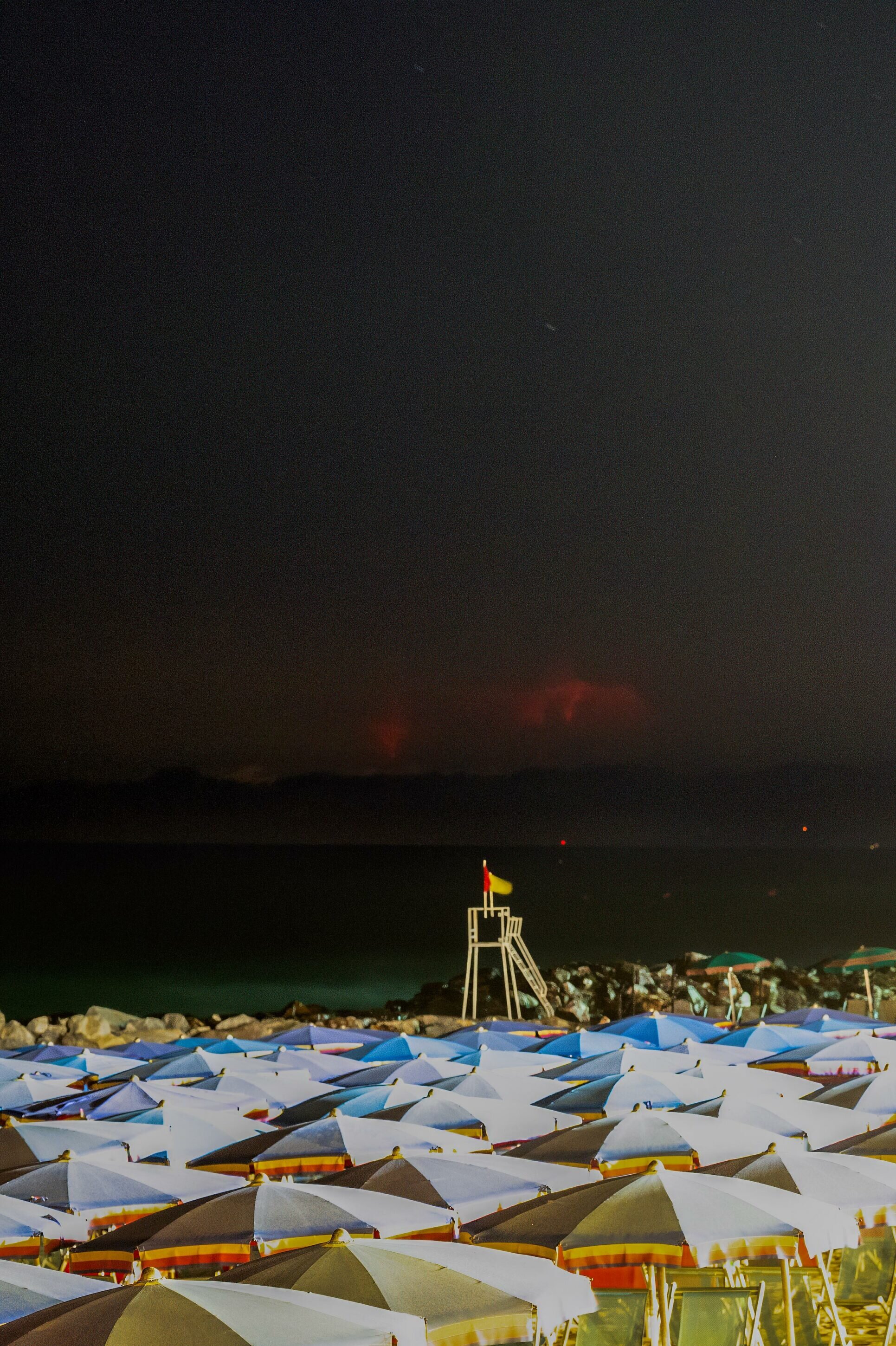
A Red Sprite captured by the astrophotographer Stephane Vetter on 10 September 2019 from Isola del Giglio (Gr). Stephen is one of the photographers of The World at Night #TWAN
In 1920 the Scottish physicist C.T.R. Wilson theorized the formation of electrical anomalies above large thunderstorm cells. It was found that these can generate the optical phenomena of Red Sprites, Blue Jets and Elves between the stratosphere and the mesosphere.
The first image of a Red Sprite was taken in 1989 from the Space Shuttle (STS-34), which recorded flashes while passing over a storm in northern Australia; later, in 1990, about twenty images were recorded. The phenomenon consists of a group of one or more red spots that develop vertically above the area ionized by electrical discharges of the storm cloud. They may appear as red spots, upward-branching carrots, jellyfish or tentacled octopuses. They generally occur at altitudes ranging from 65 to 90 km.
However, some scientists believe that cosmic rays, which increase during solar-minimum cycles, provide the ionizing “spark” that triggers sprites. Mesoscale convective systems with strong lightning tend to produce the best sprites. Others instead blame meteoric dust.
During the summer of 2000, American researchers who took part in the Severe Thunderstorm Electrification and Precipitation Study ran simulations showing that weak lightning does not create them.
Most researchers supported the theory that they are linked to the charges of the most intense lightning. They also found that the total charge, as it moves from cloud to ground, multiplied by that distance—known as the “lightning charge moment”—is the most critical factor in sprite development. The study appeared in the April 2005 issue of the Journal of Geophysical Research - Space Physics.

2 Red Sprites captured in August 2025 from Pisa toward the Piedmont/France border.
Nikon Z9 at 1600 ISO, 30" exposure, 24-70/2.8 lens at 70mm
Bibliografia nei testi consigliati