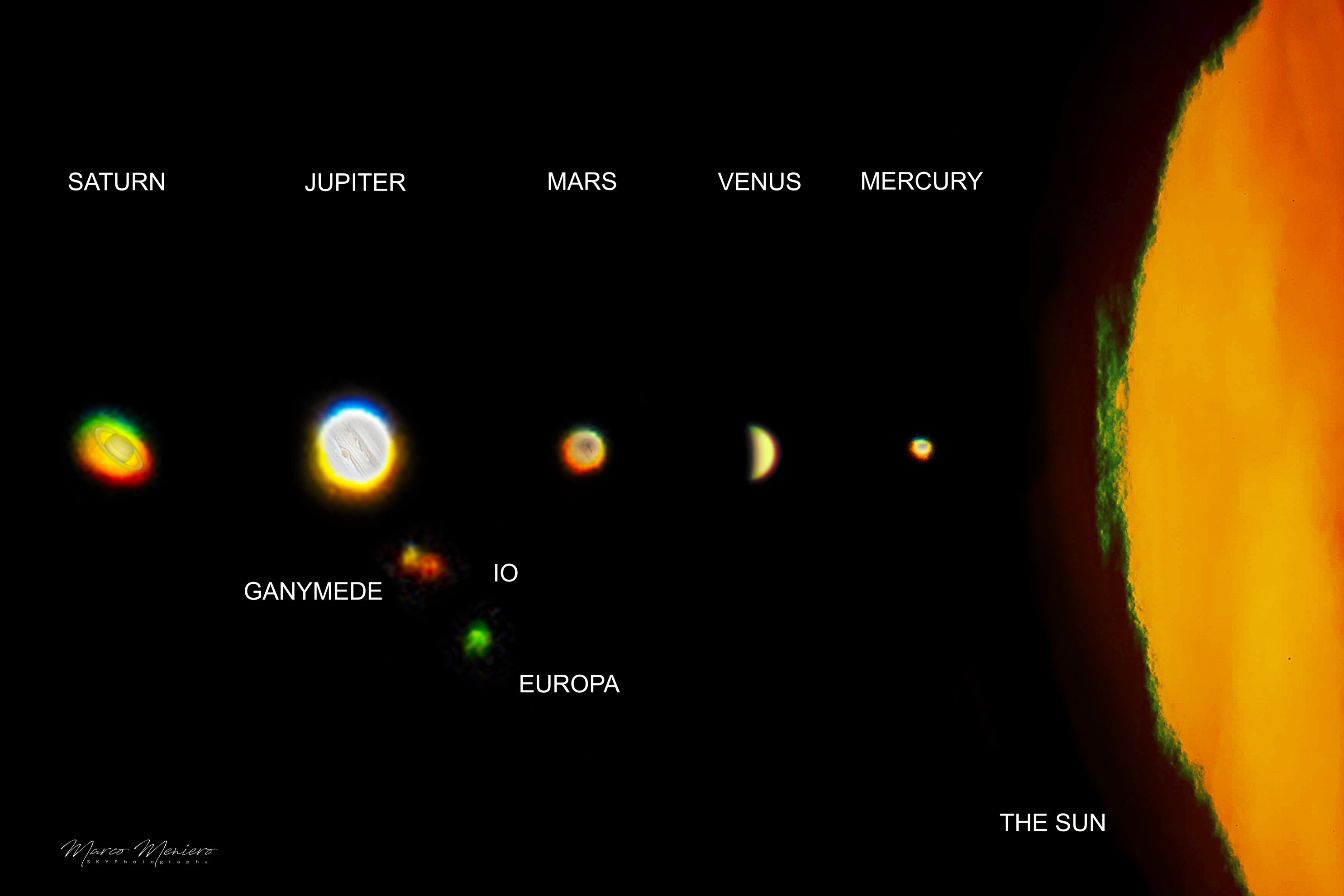


Definition of green ray (World Meteorological Organization): A predominantly green coloration of short duration, often in the form of a flash, seen at the extreme upper edge of the Sun, Moon or sometimes even a planet when disappearing below or appearing above the horizon.
The green flash phenomenon is broad and shows many shades; let’s look at the known cases:

Green segment: term spread by O’Connell (1950) to refer, in general, to the first appearance of green on the horizon that precedes the final green flash (when the Sun disappears below the horizon). Later it fell out of use.
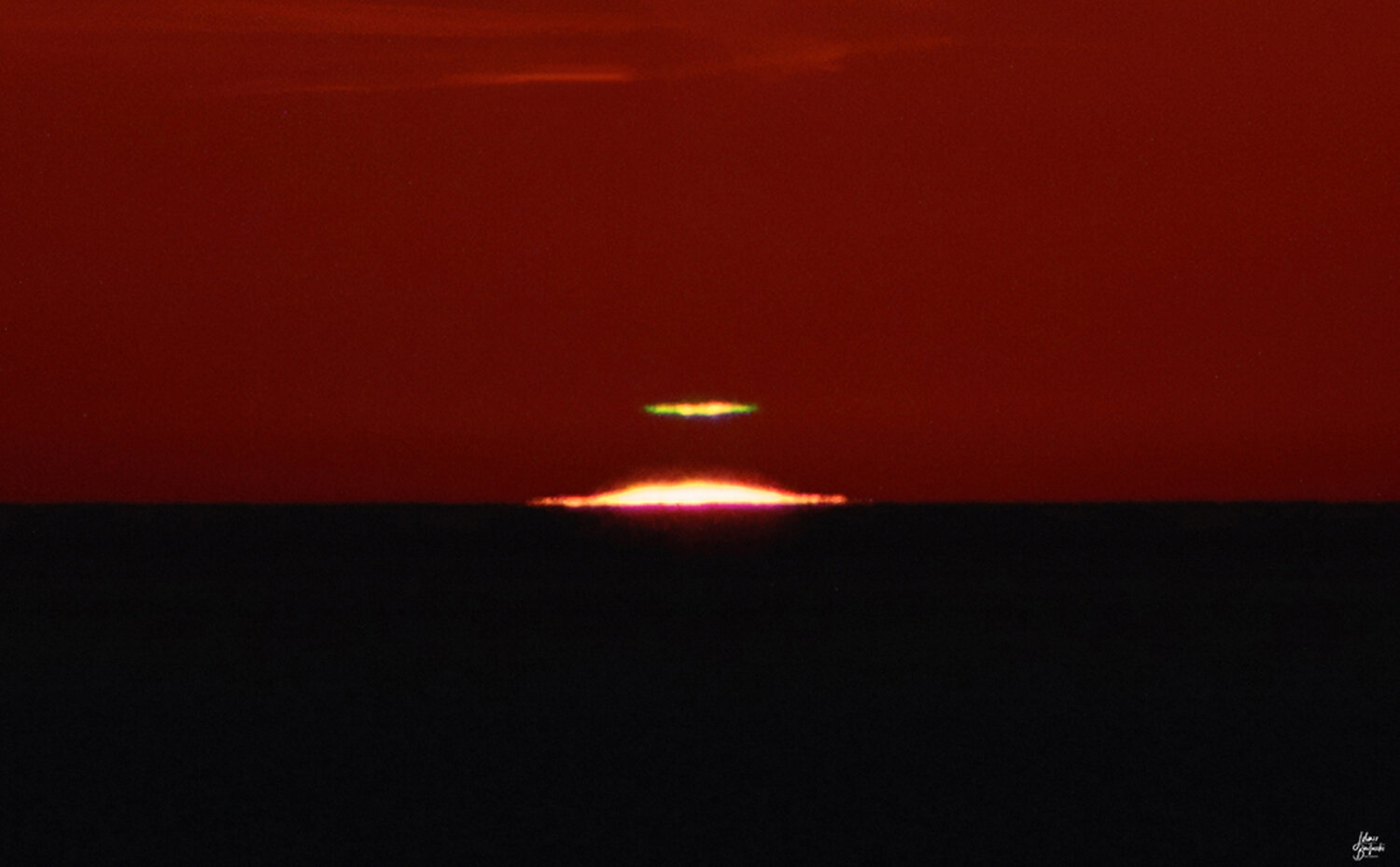
Green rim: green streaks that detach from the Sun’s upper limb; their formation heralds the true green ray (visible only with binoculars or a telescope). It can last up to 15 seconds and is visible if the observer is in a layer of air with strong thermal inversion. It can never turn blue or violet.
Blue rim: Andrew T. Young states that the blue rim does not exist; however, there are differing views in the scientific community. From personal experience I can say that sometimes the green rim may look partly bluish.
Red rim: red streaks on the lower edge of the solar, or lunar, disk. It appears symmetrically to the green rim when the body is above the horizon.
Green spikes: a series of green rims that form at the same time on the last visible limb of the solar disk. Easily recognized with binoculars if the Sun sets behind a jagged ridge such as a tree line or clouds.
Green flash (the best known): a green rim that forms from the last visible limb of the solar disk, or when it crosses a thermal-inversion layer (visible to the naked eye from coasts). It forms in hazy air if there are two air layers with different temperatures.
Green ray: faint green flash that radiates vertically from the solar disk for at least 10 degrees (very rare).
Blue flash: last visible solar limb with blue and indigo shades (visible to the naked eye from mountain tops).
Green flash on sunspots: Green formations can also be observed on the lower edges of large sunspots because they are much darker than the Sun. In these cases one should not consider the green ray on the lower part of the spot, but on the upper part of the Sun below the spot.
Most (about 2/3 or 3/4) of all observations comes from an inferior mirage. The rest from a mock mirage. This is a type of inferior mirage that produces multiple false images that change shape and position over time. It differs from a simple inferior mirage because the latter produces only one false image below the real one.
Other types of flash exist, but they are rare and make up only 1% (of all reports). Not all types are named, and there are also some not considered in this discussion, such as the flash on top of the cloud (usually seen when the Sun sinks into coastal fog, but sometimes also in distant cumulus), or Alistair Fraser’s flashes, which are seen in hilly countryside. These are a variant of the mock-mirage flash if strong inversions are present that climb up the hills.
Bibliografia nei testi consigliati