

Fujifilm GFX 100S II
A medium format under the starry sky

For over thirty-five years I photographed using the Leica format that defined modern photography: 35mm. I started with the Zenit 122, then moved on to film SLRs (Yahshica FX3 Super 2000 and EOS 30E), later DSLRs (5DMkI, 5DMKII, 5dMKIII and 1DXMkII) up to mirrorless Nikon Z9 and Zf. I have always had the same technical and practical approach that this format brings with it: speed, versatility, relatively ergonomic gear and fast lenses.
My photographic field is, however, quite specific. Much of my work focuses on astronomical photography, landscape, and documenting photometeors: from nights under starry skies to spectacular clouds and other events that often require a good reading of light, versatile equipment, but also extremely high image quality.
For this very reason, in recent months I decided to take a step that for me represents a real paradigm shift: moving from 35mm to digital medium format. I decided to get the small medium-format Fujifilm GFX100S II, a 102-megapixel camera that promises extraordinary image quality (on par with the Hasselblad H2D II 100C). The GFX boasts a large 43.8 × 32.9 mm sensor and offers a light-sensitive area 1.7 times larger than 24x36mm.
Fujifilm GFX100S II is one of the most interesting digital medium formats of recent years: it combines a 102-megapixel sensor with a relatively compact body and a more affordable price than Hasselblad products. To get the most out of the GFX you need to rethink light handling and tonal rendering, from dynamic range to the ability to capture extremely fine detail in landscapes or in the structures of the night sky. At the same time, it also brings compromises and operational limits that become especially evident in the very photographic genres I practice.

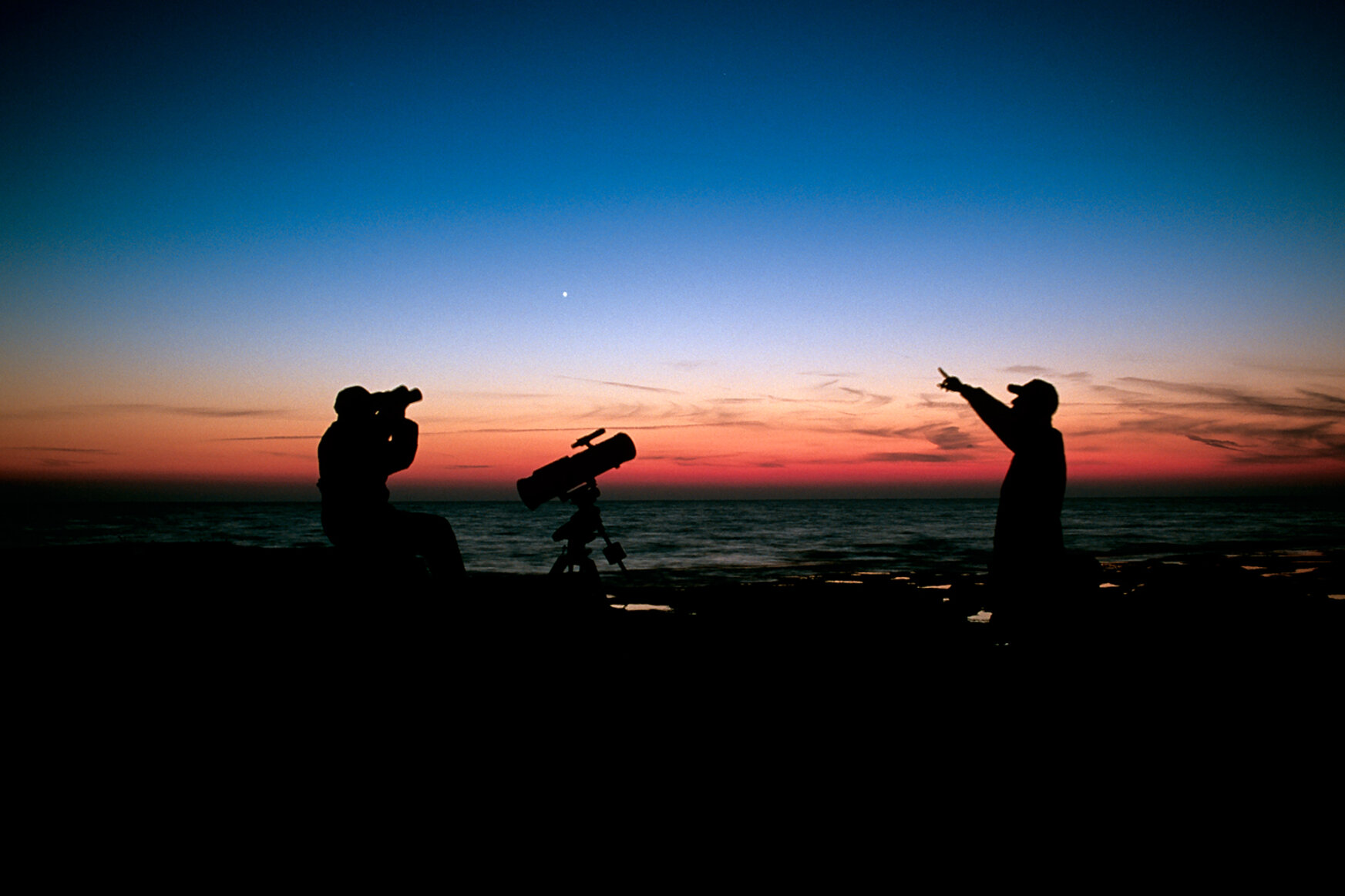
Conjunction of the planets Venus, Mercury and Saturn. Photo taken in the seaside town near Rome: Santa Marinella, close to the stilt houses of Capolinaro. Technique: Fuji GFX 100S II with GF 20-35/4 at ISO 80, exposure time 6.5 seconds, focal length 20 mm 26 February 2026, 18:40 local time.

Lunar atmospheric corona.
Technical data: Fujifilm GFX100S II at ISO 800, 1/5s, lens GF 250 f/4.
Single shot
In this text I share my first field impressions of the GFX100S II, starting from my previous experience with 35mm. I will analyze the advantages that medium format can offer in landscape astrophotography and in atmospheric optical phenomena (photometeors), but also the practical drawbacks — weight, bulk and handling — that emerge when you take a camera like this out of the studio and under the real sky.
The 102 MP medium-format sensor changes not only resolution but also the way faint, diffuse structures in the sky are recorded: subtle atmospheric phenomena, or the fine details of the Milky Way can benefit from a larger sensitive area and a wider tonal range. However, 35 mm keeps practical advantages such as a broader availability of fast lenses (f/1.4 or even faster) and high-ISO noise handling often more optimized for very short exposures, crucial when you want pinpoint stars without tracking. The GFX medium format, on the other hand, excels in more controlled exposures — for example with astronomical tracking or during slow atmospheric phenomena like noctilucent clouds, halos, circumhorizontal arcs or auroral structures — where the combination of large sensor area, tonal depth and resolution makes it possible to render extremely delicate color transitions and a level of detail that is rarely seen in the 35 mm format. In this sense medium format does not replace 35 mm in astrophotography, but expands its possibilities in more “scientific” and descriptive directions for photometeors and the deep sky.
Main strengths
1. Outstanding image quality from the 102MP sensor.
The main strength is that it delivers very high levels of detail, dynamic range, and tonal depth. This allows extremely workable files in post-production, with great ability to recover shadows and highlights.
For landscape, fine art, or astrophotography this means:
- The real advantage of having a larger sensor: the ability to gather more data than an FF sensor; it can recover up to 5 stops in the shadows without showing noise. The signal-to-noise ratio is better than full frame.
- ability for very heavy crops (even 10x for a good 30cmx40cm print)
- great cleanliness in sky gradients
- huge amount of detail in landscapes
- three-dimensionality of the photos
2. Dynamic range and color depth
The large sensor enables a very natural tonal rendering and very smooth transitions between highlights and shadows, one of the main reasons many photographers choose medium format. This is especially useful in:
- high-contrast landscapes
- night-sky photography
- atmospheric phenomena with clouds and tricky light (for example lunar coronas or iridescence on cirrus near the solar disk).
3. Very effective stabilization
The camera integrates a very effective 5-axis IBIS sensor stabilizer, which helps get sharp images even with relatively long shutter speeds. In theory it holds up to 8 EV of tolerance (the H2D II 100C Hasselblad has a stabilizer that reaches 10EV).
This is useful:
- for handheld landscapes
- with medium-format long focal lengths
- in low-light conditions.
4. Relatively compact body for a medium format
Compared to other medium-format cameras, the GFX100S II is fairly compact and easy to handle, approaching the size of some full-frame mirrorless cameras. This is one reason many photographers use it outside the studio too. It feels like using a Canon EOS 5D series, or a Nikon 850, with the quality of a Hasselblad (with a few exceptions like colors).
5. Improved autofocus with AI
The AF system includes subject recognition and improved tracking, much more advanced than the first GFX models. The AI-implemented autofocus is accurate and fast. But it’s still not on the level of Sony, Canon, and Nikon flagships, not so much for the ability to find focus, but for the inertia of the motors fitted in the lenses.
The AF menu adjustments are few but essential and no-frills. Everything you need is there. The button to switch focus from Auto to Manual is placed on the back of the camera and not on the lens; this lets you change without touching the lens and risking changing focal length and focus point

The sky above St. Peter’s. 10 December 2025, 60-minute star trail made like this: sky composed of 400 shots of 8 seconds each + 1 second interval, Fujifilm GFX 100S II at 400 ISO, GF 20-35/4 at 20mm f/5.6.
Panorama shot following the light meter indications (a single shot).

Full moon among the clouds.
Raw shot with GF 250 f/4, 1/5 exposure, 640 ISO

Same file as the previous one but with shadows recovered with ACR
Other strengths
- Customization
- Crazy output even in print up to 6400Iso
- Solid build like a Leica
- Lower noise floor than FF in the midtones
- Viewfinder with lots of resolution (but see the cons)
- Ability to display the histogram in real time on the screen can be useful
- Very handy the dial placed under the shutter button that has a dual function: rotation/ rotation with click. Personally I set rotation to change the lens aperture and rotation with click to change the Iso
- The top display stays on and is handy because it lets you see how the camera is set before turning it on. This increases operating speed in a context where the camera is inherently very slow (but see the cons)
- The “Film Simulation” is useful to preview the file in the viewfinder even if the Raw is then post-processed. Film Simulation is useful for those who shoot .jpg, but I consider it a waste to buy a GFX and not use RAW.
- Pixel Shift Combiner, to generate 400MP images, also very solid Custom settings (there are 6) and quick to set.
- Q button is very useful and positioned intelligently, but too small.
- Ability to disable the touch screen
- Ability to view the menus in red light (better for astrophotography)
- “disp/back” button very handy to display information on the screen
- Button to switch focus from Auto to Manual placed on the back of the camera and not on the lens; this allows changing without touching the lens and risking changing focal length and focus point.
- Being able to change in-camera (also in the viewfinder) the aspect ratio from the original 4:3 to the 2:3 of 35mm.
- Fujifilm color science in my view superior to Nikon and Sony and inferior to Hasselblad.
- Auto white balance with the option to choose between two WB options: WB-W (for more neutral whites) and WB-A (more suitable for warmer whites). I use the first option.
- The Dynamic Range option, which acts on the signal exposure, can be set to three levels: DR100, DR200 and DR400. Personally I use the first because it’s the least invasive; the others underexpose by 1 and 2 stops and set base ISO to 200 and 400. To get the most out of this option you need to convert the RAW with CaptureOne.
- The “depth of field scale” visible in the viewfinder helps focusing in landscape.

Jupiter over Santa Maria in Castello, Tarquinia (VT)
Flaws
1. Slower system than same-price full frame
Even if improved, autofocus doesn’t reach the speed of the best full-frame systems from Sony, Canon or Nikon.
For this reason the camera is not ideal for:
- sports
- very fast action
- dynamic wildlife photography
- videomakers
- fast street (the typical Leica M system style)
2. Limited burst
The burst rate is relatively modest (about 7 fps) and with live view it can be even slower. This confirms it’s a camera designed more for quality than for speed.
3. Big lenses, limited catalog choice and expensive
The GF system offers excellent lenses but often:
- more expensive than full-frame equivalents, but they’re built obsessively and are very rugged
- some zooms, even short focal length ones, shift the system’s balance point (camera+lens) too far forward. This negatively affects the overall weight balance of the system and you feel it on your neck.
4. Huge files
102 MP RAW files can be very heavy and require:
- computers with fast processors
- lots of storage space
- slower workflow
- only CaptureOne lets you exploit the files 100%; unfortunately Ps is limited (it doesn’t read the Dynamic Range 100, 200 and 400 settings)
Some technical limits
- Rolling shutter with electronic shutter
- the original Fujifilm EF-60 flash fires only with the mechanical shutter
- Less advanced EVF than the bigger sister GFX100 II
- Shutter speeds longer than 1 second increase with too wide steps, giving the photographer fewer choices than the competition (e.g.:1”,2”,3”,4”, 5”,6.5”,8”,10”,13”,15”,20”,25”,30”,40”,50”,60”,2’,4’,8’,15’,30’,60’…)
- In the intervalometer, to choose a number of shots above ten, the mechanism that changes the counter is slow: you can’t act on tens and hundreds, so you must increase one by one (e.g. to select 400 shots you must press the switch 400 times)
- Great ergonomics but not up to EOS 1/R1/R3 and Nikon Z9/Z8
- Missing a wide, fast dial like those on Canon Series 1 bodies
- Buttons not backlit like the Nikon Z9
- Power switch is a lever; a type like the Leica SL3 would be better
- It uses two SD cards. Writing is slow; CF Express would be desirable. An internal SSD like Hasselblad could also be useful to speed up overall operation
- The compartment that holds the memory cards has no release latch (it would be useful to have one like Canon Series 1)
- Missing the handy vertical grip
- When viewing photos after shooting, images appear about 2 seconds after the shot with SunDisk Extreme Pro V90 cards with 300Mb/s write and read (average RAW size in “Lossless” mode about 100-120Mb). This time is too slow and sometimes the wait is frustrating.
- Viewfinder/screen very noisy in dark environments, viewing is annoying
- Top display stays on and drains the battery
- Missing a pro battery like Canon and Nikon flagships
- Small buttons; small and slow joystick
- The composition grid is black and can’t be seen in dark scenes and at night
- Missing a curtain that protects the sensor during lens changes
- Menu with dated graphics, should be updated in a more modern style. Some items in submenus are not very intuitive. It should be rethought in structure, font, and colors, but you get used to it quickly. If Fuji had the interface revised by designers like Jony Ive and Marc Newson it would gain a lot.
- When holding the camera vertically, both the menu and the review of taken photos remain in horizontal view.
- 16 bit available only with “Pixel shift multi shot” and “Still Image”
- RAW Lossless recording setting is very useful to save space on the card, but it slows the computer when opening the file
- The menu in the IQ section is distracting because it has many useless items for those who post-produce in RAW (Effects and Simulations, white balance ….)
- The intervalometer countdown does not show the number of shots taken (or remaining).
- Not very efficient battery: with 500 shots of 8 seconds each at 400 ISO it used 72% of the charge. The same shots with the Nikon Z9 use 30% of the battery

Lunar corona, shot taken without noise.

The same lunar halo as the previous photo,
view of the rear LCD screen.
A lot of noise is visible

The same lunar halo as in the first photo,
view through the viewfinder.
You can see a lot of noise

Image distortion due to rolling shutter, it is easily fixed by changing the shutter settings.

Handy top monitor (power-hungry)
and rear tilting LCD
In summary
Strengths
- outstanding image quality
- 102 MP sensor
- excellent dynamic range and color (if RAWs are developed with CaptureOne)
- relatively compact body for a medium format (similar to EOS 5D series DSLRs)
I would buy it for
RAW quality (colors, resolution)
Lens quality (even if many start at f/4)
Weaknesses
- autofocus and speed below top-end full frame
- very large files
- some hardware limitations (SD slot, burst rate)
- unintuitive menu
I would not buy it for
The viewfinder when used at night
Slowness in reviewing shots
Notes:
There are some adapters to mount GF lenses on Canon R and Nikon Z mirrorless cameras and others to use FF lenses on the GFX (but with the risk of vignetting).
Alternatives (March 2026):
- Hasselblad 907 100C, 8500 Euro (system that up to 2026 offers lenses only up to 135mm)
- Hasselblad H2D II 100C, 8000 Euro (system that up to 2026 offers lenses only up to 135mm)
- Fujifilm GFX 100 II (big sister to the GFX 100S II), 8000 Euro
- Fujifilm GFX 100RF (GFX 100S II fixed-lens version 35mm f/4), 5600 Euro

Sunset behind St. Peter's, 25 February 2026
Conclusion
The GFX100S II is a camera designed for those who put image quality above everything else. It’s perfect for landscape, fine art photography, studio and commercial work, large prints, while it’s less suited for action photography, fast reportage and video.
Personally I see the sky as a photo studio and when I prepare the shot I take all the time I need, therefore I believe this Fujifilm is the ideal tool for my needs.
I thank Emanuele Costanzo for guiding me in the purchase of this product.

Green flash captured with the GF 500/5.6 + 1.4X
In-depth look at sensor diffraction on the Fujifilm GFX 100S II
L diffraction doesn’t depend on the lens’s maximum aperture, but on the effective aperture you’re shooting at. So: if you shoot at f/5.6 with an f/1.8 lens, or at f/5.6 with an f/4 lens, diffraction is practically the same, because the relative aperture diameter (the f-number) is identical. This happens because the size of the Airy disk (i.e., the blur caused by diffraction) depends only on:
- light wavelength
- aperture (f/xx)
So, regardless of the lens:
- f/2.8 → less diffraction
- f/4 → more diffraction
- f/8 → even more diffraction
In astrophotography
- at f/2.8 you have less diffraction but more stellar aberrations (coma, astigmatism)
- at f/4 you have more diffraction, but often much cleaner stars
That’s why many astrophotographers stop down by ½–1 stop.
With very small pixels (like the 102 MP of the GFX) diffraction becomes visible earlier, so: on GFX: you start to notice it already around f/5.6–f/8, while on many 35 mm: more toward f/8–f/11.
For this reason many astrophotographers believe that with medium format there may be diffraction issues.
Let’s look at the specific case of the GFX:
In astrophotography the ~102 MP medium-format sensor (like those used in some modern medium-format cameras) creates an interesting situation because very small pixels + a very large sensor change how diffraction, sampling, and optics interact. The comparison with 35 mm full-frame therefore becomes very instructive.
1. The key point: pixel size
A 102 MP medium-format sensor (for example the one in the Fujifilm GFX100 II or the Hasselblad X2D 100C) has pixels of about 3.76 µm.
This is almost identical to the pixel size of many ~45–60 MP full-frame sensors (like the Sony A7R V or the Nikon Z9 when used in high-resolution mode).
It means diffraction per pixel is practically the same.
The size of the Airy disk depends on:
d \approx 2.44 \lambda f
where
• \lambda = wavelength
• f = f-number
So it depends on the relative aperture (f/), not on sensor format.
2. But the sensor is much larger
The 44×33 mm medium format has about 1.7× the area of full frame.
So two things happen:
A. Same sampling per pixel, since the pixels are similar:
• the diffraction limit per pixel is almost the same
• the sampling scale is similar
B. But the framed field is much larger. The sensor captures more sky while keeping the same per-pixel resolution.
In practice:
• same angular resolution
• much wider field
This is an advantage because normally to get more field you have to reduce resolution.
So the 102 MP sensor:
• keeps pixels optimal for fast telescopes
• but offers a huge field.
With the same telescope the full frame sees a portion of sky, whereas the 102 MP medium format sees a 1.7× larger field without losing per-pixel detail. It follows that the 102 MP GFX has pixels as small as the best full-frame, so the same diffraction limit, but a much larger sensor: same angular resolution but a much wider field.