

A systematic method for photographers and sky watchers
Among the most fascinating visual phenomena a photographer may encounter are those linked to the interaction of light with Earth’s atmosphere. Yet, this very beauty carries with it a subtle trap: mistaking an optical flaw for a real natural phenomenon, or vice versa. With the spread of dedicated blogs and social pages, interest in so-called photometeors has grown exponentially; as a result, the frequency with which images of simple optical aberrations are mistaken for extraordinary sightings has also increased.
Distinguishing the two categories does not require specific skills. Rather, it requires understanding the physical causes that generate them and applying a few rigorous empirical tests.
Filmed by Corrado Medved
Two families of phenomena, two radically different origins
The conceptual starting point is essential: photometeors and optical aberrations belong to two completely distinct physical domains.
Photometeors are luminous phenomena that arise in the atmosphere through reflection, refraction, diffraction, or interference of sunlight or moonlight with particles suspended in the air (water droplets, ice crystals, gas molecules).
The rainbow, the 22° halo, sundogs, the circumzenithal arc, and the famous green flash are all phenomena that exist independently of any optical instrument. The camera does not produce them: it only records them.
Optical aberrations and flare, by contrast, are artifacts generated entirely inside the photographic lens or lens system. There is nothing in the air or in the sky that corresponds to them. They arise from imperfect lens geometry, the glass’s chromatic dispersion, stray reflections between optical surfaces, and the properties of the diaphragm.
In photographic telephoto lenses, the most relevant aberrations are four
Axial chromatic aberration (or longitudinal) is the most critical and widespread flaw in long‑focal‑length optics. The different colors of light — corresponding to different wavelengths — do not converge to the same point on the optical axis, creating colored halos (typically magenta or green tints) around high‑contrast subjects. This defect is especially evident wide open.
Lateral chromatic aberration, instead, changes image magnification as a function of color, producing color fringing — blue/yellow or red/cyan — only at the extreme edges of the frame.
Spherical aberration causes peripheral rays to converge before central ones, reducing overall sharpness and creating a characteristic "soft" or veiled look across the entire image.
Pincushion distortion (pincushion), finally, is the geometric distortion typical of long focal lengths: straight lines near the edges tend to curve inward toward the frame.
Added to these is flare, which appears in two distinct forms. Geometric lens flare generates polygons or bright rings aligned along the diagonal that connects the light source to the center of the image — the polygonal shape exactly mirrors the number of aperture blades. Veiling (veiling flare) produces no geometric shapes, but a diffuse luminous haze that desaturates colors and degrades contrast across the entire shot.
Photometeors: geometry set by atmospheric physics
Photometeors, by contrast, obey rigid physical laws that define their geometry with absolute precision.
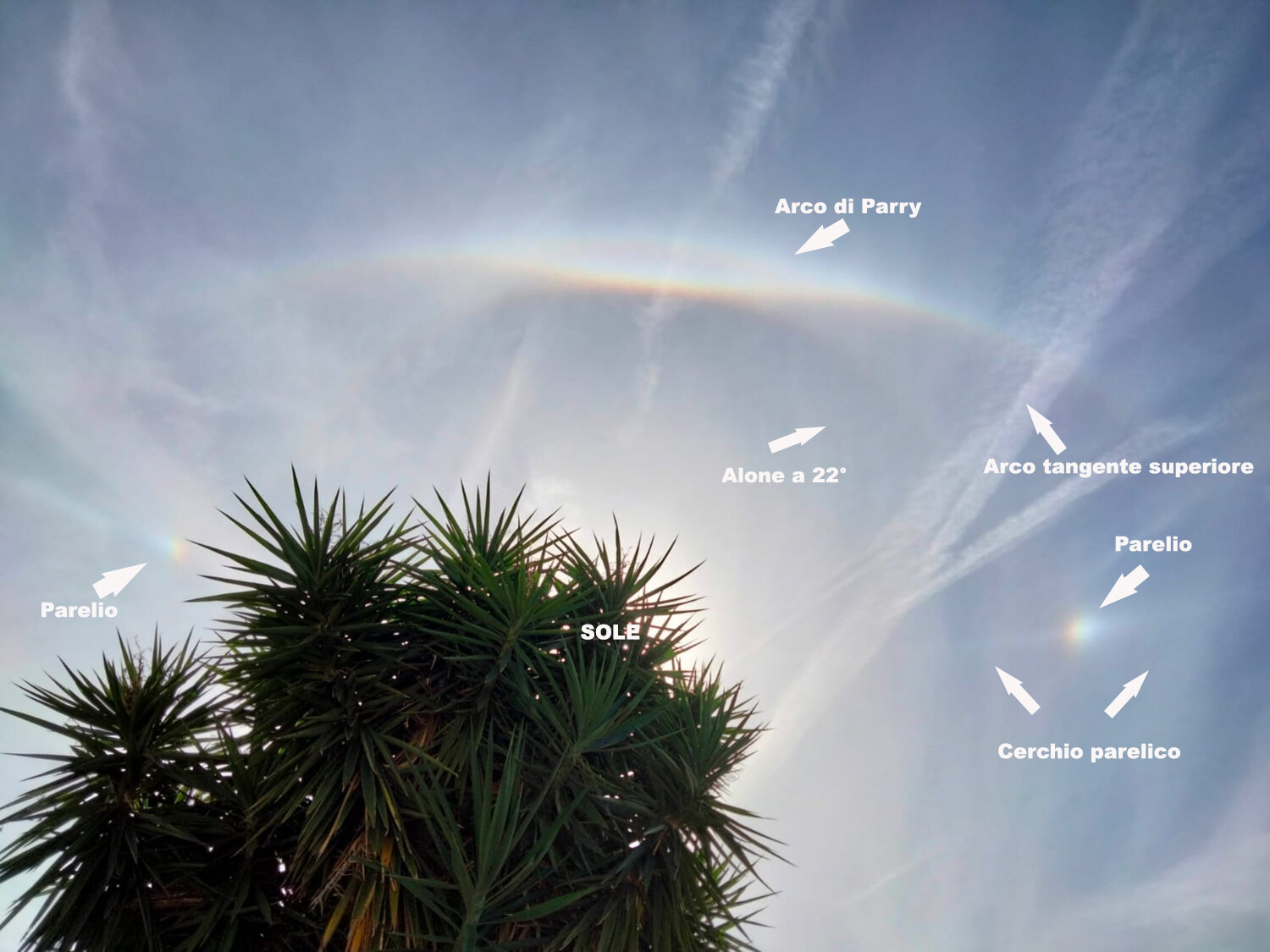
The 22° halo — the most common — appears as a bright ring with an angular radius of 22 degrees around the Sun or the Moon, with an inner edge tending to red and an outer edge fading into bluish white. It forms by refraction of light through hexagonal ice prisms randomly oriented in cirrus and cirrostratus clouds.
Parhelia (or "mock suns") appear as bright, iridescent spots placed 22° to the right and left of the Sun, at the same height on the horizon, generated by flat hexagonal crystals falling horizontally.
The circumzenithal arc forms at high altitude as an arc with vivid colors and convexity facing the Sun. It is visible only when the Sun is at low elevation.
The green flash (and the lesser-known blue flash) is a special case of mirage: it appears as a very brief flash or colored plume on the upper edge of the solar or lunar disk during sunset or sunrise, produced by the combination of atmospheric refraction, chromatic dispersion, and selective scattering.
The corona appears as a series of colored concentric rings tightly clustered around the Sun or the Moon, produced by diffraction of light through uniformly sized water droplets.
The method to tell them apart
The whole identification process is based on a simple rule: photometeors are phenomena external to the instrument; aberrations are phenomena internal to the instrument.
Experience shows that four simple checks allow, in almost all cases, to correctly distinguish between photometeors and optical artifacts:
1. The movement test
It is the most immediate criterion.
By slightly shifting the framing, a flare or a ghost image changes its position within the frame.
A photometeor, instead, keeps its position unchanged relative to the sky and the landscape.
If the phenomenon "follows" the camera, it is very likely an optical artifact.
2. Analysis of geometric shape
Flares often generate polygonal figures with well-defined sides, directly linked to the diaphragm structure.
Photometeors instead produce:
- circular rings;
- regular arcs;
- diffuse bands;
- symmetric structures determined by atmospheric refraction.
The presence of sharp edges is generally incompatible with an atmospheric phenomenon.
3. Response to aperture variation
By changing the lens aperture, different behaviors are observed.
In optical artifacts:
- the shape and size of flares change;
- the intensity of chromatic aberrations varies;
- star effects may appear around light sources.
Photometeors do not undergo intrinsic geometric changes as the diaphragm aperture varies.
4. Behavior at the edges of the frame
Many aberrations increase noticeably toward the image periphery.
Coma, astigmatism, and lateral chromatic aberration tend to worsen as one moves away from the optical axis.
Photometeors, instead, keep the same structure regardless of their position in the framed field.
The case of the blue ray that can be mistaken for chromatic aberration
One of the most frequent mistakes concerns the interpretation of the colorations observed along the Moon’s limb.
Chromatic aberration generally produces a colored band distributed uniformly along much of the lunar edge.
The blue ray, by contrast, appears as an asymmetric, localized structure only on the top of the disk, at the atmospheric horizon.
In other words:
- chromatic aberration “frames” the object;
- the blue ray emerges from a specific region of the disk.
The morphological difference is often enough for correct identification.

(On the left: blue ray photographed by Gianni Tumino. On the right: example of chromatic aberration on the lunar disk)
In case the flare can be mistaken for a halo phenomenon
Confusion between flare and atmospheric halos is also extremely common.
Halo phenomena occupy angular positions strictly determined relative to the light source.
A sundog will always be located about 22° from the Sun and at the same height. A Pillar will always be above or below the vertical of the light source….
A flare, instead, depends solely on the internal geometry of the lens and changes position as the framing changes.
In this case the movement test is decisive: just move the camera a few degrees to see the flare migrate within the frame, while the atmospheric phenomenon remains unchanged in the sky.

(Top: examples of geometric distribution of halo phenomena. Bottom: flare produced by a strong light source within the frame)
The rule that almost never fails:
Photometeors depend on the atmosphere - aberrations depend on the lens
If the phenomenon changes when you change lens, aperture, or framing, it’s probably not in the sky but inside the optical system.
If instead it keeps its geometry regardless of the gear used, it’s very likely you’re observing a genuine atmospheric phenomenon.
For the nature and landscape photographer, this awareness is far more than a simple technical curiosity: it means learning to read the sky and recognize when nature is truly offering a rare show.
Bibliografia nei testi consigliati