
Observations, classification and interpretation of photometeors
The systematic observation of atmospheric optical phenomena represents one of the most sophisticated aspects of traditional Chinese astronomy. Among these, solar and lunar halos, sundogs, tangent arcs and other photometeors were the subject of continuous documentation for over two millennia. Although such observations were framed within a cosmological and politico-religious conception based on the Mandate of Heaven, they reached a descriptive and classificatory level of remarkable precision, anticipating by many centuries similar studies developed in Europe.
In the 15th century, during the Ming dynasty, the Chinese observational tradition had by then consolidated a technical terminology, a detailed classification of phenomena and a vast iconography that today constitutes a source of great interest both for the history of astronomy and for the history of meteorology.
The classification of halos in the Chinese astronomical tradition
The oldest systematization of halo phenomena appears in the section devoted to the so-called "Ten Halos" (Shi Yun) contained in the Jin Shu (History of the Jin dynasty), compiled in 637 AD. This treatise represents one of the earliest technical classifications of photometeors that has come down to us.
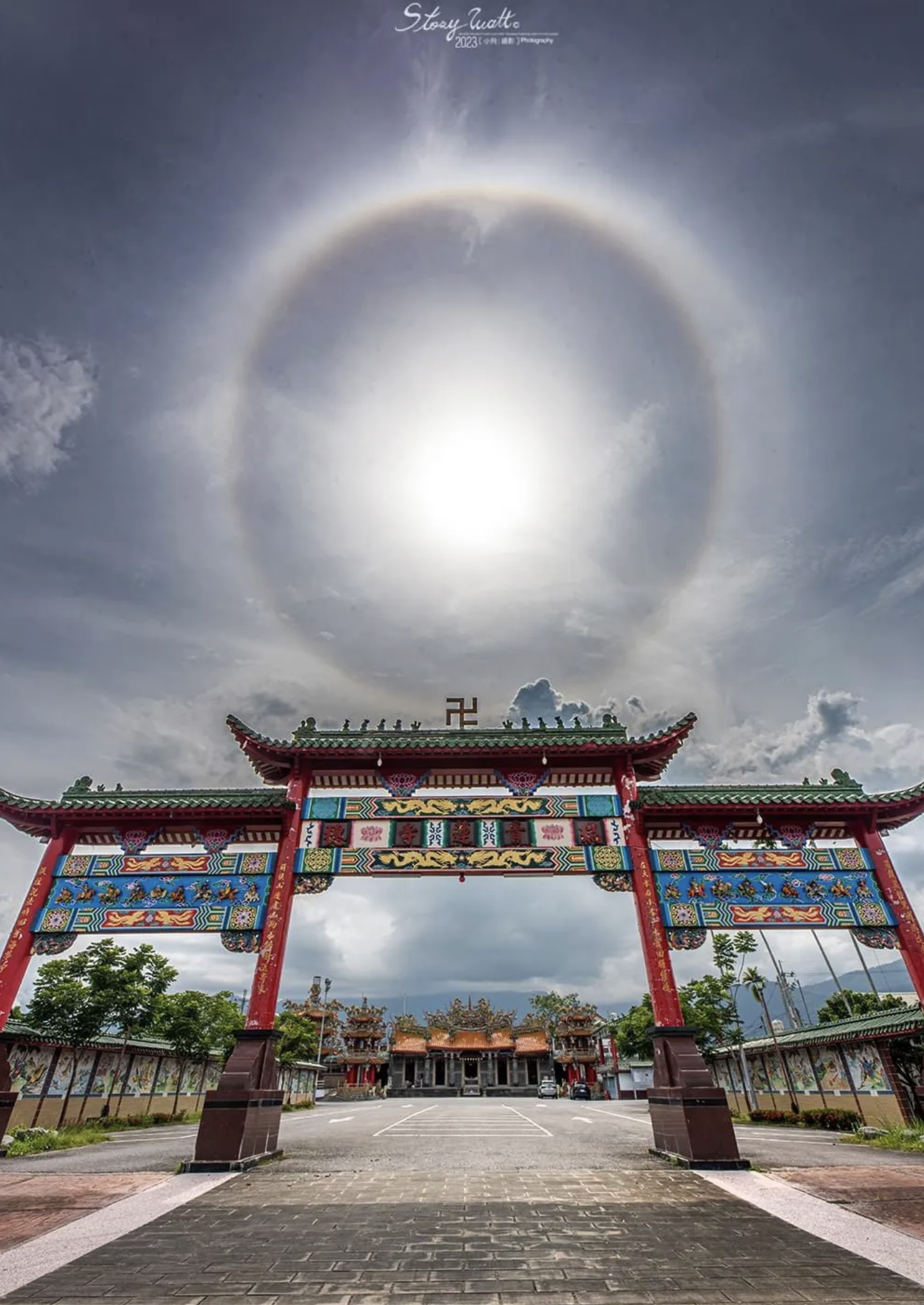
Imperial astronomers distinguished at least twenty-six different configurations of solar halos through a specific terminology based on the geometry of the observed phenomenon. Concentric arcs, tangent ones and parhelic circles received different names depending on their position relative to the Sun and their morphological features. Terms such as pao ("to embrace") or pei ("to oppose") described the geometric relationship between the halo and the solar disk, showing a remarkable attention to observational aspects.
This classification predates by about a millennium the first systematic European descriptions of complex halo systems, developed only between the 17th and 18th centuries.
The main photometeors observed
Solar and lunar halos (Yun)
Halos (Yun, 晕) are the atmospheric phenomena most frequently recorded in Chinese astronomical chronicles. Observations, documented as early as the Warring States Period (481–221 BC), regularly report:
- apparent diameter;
- duration of the phenomenon;
- light intensity;
- color sequence;
- possible presence of secondary arcs.
The color descriptions, often reported as red on the inner part and blue-green toward the outside, are consistent with what is now known about the refraction of light in ice crystals present in cirrus clouds.
Sundogs (Er)
Particular attention was devoted to sundogs (Er, 珥), now interpreted as secondary images of the Sun produced by refraction of light through oriented hexagonal ice crystals.
The chronicles report numerous cases of "three", "five" or even more suns simultaneously visible in the sky. Some scholars have also suggested that the symbols of the Ten Heavenly Stems, attested on the oracle bones of the Shang dynasty, may have been inspired precisely by the observation of particularly complex sundog configurations, although this interpretation remains debated.
The "Buddha's Light" (Fo Guang)
Another photometeor frequently described is the so-called Buddha's Light (Fo Guang, 佛光), identifiable with the modern physical phenomenon of the glory.
It consists of a series of colored rings surrounding the observer's shadow projected onto clouds or banks of fog. The earliest accounts date back to 63 AD and are associated especially with the mountainous areas of southwestern China, such as Mount Emei and Mount Huangshan, environments particularly favorable to the formation of the phenomenon.

Political function of astronomical observations
In the Chinese cosmological conception the sky constituted a communication system between the universal order and earthly government. Any variation in the appearance of the Sun or Moon was interpreted as a manifestation of the heavenly will toward the emperor.
The astronomers of the Imperial Astronomical Bureau therefore had the task of precisely recording all exceptional atmospheric phenomena and conveying their interpretation to the court.
Observations thus took on a dual function:
- accurate astronomical documentation;
- astrological-political interpretation.
In particular, halos and sundogs were considered indicators of the state of the Mandate of Heaven and therefore of the stability of the Empire.
Symbolic interpretation of photometeors
The symbolism associated with halos followed a logic consistent with Chinese political cosmology.
Sundogs and imperial sovereignty
Since the Sun symbolically represented the Emperor, the appearance of one or more "false suns" was interpreted as the presence of political rivals, claimants to the throne or usurpers.
Configurations with three or more suns indicated a compromise of the cosmic balance and foreshadowed dynastic crises or struggles over succession.
Halos and politico-military omens
The complete halo around the Sun (Zha) was often interpreted as the symbol of a court besieged by corrupt ministers or by enemy armies.
Tangent arcs, light pillars and rays crossing the solar disk instead took on the meaning of celestial weapons, announcing wars, rebellions or the collapse of imperial authority.
According to some interpretations reported in the chronicles, an arc crossing the Sun centrally could even foreshadow the assassination of the sovereign or a coup d'état.
The manuscript Thien Yuan Yu Li Hsiang I Fu (ca. 1425)
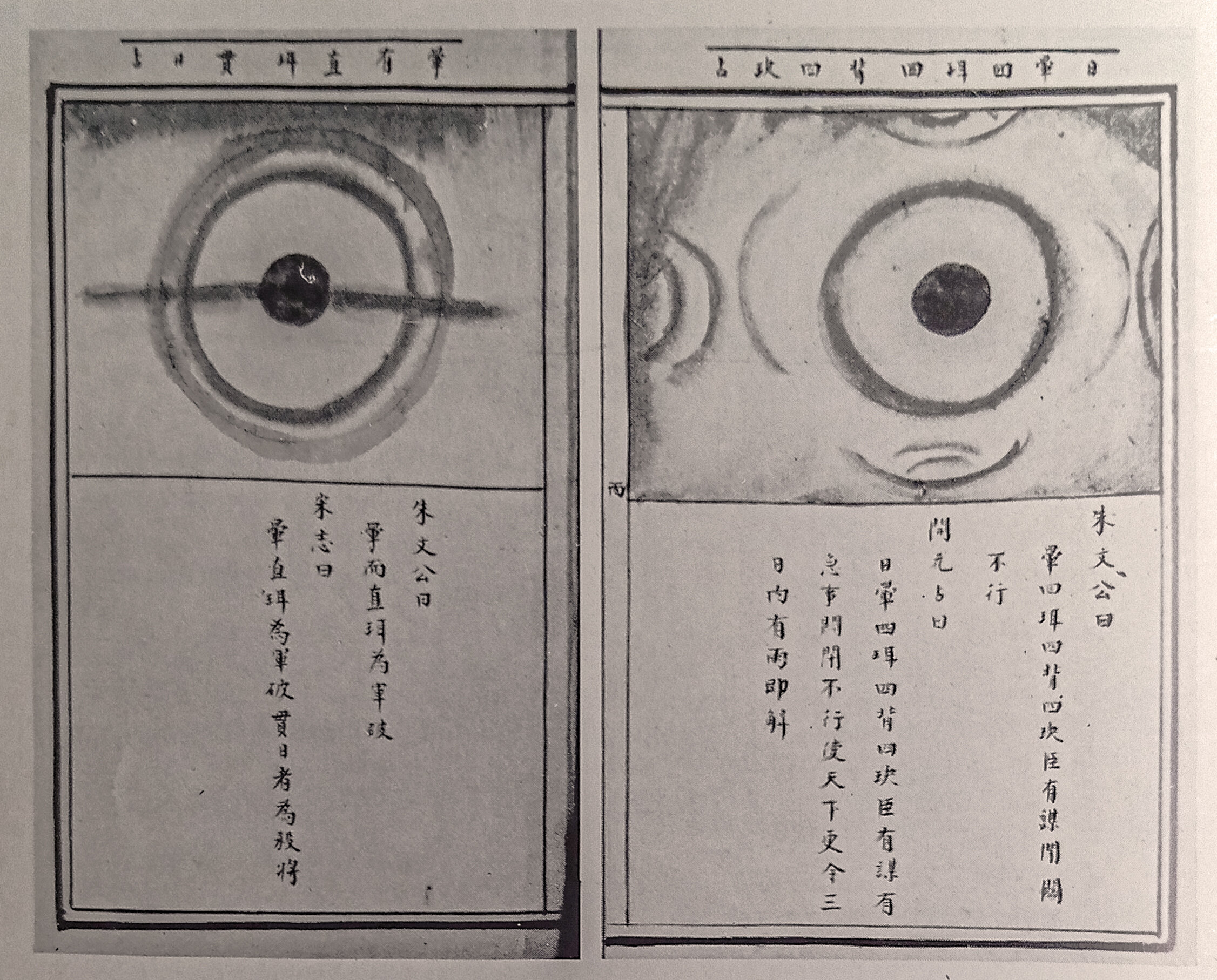
One of the most important iconographic testimonies of the Ming astronomical tradition is the manuscript Thien Yuan Yu Li Hsiang I Fu, attributed to the emperor Ming Chu Kao-Chih and datable to around 1425. The plates preserved at the Cambridge University Library illustrate numerous halo configurations accompanied by the related astrological interpretation.
In the left plate a halo (Yun) is shown crossed by a linear Er. According to Chu Win Kung this configuration announced the defeat of an army; the Monograph of the History of the Song adds that, if the Sun were crossed by luminous streaks, a commander would be destined to die.
The right plate instead depicts a complete halo accompanied by four Er, four Per and four Chueh. In this case the interpretation referred to conspiracies by court ministers. The text advised the emperor to remain in the palace, close the city gates and arrange extraordinary orders for the whole Empire; should rain arrive within three days, such measures could be revoked.
Although the interpretations were astrological in nature, the drawings show remarkable scientific accuracy. It is in fact possible to clearly recognize the parhelic circle, the 22° and 46° halos and various types of tangent arcs, demonstrating the high observational skill achieved by Chinese astronomers.
Conclusion
The observation of photometeors in imperial China constitutes one of the most important examples of systematic documentation of atmospheric optical phenomena in antiquity. Although placed within an astrological and political interpretive context, the descriptions collected by imperial astronomers show a surprising precision in the classification of the different halo configurations.
The testimonies of the Jin Shu and the manuscript Thien Yuan Yu Li Hsiang I Fu highlight how the Chinese astronomical tradition had developed an extremely advanced technical language and observational methodology, anticipating by many centuries European studies on photometeors. Today these documents represent a fundamental source for understanding both the evolution of historical meteorology and the relationship between scientific observation and symbolic interpretation of the sky in premodern civilizations.
Terminological note. In modern Chinese the term Yun (云) means "cloud", whereas the character 晕 used in ancient astronomical texts specifically denotes the optical halo produced by the cloud.
Thanks are due to Professor Antonietta Primavera for her collaboration.
Bibliografia nei testi consigliati