
“Red sky at night, shepherd’s delight”, “Red sky in the morning, bad weather is coming”… these two folk sayings come from sailors’ superstitions; let’s see whether they hold any truth ….

“Red sky at night, shepherd’s delight”, “Red sky in the morning, bad weather is coming”… these two folk sayings come from sailors’ superstitions. Let’s see what truth they contain: On average in Italy, the sky at sunset turns red because sunlight is scattered by dust particles in the dry air typical of high pressure with no disturbances, and thus typical of fair weather. Conversely, when the Sun rises and the red is in the East, it means the dry air has been pushed eastward by a disturbance arriving from the West, due to an approaching low pressure system with rain and humidity (generally with Maestrale or Libeccio winds).
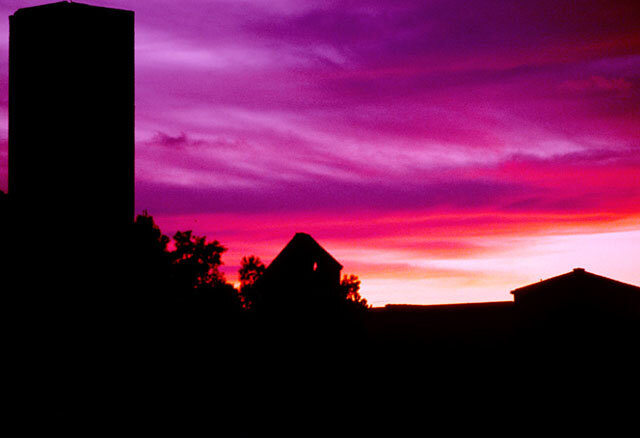
The folk saying is rooted in precise physical dynamics of atmospheric optics and in the synoptics of weather systems at mid-latitudes.
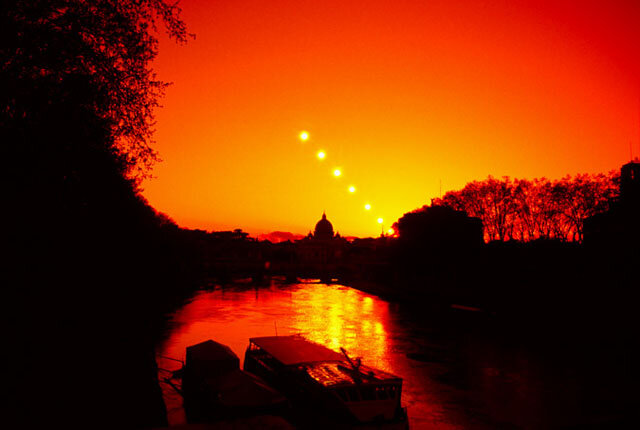
1. The physics of light: Rayleigh and Mie scattering
The origin of the reddish colors at sunrise and sunset lies in the interaction between solar radiation and Earth’s atmosphere.
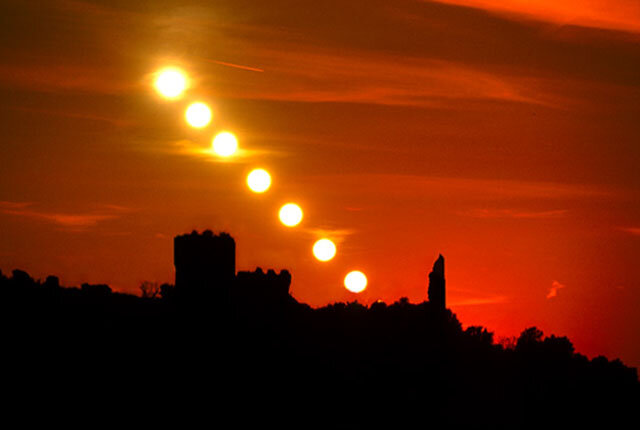
- Rayleigh scattering: Sunlight encounters atmospheric gas molecules whose diameter is much smaller than the wavelength of visible light. This type of scattering is inversely proportional to the fourth power of the wavelength. When the Sun is near the horizon (at dawn or at sunset), the rays pass through an atmospheric thickness (air mass) far greater than at noon. The shorter wavelengths (blue and violet) are scattered and dispersed in all directions before reaching the observer, while the longer wavelengths (red and orange) manage to penetrate the atmospheric layer and reach our eye directly.
- Mie scattering: In the presence of dry air associated with high-pressure (anticyclone) regimes, the atmosphere tends to keep aerosol particles, dust, powders and small pollutants suspended. These particles have sizes comparable to or larger than the wavelength of visible light. The resulting Mie scattering does not show a strong dependence on wavelength, but it has a marked forward directional component (forward scattering). This phenomenon enhances the brightness and extent of the red and golden component around the solar disk on the horizon.
2. Atmospheric dynamics: West-to-East zonal circulation
2. Atmospheric dynamics: West-to-East zonal circulation
To understand the forecasting validity of the saying, the physics of light must be combined with dynamic meteorology at mid-latitudes (including Italy):
- General circulation (Westerlies): At our latitude, disturbances and frontal systems (warm and cold fronts associated with pressure minima) move mainly from West to East, driven by the jet stream and by westerly zonal winds (such as Libeccio or Maestrale).
- Why “Red sky at night, shepherd’s delight”:
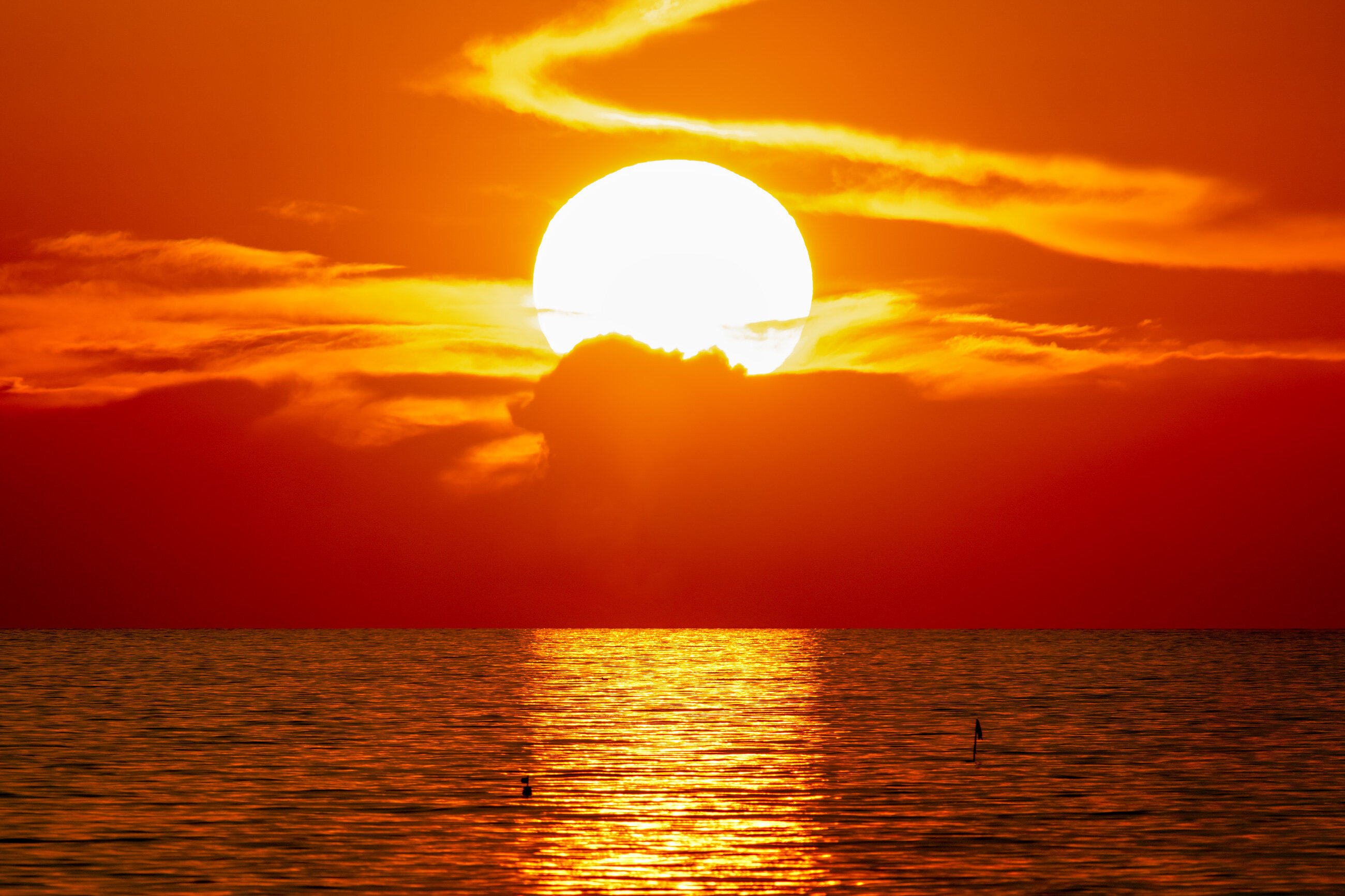
- When you observe a clear, distinctly red sunset to the West, it means sunlight is passing through an atmosphere free of thick cloud layers for hundreds of kilometers in that direction.
- The air to the West is dry and rich in aerosols trapped within a stable (anticyclonic) air mass.
- Since weather “travels” from West to East, that stable, cloud-free air mass will reach the observer’s location in the following hours, ensuring fair-weather conditions for the next day.
- Why “Red sky in the morning, bad weather is coming”:
- At dawn the Sun rises in the East. If the sky to the East turns a very deep red, it means the clear, dry atmosphere is already to the East of the observer, pushed away eastward.
- At the same time, the arrival from the West of a disturbance brings the first cirrus or thin altostratus overhead or to the West of the observer. These advanced cloud layers reflect the red light of the rising Sun coming from the East.
- The advance of the low-pressure system brings humid air and progressively thicker cloud cover, heralding the arrival of rain in the short term.
LIMITS:
The scientific validity of this phenomenon is tied to the presence of West–East zonal circulation. In tropical regions (where easterly trade winds dominate) or in the presence of blocked synoptic patterns (such as blocking highs or retrograde cold drops moving from East to West), the saying loses much of its meteorological reliability.

Bibliografia nei testi consigliati