
A Mock Mirage can turn the setting Sun into a sequence of overlapping images, some upright and others inverted. The cause is a particular layering of atmospheric temperature, which alters the path of light rays.

Photo by Ra Moon Perez
When the atmosphere becomes a lens and turns the Sun into a stack of images
A sunset over the sea seems like one of the simplest things we can observe: the Sun slowly sinks toward the horizon, deforms a bit, and finally disappears. But, under particular atmospheric conditions, that same sunset can turn into something far more spectacular: the solar disk may look flattened, split into several sections, or even multiplied.
The phenomenon is called Mock Mirage and is one of the most curious displays of atmospheric optics.
The cause is not the Sun, but the air that lies between us and the Sun.
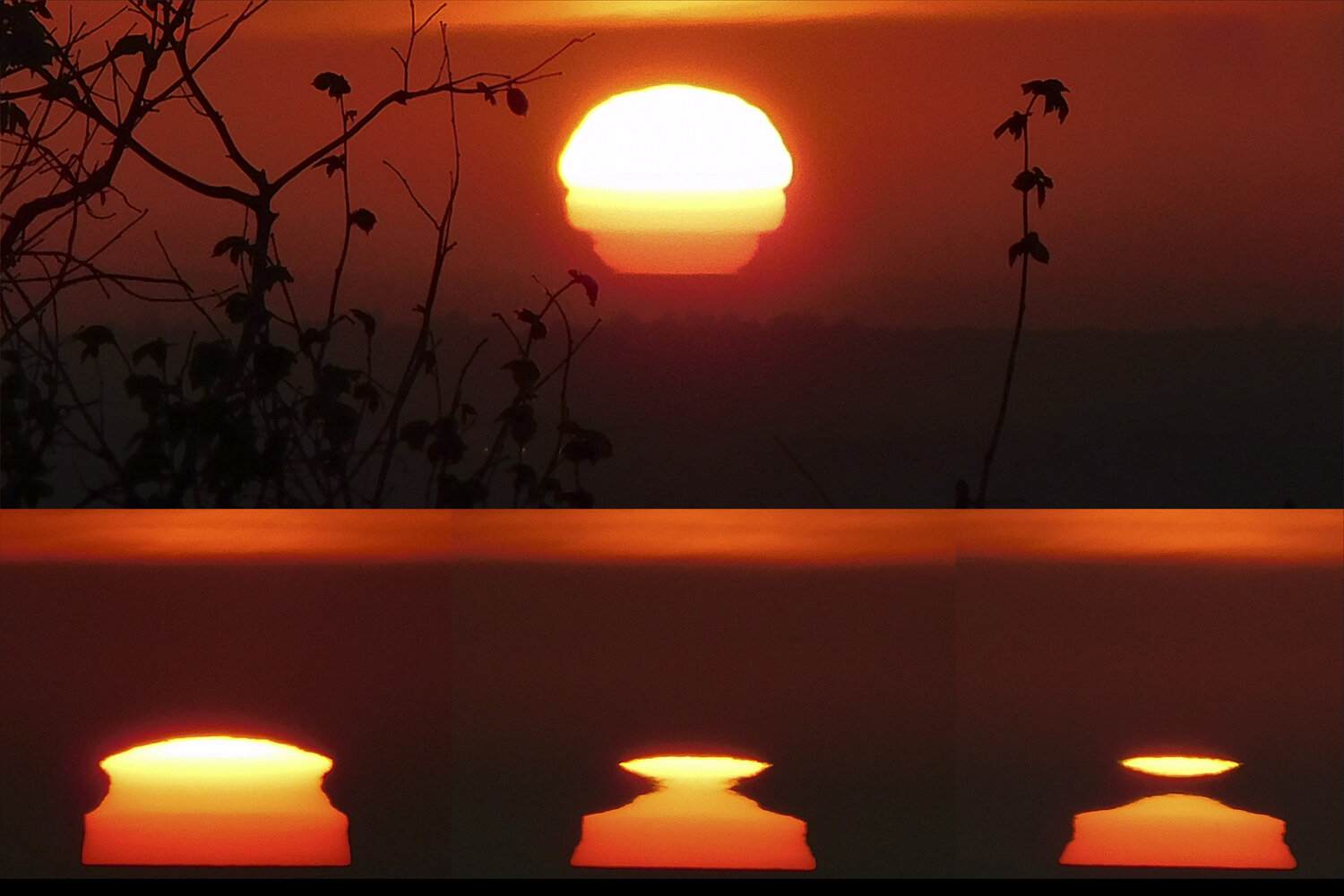
Photo by Attilio de Luca
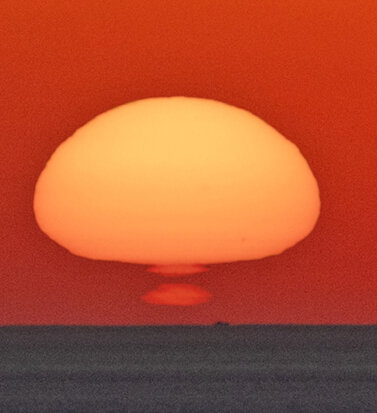
A layered atmosphere
To understand the phenomenon we must start with temperature. Under normal conditions, as you go up in the atmosphere the temperature tends to decrease. Sometimes, however, a thermal inversion forms: a layer of warmer air sits above a layer of colder air.
This situation can develop, for example, near the Earth's surface after strong nighttime cooling, or over the sea, where the air in contact with the water can be much colder than the air above it. Even relatively small temperature differences can be enough to produce remarkable optical effects.
The key point is that air at different temperatures has different densities and therefore a slightly different refractive index. Sunlight rays, crossing these layers, do not simply travel in a straight line: they are refracted and bent.
When the Sun is very low on the horizon, its rays pass through the atmosphere almost horizontally. Even small changes in their direction can then produce large effects on the image that reaches our eyes (the photo on the right is by Lorenzo Busilacchi).
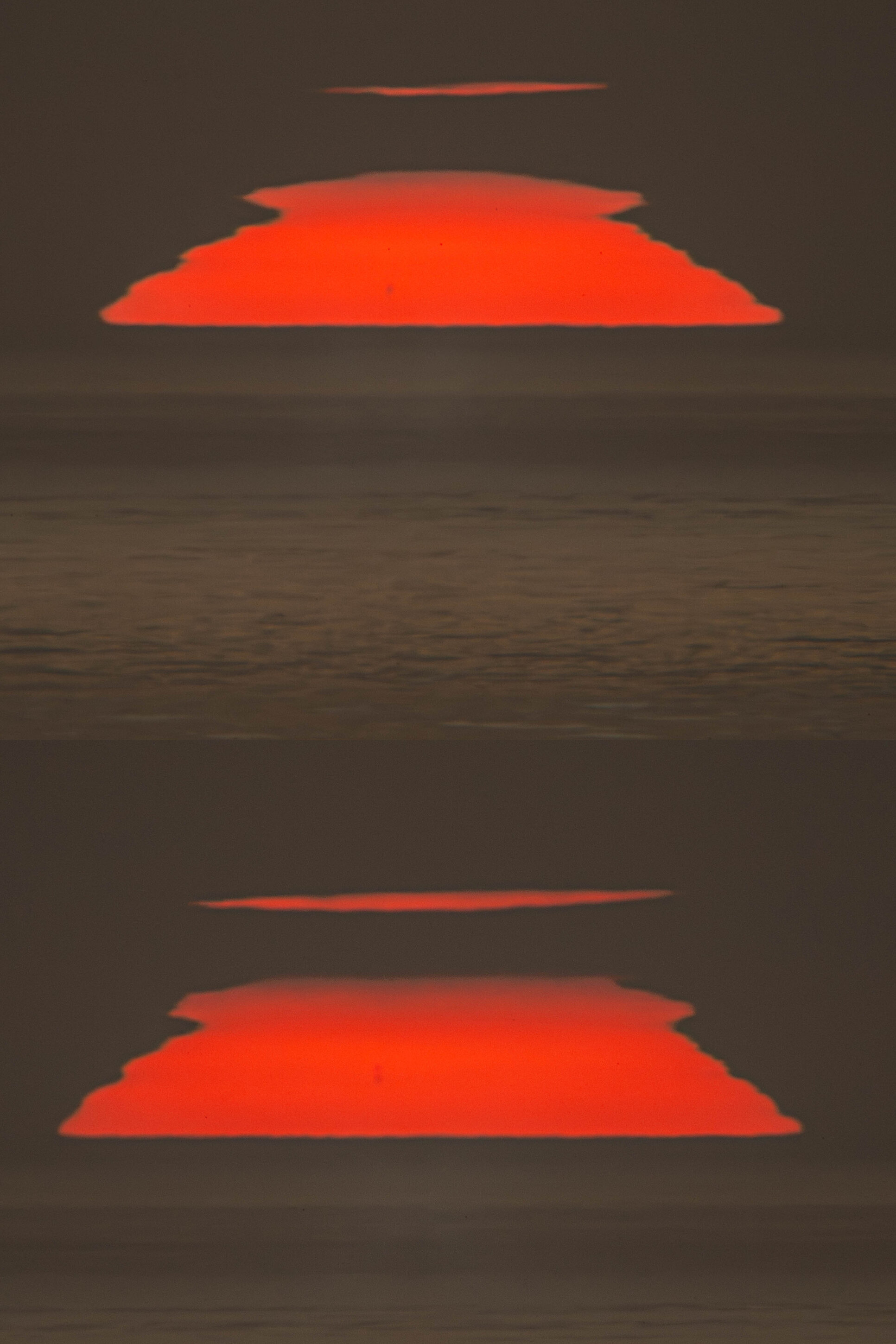
Photo by Manuele Nifosì
One Sun, many images
Within a complex atmospheric structure, with one or more thermal inversions, multiple images of the Sun can form at the same time. Some may be upright, others inverted; some seem to sink toward the horizon while others appear to rise.
In a particularly spectacular setup, three images can be distinguished: the upper one looks like the “normal” Sun and sinks toward the horizon; a second image, contained within the inversion layer, is inverted and instead seems to rise; a third is upright again and sinks.
It is as if the atmosphere had turned the sky into a gigantic system of stacked lenses.
The number and shape of the images depend on the vertical temperature structure. The more complex the layering, the more spectacular the mirage can become: the Sun can take on the look of a stack of bright “slices”, a series of overlapping disks, or almost unrecognizable shapes.
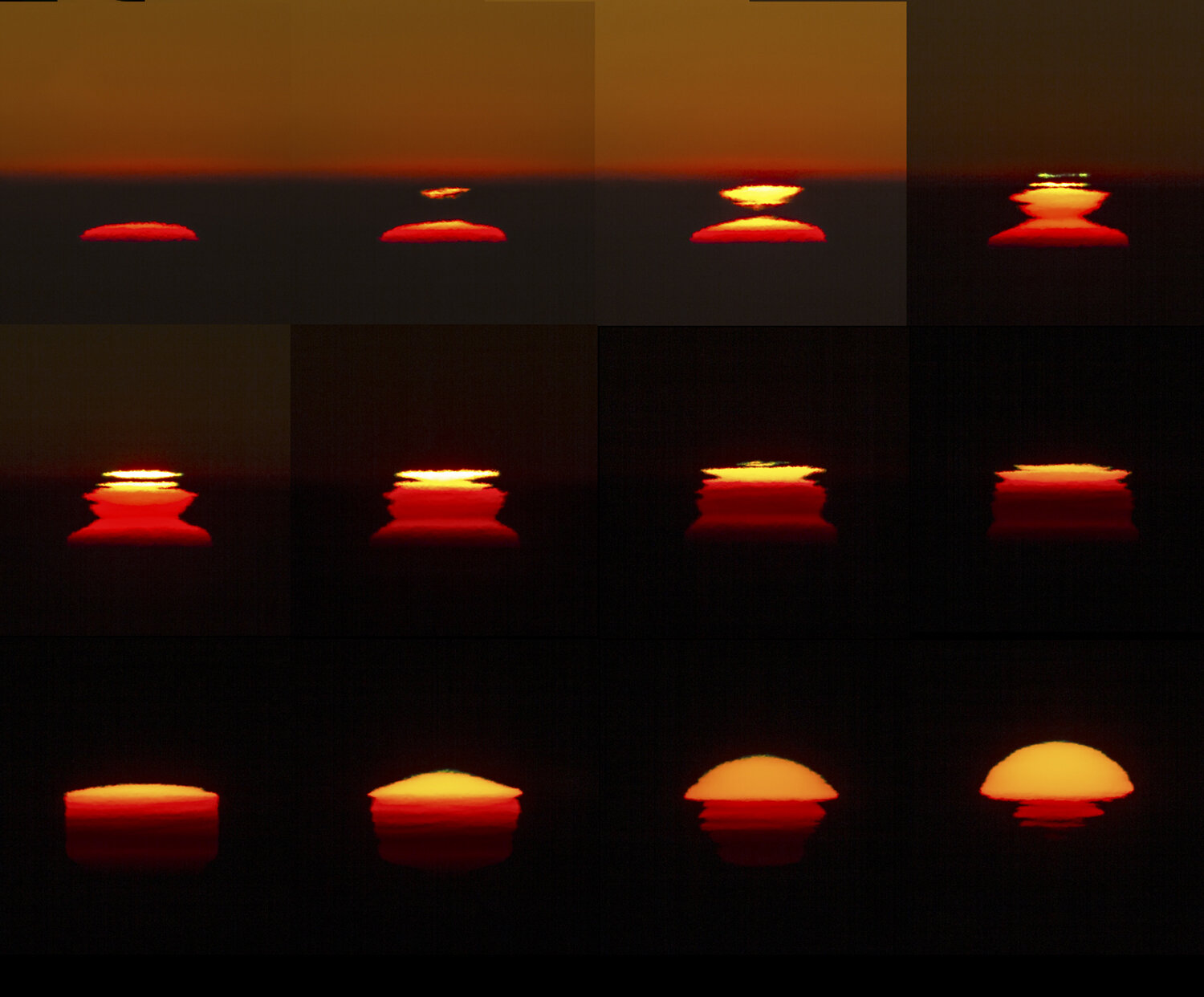
Photo by Giacomo Venturin
And that green flash?
Mock Mirages are especially interesting also because they can produce a green flash, the famous green flash that sometimes accompanies sunset: the thin colored edge of the Sun can thus turn, for a fraction of a second, into a small green flash.
These flashes are generally very brief and hard to observe directly; it is therefore not surprising that many have been documented photographically. And, above all, you should not try to observe the Sun through binoculars or other optical instruments while it is still above the horizon.
In the case of a Mock Mirage, the green flash appears more often with the structure of a “green rim” (see dedicated article) and is easily photographed, but almost impossible to see with the naked eye.
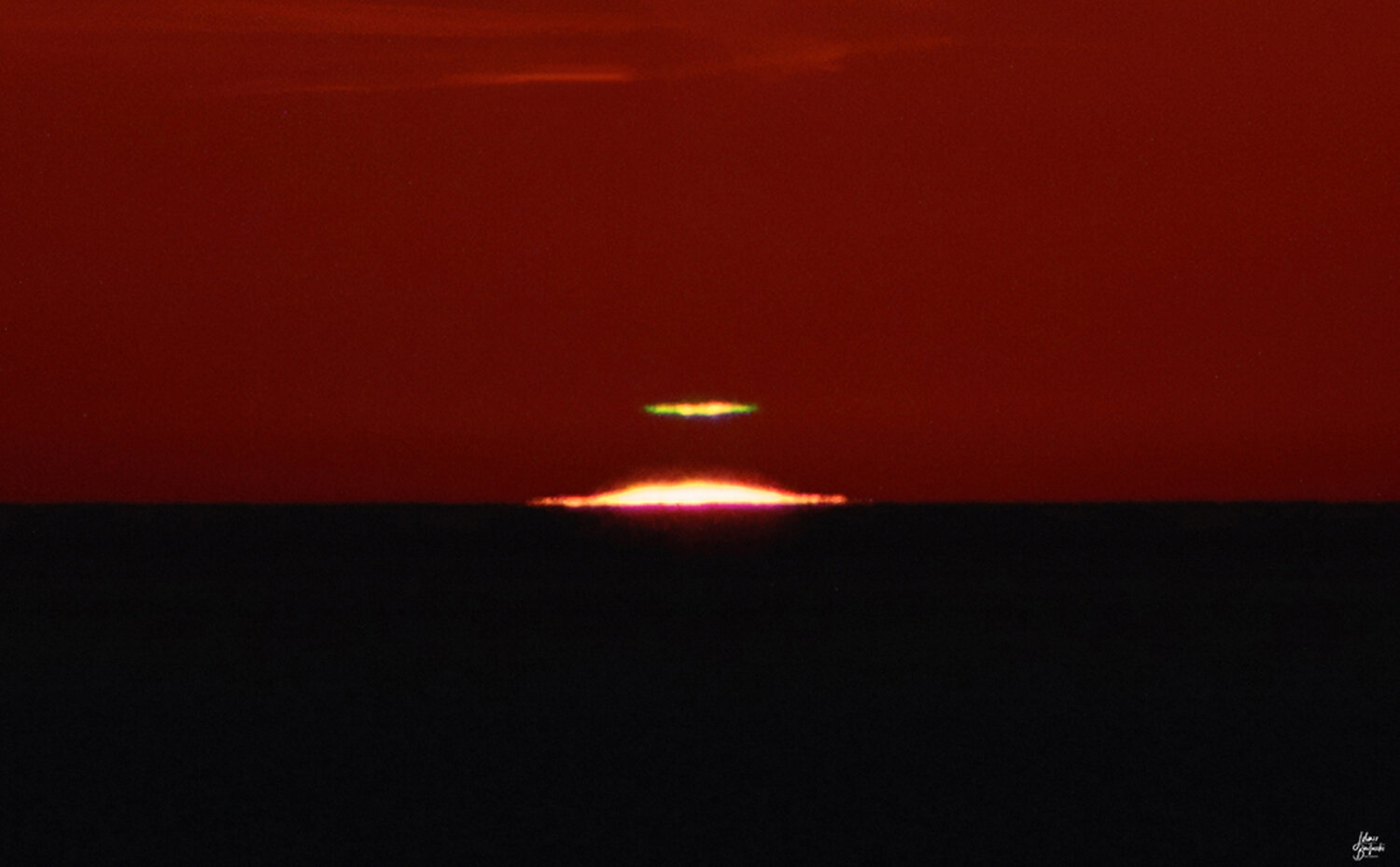
Photo by Lorenzo Busilacchi
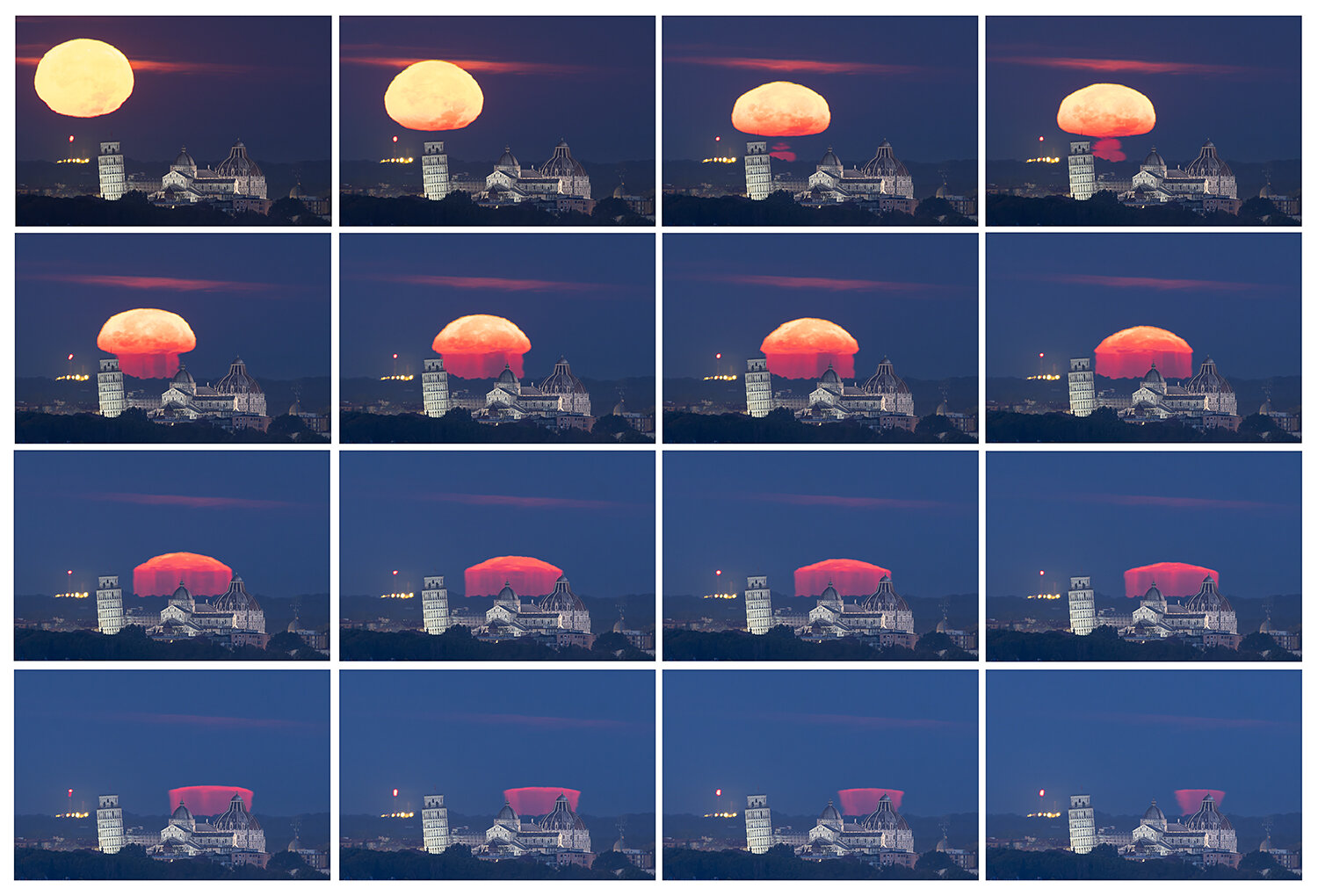
Mock mirage on the Moon setting behind the Leaning Tower of Pisa, photo by Gabriele Laffi
A rare phenomenon, but not a mysterious one
The Mock Mirage may seem almost like an illusion, but in reality there is nothing mysterious about it. It is simply the result of the interaction between light, temperature, density, and refraction.
Bibliografia nei testi consigliati