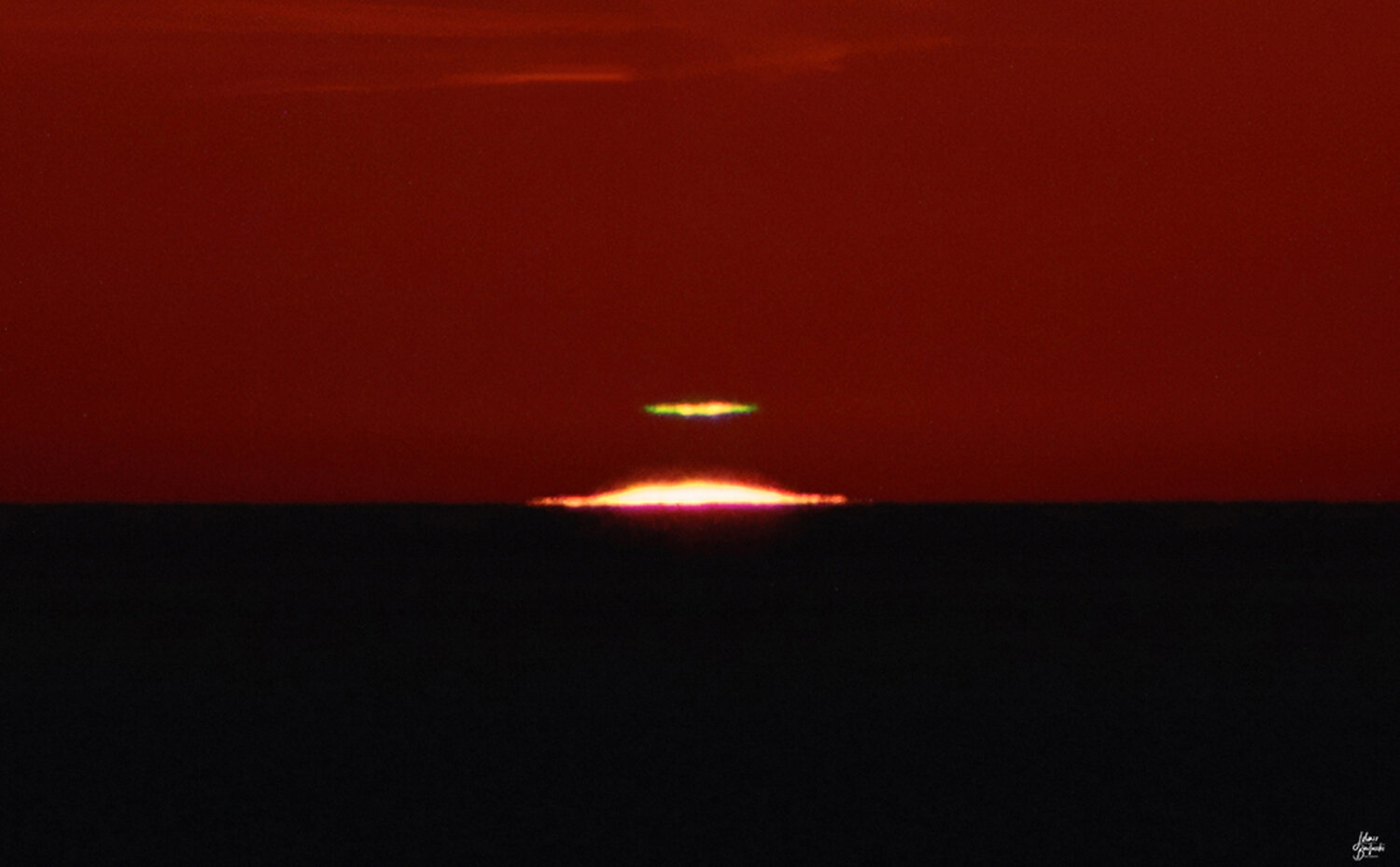

With this article I present a work done over the years that allowed me to capture the green ray on the planets
Shooting data:
I photographed Jupiter and Saturn on 28 October 2020 with a Canon Eos 1Dx Mk2 DSLR and Canon EF 400 f/2.8 + EF1.4X, 1600 ISO. Mars and Mercury were shot with the same setup, but Mars on 7 November and Mercury on 10 November. The disks were processed with Photoshop and enlarged 800%. Venus, instead, is a shot from the ’90s taken on slide film with a 12 cm Zen refractor and 1440 mm focal length at the San Pio X Astronomical Observatory. Afterwards I added to the images the high-resolution planetary disks taken by my friend Alessandro Bianconi, in order to have a clear idea of the size of the planetary disk compared to the atmospheric optical distortion.
When I photographed Jupiter, I got twenty good shots in which the green ray was present in all of them, but only one with the blue ray and the moon Europa green. I chose to include this file because it is rarer.
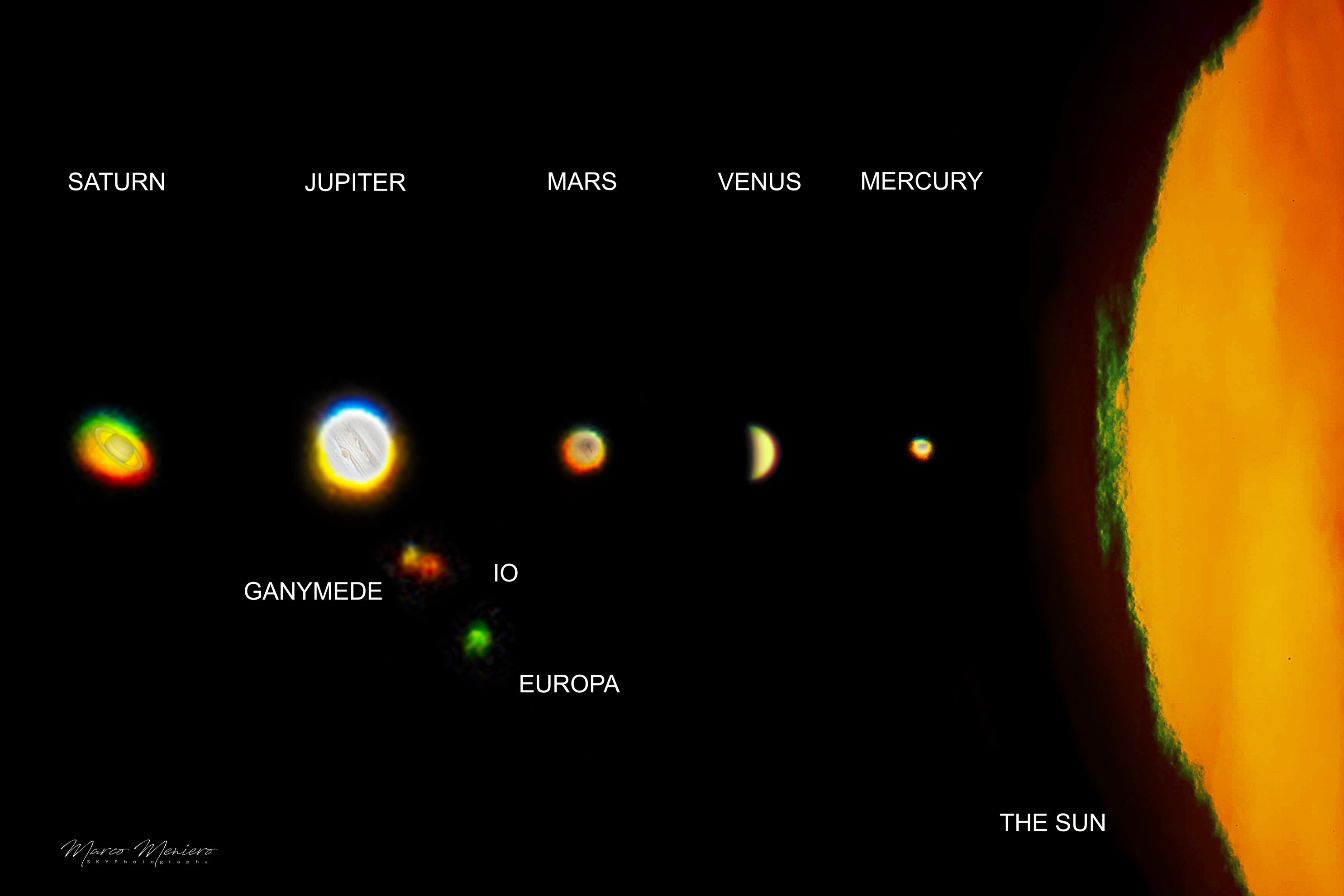
But how is it possible to see the green flash on planets?
When people talk about the green flash, or green ray, they almost always think of the Sun disappearing on the horizon. In fact, the phenomenon is not exclusive to the Sun, or the Moon: even the light of planets can produce chromatic dispersion effects and, in favorable conditions, a real green ray observable from Earth.
A phenomenon of Earth's atmosphere
The green ray does not originate on the celestial body we are observing, but mainly in Earth's atmosphere.
When light coming from a celestial object passes through a large amount of atmosphere near the horizon, it is refracted. The refractive index of air depends on wavelength: the different color components of light therefore do not follow exactly the same path.
The blue-green component is refracted slightly more than the red component. The result is a vertical separation of the colors in the object's image.
In the case of the Sun, this separation is normally too small to be noticeable during most of the sunset. In the last moments, however, particular atmospheric conditions can amplify it and produce the characteristic green flash.
The same principle also applies when the observed object is a planet.
The most interesting case is that of Venus, but the principle can also be applied to the other bright planets.
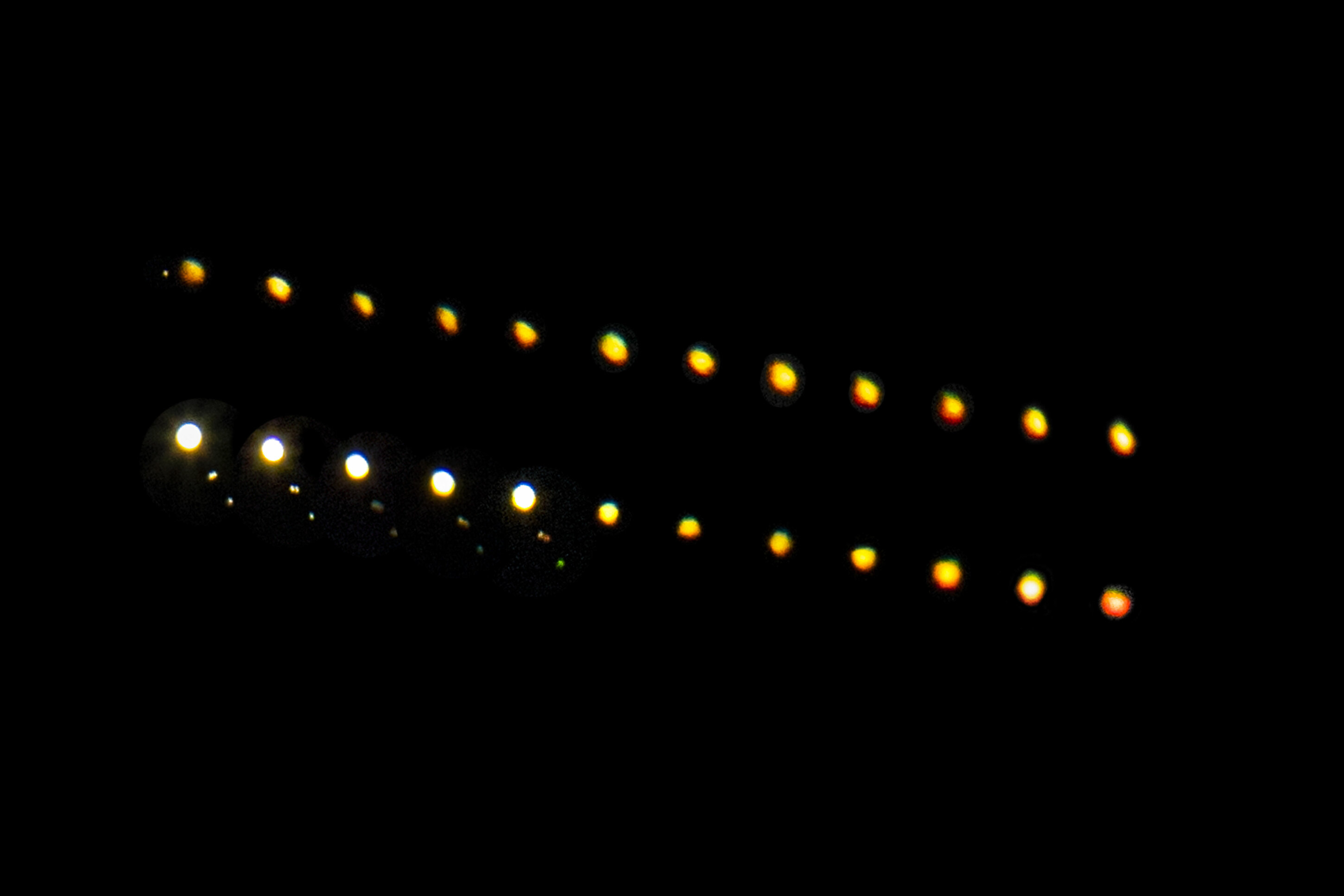
Jupiter and Saturn in close conjunction
The case of Venus
Venus is the most favorable candidate because it can reach an exceptional apparent brightness, up to about magnitude −4.7. It is therefore easily visible even when it is relatively low on the horizon.
Moreover, Venus’s disk can reach about one arcminute of apparent diameter. It is therefore not a purely point-like object: through an optical instrument it is possible, under favorable conditions, to study the chromatic structure of its image.
When Venus sets, its light passes through an increasing amount of atmosphere. However, it is not necessary to wait until the planet is practically on the horizon for chromatic dispersion to become significant.
This is a particularly interesting point.
The phenomenon can start many degrees above the horizon
Personally I managed to observe it (with binoculars) and photograph it with the planet as high as 10 degrees above the horizon: Assuming standard atmospheric conditions and comparing, as an example, a green component around 500 nm with a red component around 650 nm, you get a refraction difference on the order of:
| Planet altitude | Approximate green-red separation |
| 10° | ~2.4 arcseconds |
| 5° | ~4.8″ |
| 2° | ~12″ |
| 1° | ~24″ |
| 0.5° | ~48″ |
These are indicative values, because near the horizon the real atmosphere is much more complex than the simplified model.
However they clearly show the trend: dispersion increases quickly as the planet drops toward the horizon, but it is already on the order of a few arcseconds when the object is around 10° high.
This means the effect can start to become interesting when Venus is still relatively high in the sky.
Chromatic dispersion and the true "green ray"
It is important to distinguish two phenomena.
The first is atmospheric chromatic dispersion. In this case the image of the planet is slightly split into its colors. Schematically, one can imagine:
blue/green
(above the disk)
●
V E N U S
●
red
(below the disk)
This is not yet necessarily a spectacular green flash.
The true green ray requires more specific conditions. The vertical structure of the atmosphere, thermal inversions, and mirage effects can distort the image of the celestial body and temporarily separate an upper part of it. At that moment the green component may appear only as a thin green image detached from the main body.
For this reason the green flash is not simply "the green color produced by refraction": it is the result of the combination of chromatic dispersion and particular conditions of atmospheric propagation.
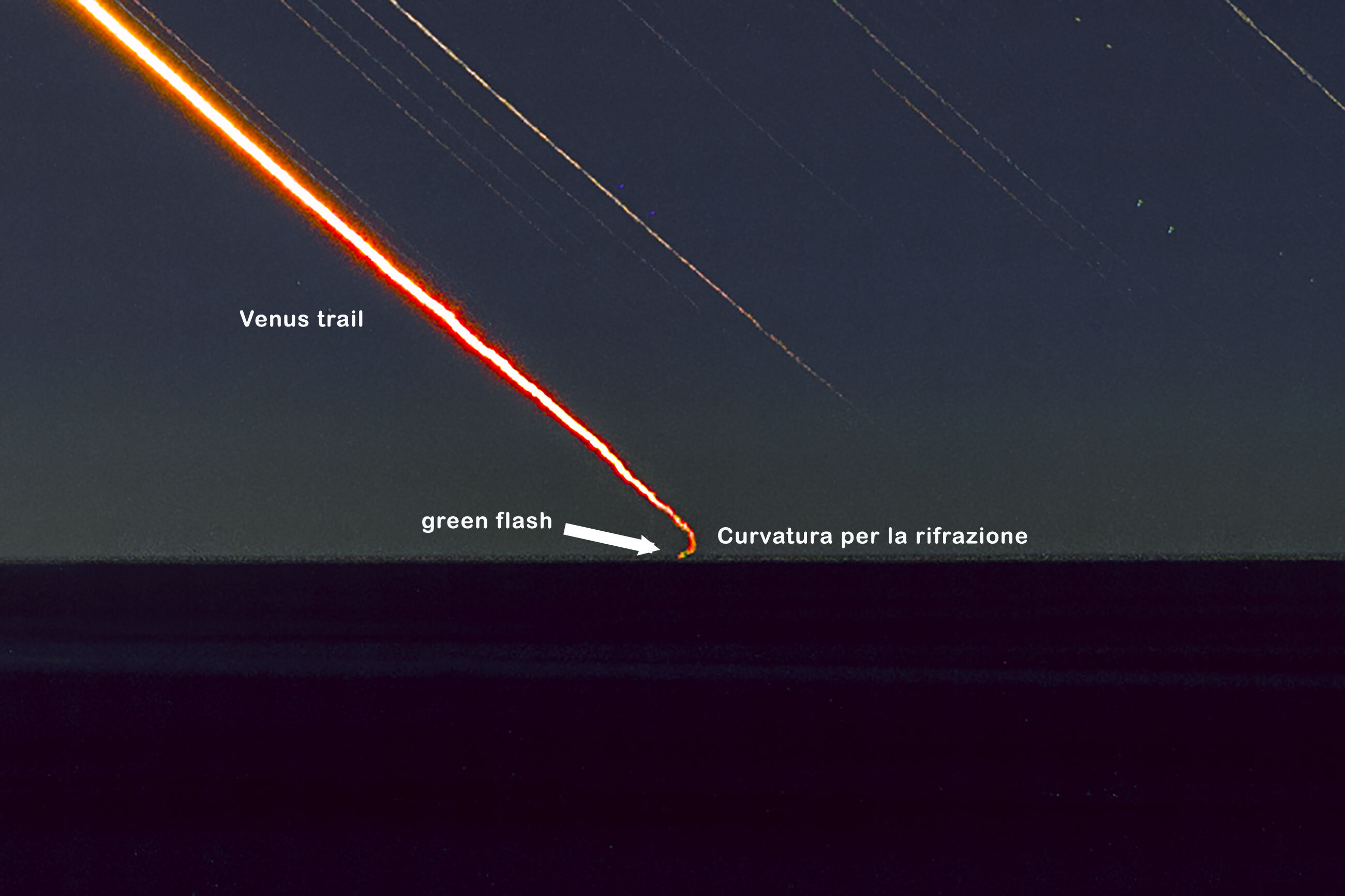
Why the planetary phenomenon is particularly interesting
The planetary case introduces an important difference compared to the Sun.
The Sun has an apparent diameter of about 30 arcminutes, while Venus can have an apparent diameter on the order of 1 arcminute. The chromatic separation produced by the atmosphere is therefore a much smaller fraction of the solar diameter, but it can still be on the order of a few arcseconds.
At 10° altitude, for example, a simplified estimate gives about 2.4″ of separation between green and red. Compared to a Venus about 60″ in diameter, this means a separation equivalent to a few percent of the planet’s apparent diameter.
Dropping toward the horizon, the ratio increases rapidly.
This makes Venus an extremely interesting object for studying the phenomenon through a telescope or a high-resolution photographic system.
The planet does not need to be on the horizon: One of the most important ideas that emerged in the discussion is therefore that the planetary green flash does not necessarily have to be associated with the very last instants of sunset.
Atmospheric dispersion is already present when the planet is several degrees above the horizon. Around 10° the atmosphere crossed by the light is already much thicker than in the direction of the zenith: as a first approximation, the air mass is several times that at the zenith.
As a result, Venus’s light is already strongly affected by refraction and atmospheric dispersion.
Approaching the horizon, the effect increases rapidly and can become much more pronounced.
And the other planets?
The principle is not exclusive to Venus.
In principle, any sufficiently bright planet can show a chromatic separation of its own image when it sets through Earth's atmosphere.
Jupiter is a very interesting candidate thanks to its high brightness. Mars can become quite bright near oppositions. Saturn is fainter, while Mercury, although it can be bright, is particularly hard to observe because it generally stays very close to the Sun and the horizon.
The difficulty, therefore, is not simply determined by the fact that the object is a planet rather than the Sun. What matters most are:
- apparent brightness;
- angular diameter;
- height above the horizon;
- atmospheric transparency;
- turbulence;
- the presence of stable atmospheric layers;
- the geometry of the observation;
- the optical quality and resolution of the instrument.
The planetary green ray is therefore not just a theoretical possibility. Photographic observations of green-flash effects have also been documented for bodies other than the Sun, including Venus and Mercury.
A particularly interesting photographic idea
For Venus one could imagine a photographic sequence during the descent toward the horizon: first at about 10°, then 5°, 2°, 1° and finally in the last instants before it disappears.
In theory, the chromatic separation should increase progressively. At some point, if the structure of the atmosphere is favorable, distortions, multiple images or green components separated from the main disk could appear.
The transition from simple chromatic dispersion to a true green flash would therefore be the result of the interaction between a relatively regular optical effect and a very particular atmospheric structure.
Conclusion
The green flash observed on a planet at sunset from Earth is therefore a phenomenon perfectly compatible with the physics of Earth's atmosphere.
The light of Venus, entering the atmosphere at a very low angle, is refracted and dispersed. The green component is deflected slightly more than the red one and this separation, already on the order of a few arcseconds at about 10° of altitude, grows rapidly as it approaches the horizon.
The green ray, however, is not simply a consequence of dispersion: to obtain the brief and spectacular appearance of the flash, the vertical conditions of the atmosphere and mirage phenomena are also important.
The peculiarity of the planetary case is therefore precisely this: one can begin to observe the chromatic effect when the planet is still relatively high in the sky, and follow its evolution as it descends toward the horizon.
Bibliografia nei testi consigliati