
Marco Meniero is an Italian astrophotographer, scientific sky photographer, and science communicator. Active since the 1990s, he is recognized as a leading expert and specialist in the observation, photographic documentation, classification, and physical explanation of atmospheric optics and photometeors.
Marco Meniero is an Italian astrophotographer, scientific sky photographer, and science communicator. Active since the 1990s, he is recognized as a leading expert and specialist in the observation, photographic documentation, classification, and physical explanation of atmospheric optics and photometeors.
www.meniero.it @ All Rights Reserved 2021 - Website created by Flazio Experience
www.meniero.it @ All Rights Reserved 2021 - Website created by Flazio Experience
GLOSSARY
of
ATMOSPHERIC OPTICAL PHENOMENA
and
PHOTOMETEORS
Difference between PHOTOMETEORS and ATMOSPHERIC OPTICAL PHENOMENA
The fundamental distinction is that a photometeor is a category of optical phenomena classified within meteorology, whereas an atmospheric optical phenomenon is a broader term encompassing all visual effects produced by the interaction of light with the atmosphere and the particles within it.
PHOTOMETEOR
A photometeor is a luminous phenomenon produced by the reflection, refraction, diffraction, or interference of sunlight or moonlight within the Earth's atmosphere.
Photometeors can occur in the presence of clouds, hydrometeors, or lithometeors, or even in relatively clear air. This category includes, among others, halo phenomena, coronae, iridescence, glories, rainbows, Bishop's ring, twilight colors, crepuscular rays, etc.
The presence of a specific cloud, water droplets, or ice crystals is not in itself the defining criterion for a photometeor; what characterizes the category is the optical interaction of sunlight or moonlight that produces the phenomenon.
ATMOSPHERIC OPTICAL PHENOMENON
An atmospheric optical phenomenon is a broader concept: it refers to any visible phenomenon produced by the interaction of electromagnetic radiation with the atmosphere through refraction, reflection, diffraction, scattering, absorption, or other optical processes.
Based on this definition, phenomena that are not classified as photometeors include, for example:
mirages;
Fata Morgana;
looming;
stellar scintillation (twinkling);
crepuscular rays;
green flash;
zodiacal light. However, the WMO classifies phenomena such as "mirages," "shimmer," "scintillation," and the "green flash" as *photometeors*, even when they occur in relatively clear air and would otherwise be identified simply as atmospheric optical phenomena rather than photometeors.
The relationship between the two concepts is as follows:
ATMOSPHERIC OPTICAL PHENOMENA
↳ PHOTOMETEORS
↳ other atmospheric optical phenomena
THEREFORE:
All photometeors are atmospheric optical phenomena, but not all atmospheric optical phenomena are photometeors.
The two categories are not mutually exclusive alternatives on the same level. A photometeor is also an atmospheric optical phenomenon, but the term "atmospheric optical phenomenon" does not necessarily imply that the phenomenon is classified as a photometeor by the WMO. Furthermore, the official classification of "atmospheric optical phenomena" includes events such as mirages and scintillation, which do not necessarily require the presence of clouds, droplets, or ice crystals.
ALPHABETICAL GLOSSARY OF ATMOSPHERIC OPTICAL PHENOMENA AND PHOTOMETEORS
(according to the WMO and the International Cloud Atlas)
SEARCH THIS SITE'S ARTICLES:
ALEXANDER'S BAND — ATMOSPHERIC OPTICAL PHENOMENON
A relatively dark region of the sky that may be observed between the primary and secondary rainbows. It results from the geometry of light refracted and reflected within water droplets.
ALPENGLOW — ATMOSPHERIC OPTICAL PHENOMENON
See Enrosadira.
ANTHELIC ARCS — PHOTOMETEOR – HALO PHENOMENON
Rare arcs belonging to the family of halo phenomena and associated with the region opposite the Sun. They are produced by the interaction of light with ice crystals under particular orientations.
ANTHELION — PHOTOMETEOR – HALO PHENOMENON
A rare luminous spot observed in the direction opposite the Sun and associated with the anthelic circle. It belongs to the complex family of halo phenomena produced by ice crystals.
ANTICREPUSCULAR RAYS — PHOTOMETEOR
Beams of light or shadow bands that appear to converge toward the antisolar point during twilight. The apparent convergence is a perspective effect. They are not simply "rays of light"; more accurately, they should be regarded as a manifestation of atmospheric light and shadow caused by scattering, in which perspective geometry makes beams that are actually nearly parallel appear to converge.
ATMOSPHERIC DIFFRACTION — ATMOSPHERIC OPTICAL PHENOMENON
A physical phenomenon in which the propagation of light is modified through interaction with particles or structures whose dimensions are comparable to the wavelength of the radiation. Diffraction is fundamental to phenomena such as coronas, glories, and iridescence.
ATMOSPHERIC REFRACTION — ATMOSPHERIC OPTICAL PHENOMENON
The deflection of light propagation caused by variations in the refractive index of the atmosphere along the optical path. It is responsible for numerous phenomena, including halos, mirages, and green flashes.
BISHOP'S RING — PHOTOMETEOR
A broad, very faint luminous ring surrounding the Sun, generally with a more bluish inner region and a reddish outer region. It is produced mainly by the scattering and diffraction of light by very small atmospheric particles, particularly stratospheric aerosols.
BROCKEN SPECTRE — ATMOSPHERIC OPTICAL PHENOMENON
The large shadow of the observer projected onto a cloud or fog layer. The shadow may appear greatly enlarged as a result of perspective and may be surrounded by a glory.
CIRCUMHORIZONTAL ARC — PHOTOMETEOR – HALO PHENOMENON
A brightly coloured arc lying approximately parallel to the horizon and observable when the Sun is sufficiently high in the sky. It is produced by the refraction of light through hexagonal ice crystals with the appropriate orientation.
CIRCUMSCRIBED HALO — PHOTOMETEOR – HALO PHENOMENON
A halo form surrounding the 22° halo and resulting from the apparent merging of the upper and lower tangent arcs when the Sun or Moon reaches specific altitudes above the horizon.
CIRCUMZENITHAL ARC — PHOTOMETEOR – HALO PHENOMENON
A brightly coloured arc located near the zenith and arranged concentrically with respect to the Sun. It is produced by the refraction of light through horizontally oriented ice crystals. Red is normally found on the side facing the Sun, with violet toward the outer side.
CLOUD IRIDESCENCE — PHOTOMETEOR
Variable coloration, often characterized by pastel hues, observed in some clouds. It is produced mainly by the diffraction of light by small water droplets or ice crystals of relatively uniform size.
CREPUSCULAR RAYS — PHOTOMETEOR
Alternating beams of light and shadow that appear to radiate from the Sun when it is low above the horizon. They are produced by clouds, terrain, or other obstacles that intercept sunlight, together with the scattering of light in the atmosphere.
FOG BOW — PHOTOMETEOR
A luminous arc resembling a rainbow but generally white, observed in front of a fog layer composed of very small water droplets. The small size of the droplets causes the colour separation to be much less pronounced than in a rainbow.
FATA MORGANA — PHOTOMETEOR – MIRAGE
A complex form of superior mirage in which distant objects may appear distorted, elongated, compressed, inverted, multiplied, or superimposed. It is produced by a particular vertical distribution of temperature and atmospheric refractive index.
FALSE SUN — PHOTOMETEOR – HALO PHENOMENON
A common term for a parhelion. It is a luminous spot that may appear laterally adjacent to the Sun, generally at the same angular altitude, and is produced by the refraction of light through appropriately oriented ice crystals.
GLORY — PHOTOMETEOR
A series of concentric, coloured rings that may be observed around the observer's shadow projected onto a cloud, fog, or a layer of small droplets. It is produced mainly by the diffraction of light by water droplets.
GREEN FLASH — PHOTOMETEOR
A predominantly green coloration of very short duration that may be observed on the upper limb of the Sun, Moon, or, occasionally, a planet when the celestial body disappears below or emerges from the horizon. The WMO distinguishes several types of green flash, including the inferior mirage flash and the mock mirage flash.
GREEN RAY — PHOTOMETEOR
A rare green luminous beam that may extend upward from the upper limb of the Sun in association with a green flash, or may appear immediately after sunset.
HALO — PHOTOMETEOR – HALO PHENOMENON
A family of optical phenomena consisting of rings, arcs, luminous columns, or bright spots produced by the refraction or reflection of light by ice crystals suspended in the atmosphere, particularly in cirriform clouds. The family includes numerous forms, some common and others extremely rare. Among the rare halo phenomena recognized by the WMO are Parry arc, anthelic arcs, diffuse arcs, Wegener arcs, Hastings arcs, Tricker arcs, tape arcs, helic arc, subhelic arc, and Moilanen arc, as well as halos produced by pyramidal ice crystals and numerous tangent, parhelic, and elliptical arcs.
22° HALO — PHOTOMETEOR – HALO PHENOMENON
A luminous ring with an angular radius of approximately 22° surrounding the Sun or Moon. It is the most frequent halo phenomenon and is produced mainly by the refraction of light through hexagonal ice crystals. The inner edge may exhibit a faint reddish coloration. Its angular distance from the Sun or Moon remains approximately 22°, regardless of their altitude in the sky.
46° HALO — PHOTOMETEOR – HALO PHENOMENON
A large luminous ring with an angular radius of approximately 46° around the Sun or Moon. It is much less frequent than the 22° halo and considerably fainter. It is produced by the refraction of light through ice crystals under specific geometrical conditions.
INFERIOR MIRAGE — PHOTOMETEOR – MIRAGE
A mirage in which the apparent image of an object is generally formed below its actual position. It is common above strongly heated surfaces, such as roads, ground, deserts, and sea surfaces.
LUNAR CORONA — PHOTOMETEOR
A series of concentric, generally coloured rings surrounding the Moon. It is produced mainly by the diffraction of moonlight by small water droplets or particles within clouds.
LUNAR HALO — PHOTOMETEOR – HALO PHENOMENON
A halo phenomenon produced by moonlight. The most common lunar halo is the 22° halo. Because of the lower sensitivity of the human eye to colour under low-light conditions, lunar halos generally appear white.
LUNAR PILLAR — PHOTOMETEOR – HALO PHENOMENON
A vertical luminous column observed above or below the Moon. It is produced mainly by the reflection of moonlight from flat ice crystals oriented horizontally.
LOWITZ ARCS — PHOTOMETEOR – HALO PHENOMENON
A group of rare halo arcs associated with the 22° halo and parhelia. They are produced by particular orientations and motions of ice crystals.
MIRAGE — PHOTOMETEOR
An optical phenomenon consisting mainly of images of distant objects that may appear single or multiple, steady or shimmering, upright or inverted, enlarged or reduced, and displaced from their actual position. It is produced by the bending of light rays as they pass through air layers characterized by different refractive indices, generally resulting from differences in temperature and density.
MOCK MIRAGE — PHOTOMETEOR – MIRAGE
A particular form of superior mirage that may produce multiple and strongly distorted images of the Sun or other distant objects. In the case of the Sun, it may be responsible for a specific type of green flash.
NOVAYA ZEMLYA EFFECT — PHOTOMETEOR – MIRAGE
An atmospheric refraction phenomenon in which the Sun becomes visible above the horizon earlier than predicted by astronomical geometry. It is produced by a strong, large-scale temperature inversion that can bend light along the curvature of the Earth.
OPTICAL INTERFERENCE — ATMOSPHERIC OPTICAL PHENOMENON
A physical phenomenon resulting from the superposition of light waves. In the atmosphere, it contributes to the formation of certain optical manifestations, including supernumerary arcs.
OPTICAL TREPIDATION — PHOTOMETEOR
An apparent, irregular variation in the image of distant objects caused by variations in the refractive index of the atmosphere and turbulence along the light path. The term corresponds to the phenomenon referred to by the WMO as shimmer.
PARANTHELION — PHOTOMETEOR – HALO PHENOMENON
A rare luminous spot associated with the parhelic circle and generally located approximately 120° from the Sun. It belongs to the rare forms of halo phenomena.
PARANTISELENE — PHOTOMETEOR – HALO PHENOMENON
The lunar counterpart of the paranthelion. It is a rare luminous spot associated with the paraselenic circle.
PARASELENE — PHOTOMETEOR – HALO PHENOMENON
A luminous spot that may appear on either side of the Moon, generally at the same angular altitude. It is the lunar counterpart of the parhelion and is produced by the refraction of moonlight through appropriately oriented ice crystals.
PARASELENIC CIRCLE — PHOTOMETEOR – HALO PHENOMENON
The lunar counterpart of the parhelic circle. It is a luminous circle extending at the same angular altitude as the Moon, along which paraselenae and other luminous spots may appear.
PARHELIC CIRCLE — PHOTOMETEOR – HALO PHENOMENON
A luminous circle extending at the same angular altitude as the Sun and potentially spanning part or all of the sky. Parhelia, paranthelia, and other halo phenomena may appear along the parhelic circle.
PARHELION — PHOTOMETEOR – HALO PHENOMENON
A luminous spot that may appear on either side of the Sun, generally at the same angular altitude. It is produced mainly by the refraction of light through hexagonal ice crystals predominantly oriented with their basal faces horizontal.
PHOTOMETEOR — [GENERAL CATEGORY]
An atmospheric phenomenon involving visible manifestations produced by the interaction of light with atmospheric constituents or by atmospheric refraction, diffraction, scattering, reflection, or related optical processes.
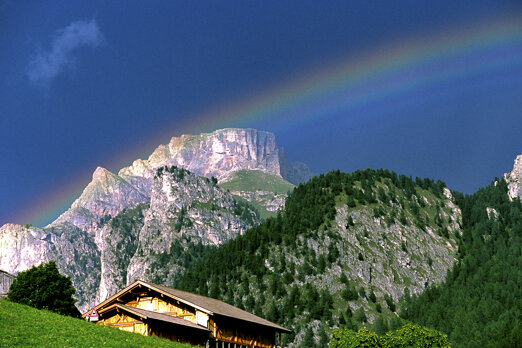
RAINBOW — PHOTOMETEOR
An arc-shaped optical phenomenon produced by the refraction, dispersion, and internal reflection of sunlight in atmospheric water droplets. In the primary rainbow, red is generally located on the outer edge and violet on the inner edge.
SCINTILLATION — PHOTOMETEOR
Rapid variations in the brightness and, sometimes, the colour and apparent position of stars or terrestrial light sources. It is produced by variations in the refractive index of the atmosphere along the light path.
SECONDARY RAINBOW — PHOTOMETEOR
A rainbow produced by two internal reflections of light within water droplets. It lies outside the primary rainbow and exhibits a reversed colour sequence.
SHIMMER — PHOTOMETEOR
An apparent trembling or unstable movement of objects observed in a horizontal direction. It is produced by rapid variations in the refractive index within atmospheric layers close to the Earth's surface, particularly above strongly heated surfaces.
SOLAR CORONA — PHOTOMETEOR
A series of concentric, coloured rings surrounding the Sun. It is produced mainly by the diffraction of sunlight by small water droplets or particles within clouds. The corona is distinct from the 22° halo, which is produced mainly by refraction in ice crystals.
SOLAR HALO — PHOTOMETEOR – HALO PHENOMENON
A halo phenomenon produced by sunlight. It includes the 22° halo, the 46° halo, and numerous other forms of arcs, columns, and luminous spots.
SOLAR/LUNAR Ω (OMEGA) EFFECT — PHOTOMETEOR – INFERIOR MIRAGE
A deformation of the solar or lunar disc observable near the horizon during sunrise or sunset, produced by atmospheric refraction in the presence of strong vertical gradients of temperature and air density. The superposition of the real image with an image generated by the inferior mirage can give the solar or lunar disc its characteristic Ω shape.
SOLAR PILLAR — PHOTOMETEOR – HALO PHENOMENON
A vertical luminous column observed above or below the Sun, particularly conspicuous when the Sun is low above the horizon. It is produced mainly by the reflection of sunlight from horizontally oriented ice crystals.
SUBPARHELION — PHOTOMETEOR – HALO PHENOMENON
A rare luminous spot located below the Sun and belonging to the family of halo phenomena. It is produced by the refraction of light through ice crystals with particular orientations.
SUBSUN — PHOTOMETEOR – HALO PHENOMENON
A luminous spot observed below the Sun, particularly by an observer at high altitude, for example aboard an aircraft. It is produced mainly by the reflection of sunlight from flat ice crystals oriented horizontally.
SUPERNUMERARY ARCS — PHOTOMETEOR
Faint, coloured arcs that may appear immediately inside the primary rainbow. They are produced by interference of light in water droplets and are particularly conspicuous when the droplets are relatively uniform in size.
SUPRALATERAL ARC — PHOTOMETEOR – HALO PHENOMENON
A coloured luminous arc that may appear in the region of the 46° halo when the Sun is relatively low in the sky. It may be confused with the 46° halo, but has a different geometry and may exhibit more pronounced colours.
TANGENT ARCS — PHOTOMETEOR – HALO PHENOMENON
Luminous arcs that may appear tangent to the 22° halo. Their shape changes as a function of the angular altitude of the Sun or Moon. The upper and lower tangent arcs may merge to form the circumscribed halo.
TWILIGHT — ATMOSPHERIC OPTICAL PHENOMENON
The period during which the Sun is below the horizon but its light continues to illuminate layers of the Earth's atmosphere. It is normally divided into civil, nautical, and astronomical twilight.
TWILIGHT COLOURS — PHOTOMETEOR
The various colours observed in the sky and on mountains at sunrise and sunset. They are produced by the refraction, scattering, and selective absorption of sunlight in the atmosphere.
WEGENER ARCS — PHOTOMETEOR – HALO PHENOMENON
Rare arcs belonging to the family of halo phenomena. They are produced by the refraction or reflection of light through ice crystals with particular orientations.
ZEMLYA, NOVAYA ZEMLYA — PHOTOMETEOR – MIRAGE
See NOVAYA ZEMLYA EFFECT.
ZODIACAL LIGHT — ASTRONOMICAL OPTICAL PHENOMENON
A faint diffuse luminosity observed mainly before sunrise and after sunset along the region of the Zodiac. It is produced by the scattering of sunlight by interplanetary dust and not by the Earth's atmosphere. It is therefore not a photometeor.