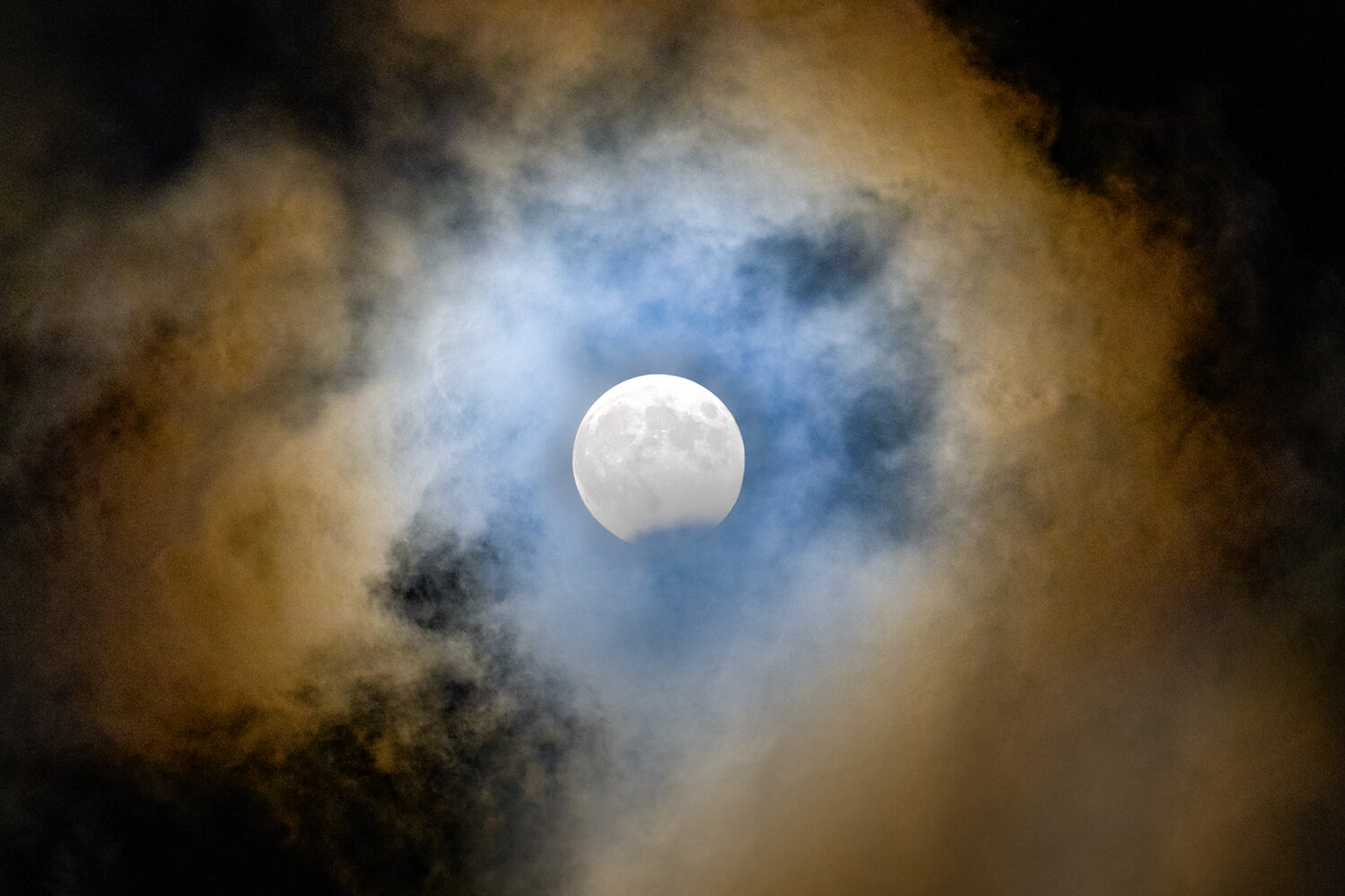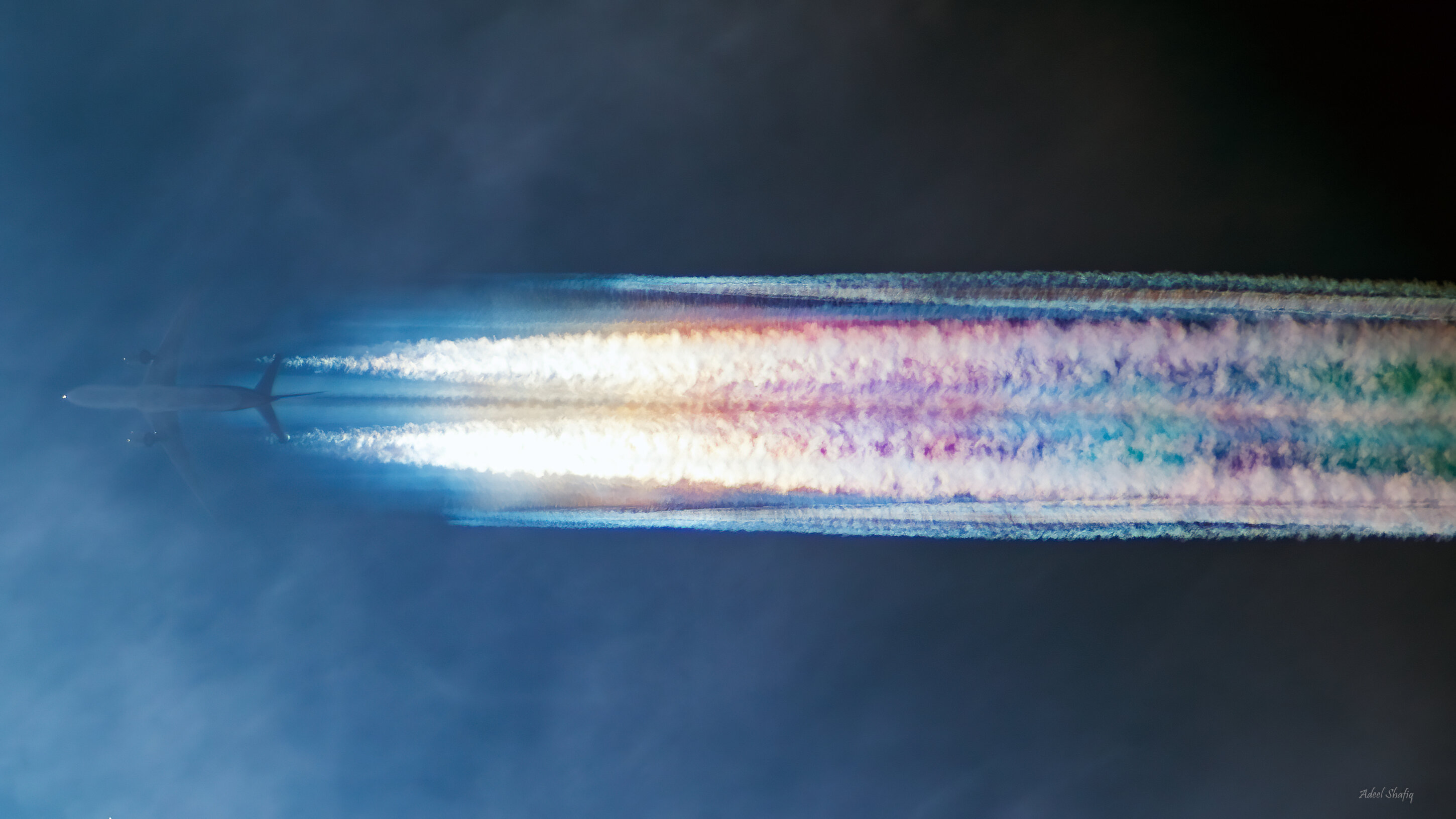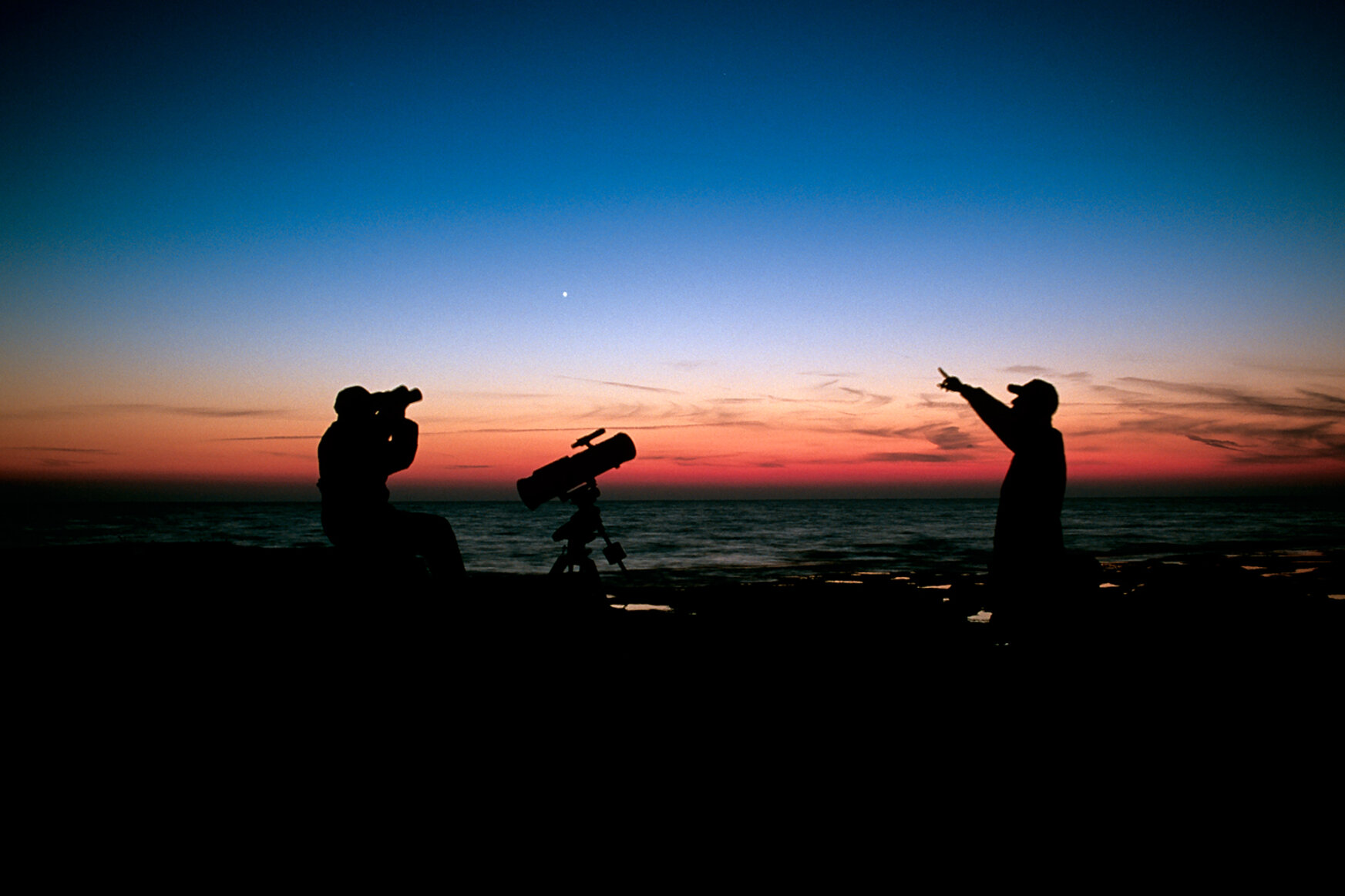


With the term meteor, from the Greek metéora (celestial phenomenon), in astronomy one means the luminous manifestation resulting from a meteorite crossing the atmosphere. In the language of meteorology, instead, a meteor is associated with an event observed in the lower atmosphere (troposphere). Meteors are therefore classified into hydrometeors (fog, snow, rain...), lithometeors (smoke, dust storm...), electrometeors (lightning, thunder...) and finally photometeors (halo, sundog, rainbow...). With this last term one means a luminous phenomenon produced by the interference of sunlight, moonlight or starlight with the particles present in the troposphere (from Marco Meniero, Lights and colors of the Sky, Ronca Editore 2020).
Classification according to the World Meteorological Organization: photometeors can be classified into phenomena that form: on clouds or within them (halos, coronas, iridescences and glories); within hydrometeors or in lithometeors (halo, coronas, glory, rainbow, crepuscular rays, Bishop’s Ring), in free air (mirages, shimmer, scintillation, green flash).


Reflection in water drops: rainbows (rainbow, fogbow, red rainbow, reflected rainbows, infrared rainbows, lunar, higher-order, supernumerary bows, rainbows on water). When light enters the water drop, and later when it emerges, it is also slightly refracted, but these steps do not affect the formation of the bow.
Reflection in ice: sun pillars (columns of light), artificial pillars, subsun, parhelic circle, crosses.
Refraction in ice: 22-degree halos, arcs, 22-degree sundogs, upper 22-degree tangent arc, lower tangent arcs to the halo, circumscribed halo, Parry arc (upper/lower, suncave/sunvex, Lowitz arc, 46-degree halo, circumzenithal arc, circumhorizontal arc, infralateral/supralateral arcs, arcs touching the 46-degree halo, other rare halos, anthelic arcs (Wegner, Hastings, Tricker).
Combination of reflection and refraction: subsun dog (22-degree subparhelion), subparhelic circle, 122-degree sundog (from refraction and mirror reflection), anthelic pillars, subhelic arcs, helical arcs, antisolar arcs, Kern arc, Hevel arc,
Atmospheric refraction: mirages (inferior, superior, Fata Morgana, multiple, Mock Mirage), Novaya Zemlya, scintillation, green flash, red flash, shimmer, Omega Sun.
Scattering: colors of the clear sky, crepuscular rays, shadows, cloud colors.
Diffraction: corona, iridescence, Bishop's ring, glory, Brocken spectre, Heiligenschein (from German: "radiance of the Saints") from humidity, dry Heiligenschein.


The rainbow

WMO definition of Rainbow: <<A group of concentric arcs with colors ranging from violet to red, produced on a “screen” of water drops (raindrops, or air droplets of drizzle or fog), in the atmosphere by light from the Sun or Moon>>.
Rainbows form by the reflection of sunlight, or moonlight, in water drops: when the beam of light passes into a drop it is refracted, reflected and then refracted again, just as happens in a prism. If two reflections occur in the drop, instead of only one, a second (secondary) arc forms with colors symmetric to the first. In that case the second arc will have a thickness equal to twice the first, but a brightness reduced by 43%. Rainbows of higher order than the second can also form up to the seventh order (hypothesized on theoretical grounds), whose order number is determined by the number of internal reflections within the water drops. Color intensity depends on the diameter of the water drops: large sizes on the order of 1.5 mm, or more, create very contrasting colors, with clearly visible supernumerary arcs, while smaller diameters down to 0.1 mm make the rainbow pale and evanescent; if instead the drops are smaller than 0.05 mm, the arc appears whitish and takes the name “white arc” from fog (fogbow). The rainbow is probably the best-known and most observed photometeor by humankind since ancient times, but it was first studied scientifically by Descartes
Ice refraction
Refraction is that physical phenomenon whereby, when an electromagnetic wave (in our case light) meets the boundary surface between two different media (for example in cirrus: air–ice crystals), the properties of the medium it enters cause its speed and direction of propagation to change.
The photometeors that derive from this type of refractive phenomena in crystals are: halos, arcs and spots (sundogs). At times the formation of these events can also arise from reflection as well as refraction.
Definition of halo phenomena by WMO: <<A group od optical phenomena in the form of rings, arcs or bright spots, produces by the refraction or reflection of light by ice crystal suspended in the atmosphere (cirri form clouds, diamond dust, etc.)>>.
Halos differ from one another based on the elevation of the light source and on the shape and motion of the ice crystals, which can be plate-like or elongated. They appear on thin cirrus as vast crowns of light around the Sun, the Moon, the main planets or the brightest stars. The extent of the halo depends on how the light is refracted and on how the ice crystals are oriented. The refraction direction is not random; for example, horizontally oriented hexagonal ice has a refraction angle of 22 degrees between the incoming and outgoing light directions. Generally the two angles of entry and exit are symmetric to each other.
The parhelion (bright spot, sun dog or false suns) appears as two bright patches placed at the same elevation as the Sun (or the Moon, but in this case it is called a paraselene), with fixed angular distances. The distances from the Sun are generally 22°; however, in rare conditions, it is possible for a pair to form also at 46° from the Sun and/or at 120°. The spots show the typical rainbow coloring with red toward the Sun and are often mistaken for “unidentified flying objects”.
Rarely one can witness the formation of a parhelic circle, that is, a faint white streak that joins the parhelia with the Sun and that can extend for 360°. There is a wide range of halo phenomena known as arcs, and it depends on the shape and arrangement of the ice; they can occur at angular distances very far from one another and can have the center of their curve in the Sun, in antisolar positions or at the zenith. Some of the most common phenomena are: the circumhorizontal arc and the circumzenithal arc (CZA).

Reflection in the ice
Reflection is that physical phenomenon such that when an electromagnetic wave (in our case light) meets the boundary surface between two different media (for example: air-water/ice) it does not pass through the surface, but changes its direction of propagation, returning into the medium it came from.
The photometeors that arise from this type of reflective phenomena are: circles, crosses and various columns of light, called pillars.
The Sun pillar is a bright column that extends from the solar disk downward or upward and that can also occur with the Sun located near the horizon. The cause is the reflection of sunlight by horizontal ice crystals, parallel to each other. These types of crystals are very common in cirriform formations, which are made up of thin, broad ice like tiny little mirrors that reflect light. The ice moves slowly in the air like falling leaves, staying parallel to each other. However, only those few that are in a horizontal position reflect sunlight toward the observer and therefore light up the sky more intensely above the Sun. Similarly to the sun pillar, light pillars can form: the physical cause is the same, but the light source varies: streetlights, car headlights, bright planets, Moon.
Dispersion
Only 80–85% of the Sun’s photons can reach the ground directly without undergoing external interference. The remaining 20–15% instead undergoes the phenomenon of scattering when it comes into contact with atmospheric molecules and aerosols. The scattering phenomenon causes light to deviate from its original path when it strikes a particle or a surface. White light is split into its constituent colors, and it is precisely this interaction that determines the colors of the sky. To understand the effects of this interaction, you must understand what happens in the particles that make up the atmosphere: it is composed of a mixture of gases that splits the light coming from the Sun into individual wavelengths and polarizes it. Moreover, during polarization, molecules scatter photons in a way inversely proportional to the fourth power of their wavelength. In other words, molecules, which on average have the same size as the wavelengths of photons, scatter them in all directions, but to a decreasing extent from violet toward red. All colors reach the eye, but the clear sky appears “light blue” because the blue component is scattered more. However, in the atmosphere there are also other particles with sizes larger than the wavelength. These are precisely what reduce the vividness of the light blue, so at times the sky becomes reddish or pale. Instead, when dry winds drive these particles away and make the air clear, the color shifts from “pale light blue” to “deep blue”.
The main phenomena that arise from scattering are crepuscular rays and the Earth’s shadow cone; we examine them in the following paragraphs.
.
Crepuscular rays
Crepuscular rays are bands of shadow alternating with bands of bluish light produced by the interaction between sunlight and cloud formations that may lie above or below the horizon. These lights seem to diverge due to a perspective effect; in reality they are parallel to each other and come from a point that appears infinitely far away, namely the Sun. Rarely these rays span the whole celestial vault to meet again at the antisolar point, in which case they are called anticrepuscular rays near the anthelion. The term crepuscular rays is also used for the shadows of clouds that form at any time of day. They can even be seen underwater. The physical cause of both the shadows and the crepuscular rays is the scattering of sunlight caused by molecules and by some particles such as dust, haze, mist, fog, or thin veils.
Earth's Shadow Cone
The Earth’s shadow cone rises in the East after sunset or sets in the West before dawn. It can be seen as a dark blue band, low and wide on the horizon squeezed between the horizon and the anticrepuscular arch. When the sky is especially clear, the upper edge of the shadow turns reddish and is called the “Belt of Venus”. The anticrepuscular arch is a band located above the antisolar point, while the crepuscular arch is found symmetrically above the sunset area.
Diffraction
Diffraction is a phenomenon that occurs during the propagation of quantities of a wave nature: the energy of a wave, when it meets obstacles along its path, can spread beyond the obstacle, reaching even the shadowed points, where it could not arrive if propagation occurred by straight rays. For diffraction to occur, the obstacle must provide a passage for the light wave of a size similar to the wavelength itself.
An example of diffraction is the luminous phenomenon of the Glory.
Definition of the Glory by WMO: <<One or more sequences of colures rings, seen by an observer around their own shadow a cloud consisting mainly of numerous small water droplets, on fog or, very rarely, on dew>>.
To understand the Glory: let us suppose we are on a hill, and behind us the Sun is shining. Our shadow is projected onto the fog below and is apparently transformed into a pyramid-shaped silhouette with its apex at the antisolar point, right where the shadow of our head appears. This shadow is called the Brocken Spectre. If the tip of the shadow is outlined by a luminous halo, then the Glory is observed. It is an anthelion, that is, a phenomenon that occurs in the direction opposite the star.
Another example of diffraction are the coronas and the iridescences that colour the sky with many hues.
Definition of the corona by WMO: <<Corona, one or more sequences (seldom more than three) of small-diameter coloured rings centred on the Sun or Moon.>>.
Definition of iridescence by WMO: <<Irisation or iridescence: Colours appearing on clouds, sometimes mingled and sometimes in the form of bands nearly parallel to the margin of the clouds. Green and pink occur most often, and in pastel shades>>.
The bright colours of these phenomena are generated by the diffraction of light around water droplets and ice crystals. If the sizes of the droplets and the ice crystals are similar to each other, then round coronas form; otherwise iridescences are produced.
Atmospheric refraction
Atmospheric refraction occurs when ordinary refraction is produced by atmospheric layers with different temperatures and densities. It is the main cause of the mirage family and of stellar twinkling.
Mirages
The first scientific study of mirages dates back to 1798 and is attributed to the French mathematician Gaspard Monge, who observed them during his scientific expeditions in Egypt. Monge, following Napoleon, observed that marching battalions, when seen from afar, seemed to float in the air and become distorted. When he returned home to describe the phenomenon, he coined the term se mirer, which can be translated literally as to reflect oneself. Mirages are produced by temperature differences between the various layers of air and between these and the Earth's surface. Under particular conditions, objects and landscapes, located at a considerable distance from the observer, can produce virtual images and be seen distorted, doubled, or inverted.
Mirages can appear mainly by superimposing two images, one real and the other unreal: in these cases they are called “inferior mirages” and “superior mirages”. There are also rare cases of superpositions of three, or more images, such as the Fata Morgana, Mock Mirage, Alfred Wegener’s Late Mirage and the green flash family.
In the case of inferior mirages, the lowest atmospheric layers, in direct contact with the ground, warm up more than the upper ones; consequently, if no rising currents form, a real carpet of unstable warm air is created over the ground and thus a vertical variation in air density capable of producing refraction and reflection phenomena. Light rays that meet this thickness of air do not propagate in a straight line, but curve upward, producing a virtual image inverted downward.
The most frequent example of an inferior mirage is the one that occurs in summer over asphalt stretches, where even 70°C can be reached in the first 15 cm of height from the ground. From afar, it seems that the road is “wet”: but what you see is the sky reflected by the layer of warm air above the asphalt. This type of mirage is called Shimmer.
The superior mirage, instead, is generated when the air layer is colder than the ground and denser than the upper air layers.
Green ray

Definition of green ray by WMO:<<A predominantly green coloration of short duration, often in the form a flash, seen at the estreme upper edge of the Sun, Moon or sometimes even planet when disappearing below or appearing above the horizon>>.
It consists of seeing a faint green streak, which forms on the top of the solar disk at sunset or sunrise; under particular conditions, it can turn into a real green flash, or fade into blue/indigo.
Sparkle
Definition of scintillation by WMO:<<Scintillation: Rapid variations, often in the form of pulsations, of the light from stars or terrestrial light sources>>.
Apparent brightness, color and position of stars undergo variations due to fluctuations of the refractive index in the portions of the atmosphere crossed by light rays. Scintillation is more pronounced when light travels longer paths in the atmosphere, so the twinkling of stars is more evident near the horizon than at the zenith.
Bibliografia
WMO — International Cloud Atlas: terminologia e classificazione meteorologica.
Les Cowley — Atmospheric Optics: descrizioni fisiche dei principali fenomeni ottici atmosferici.
Recommended books for further study:
- Rainbows, Halos and Glories, PIE Press, Bellingham Washington USA, 2020
- Marco Meniero, Lights and colors of the Sky, Ronca Editore 202
- Lynch D. K., Livingston W., “Color and Light in Nature” II ed., Cambridge University Press, Cambridge, CB2 2RU, U.K.
- Candy P., “The wonders of the sky”, Il Castello, 1997
- O’Connel D. J. H., Treusch C., ‘The green flash and other low sun phenomena’, North Holland Publications Co., Amsterdam, 1958