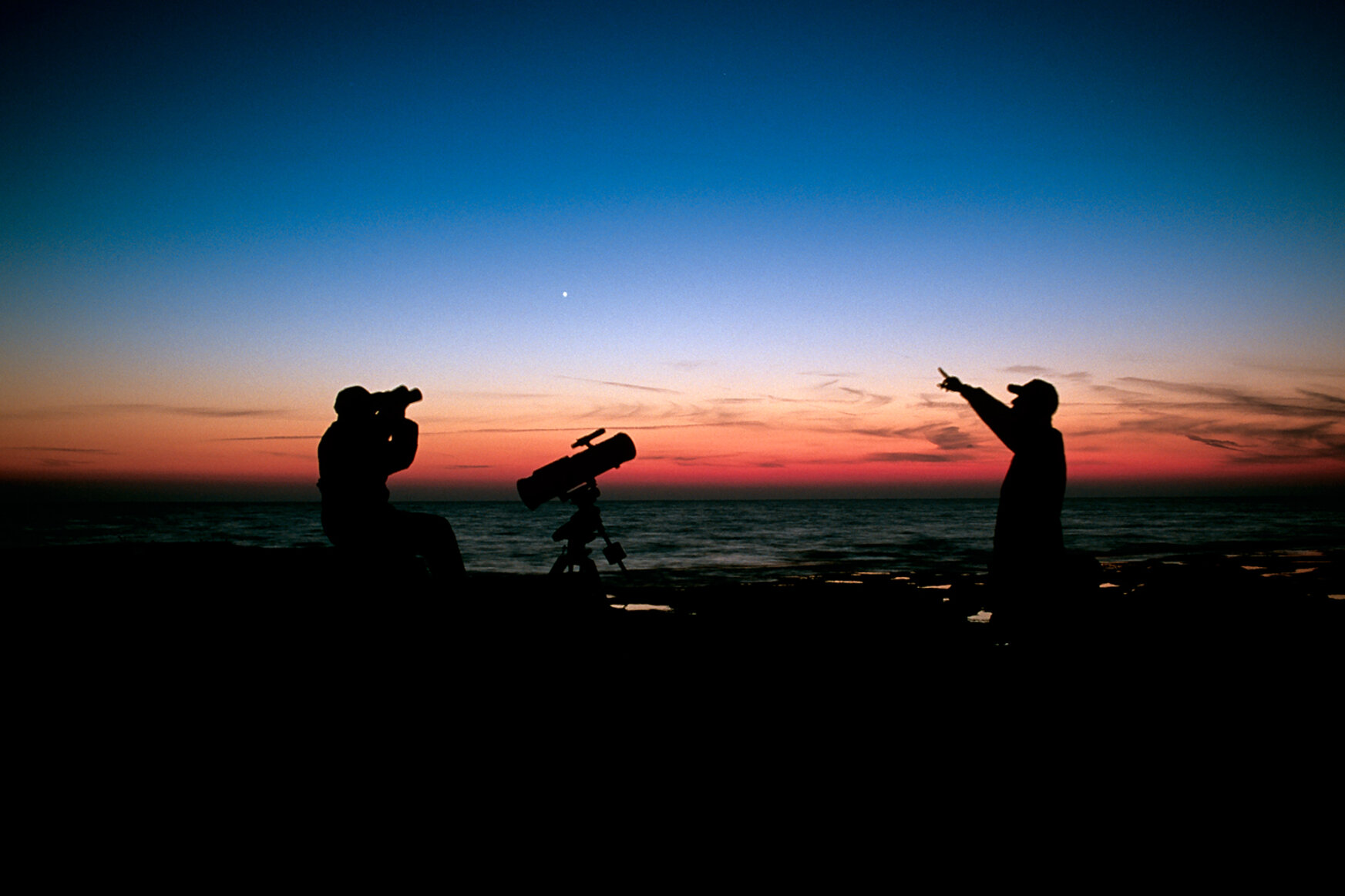


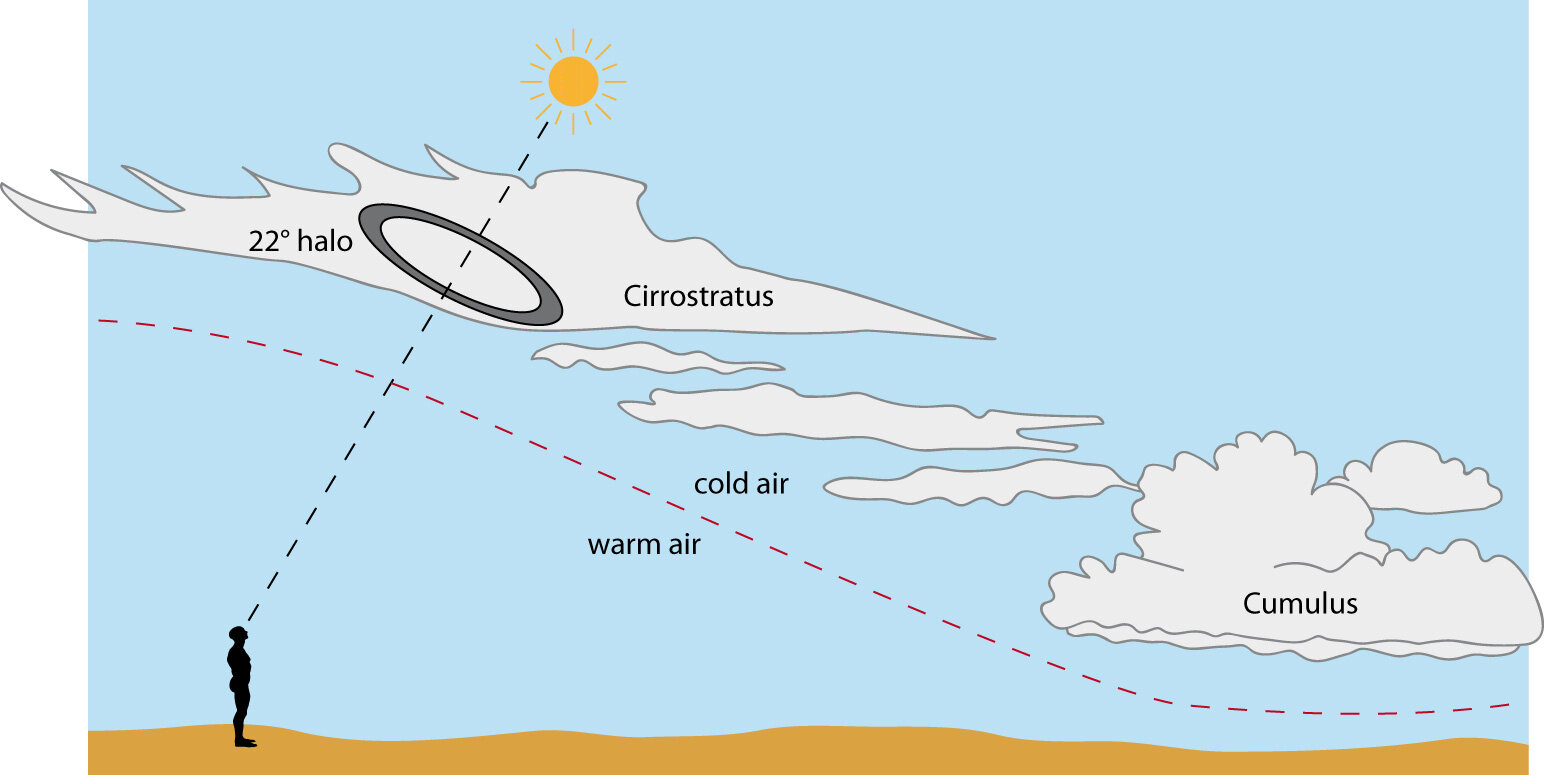
When sunlight or moonlight passes through the hexagonal ice crystals of cirrus clouds lying between six and twelve kilometres in altitude, it can be refracted and form halo phenomena. Halos differ from one another according to the elevation of the light source and according to the shape and motion of the ice crystals, which may be flat or elongated.
Halos appear as broad crowns of light around very bright sources such as the Sun, the Moon, the major planets and the brightest stars. The extent of the halo depends on how the light passing through the ice crystals is refracted and on how the latter are oriented. The refraction direction is not random; for example, hexagonal ice crystals oriented horizontally have a refraction angle of 22 degrees between the direction of incoming and outgoing light. Generally the two entry and exit angles are symmetric to each other. There are less-known halo forms characterized by different angles. During the winter season halos can also form in fog and low clouds if they contain droplets mixed with ice having shapes more complex than the hexagon. In this case the forms are more varied and different from a circle.
The parhelion (also known as sun dog, mock sun or false suns) can be considered a halo phenomenon made up of two bright spots placed at the same elevation as the Sun (or the Moon), with fixed angular distances and opposite the light source. They too form by refraction of light in horizontal hexagonal ice. The distances from the Sun are generally 22°; however, in rare conditions, it is possible for a pair to form also at 46 and/or 120 degrees from the Sun. The spots show the typical rainbow colouring with red toward the Sun and are often mistaken for “unidentified flying objects”.
Parhelia may appear associated with a halo or isolated. When the Sun or Moon are very low on the horizon they appear at a distance of 22° from the body; otherwise they move away up to 24°, while the halo stays fixed at 22°.
Rarely one can witness the formation of a parhelic circle, that is, the appearance of a faint white streak that joins the parhelia with the Sun and can extend up to 360°. On this circle, sometimes real tails associated with the parhelia may appear.
Halos can have a radius of 9, 22 or 46 degrees from the Sun and their thickness can vary from a minimum of 9° to a maximum of 35°. Lunar halos are rarer and always placed at a distance of 22° from the Moon.
There is a wide range of halo phenomena called arcs, which depends on the shape and arrangement of the ice; they can occur at angular distances very far from one another and can have the centre of their curve in the Sun, in antisolar positions or at the zenith. On the lower edges of the larger halo, infralateral arcs may appear symmetrically. The presence of these cirriform clouds that form halos is the prelude to the arrival of warm fronts, about 600-700 Km in advance.
Representations of these phenomena can be viewed with the virtual simulator “HaloSim3” (http://www.sundog.clara.co.uk/halo/halosim.htm) made available by the authors Michael Schroder and Les Cowley. This software is based on an algorithm that takes into account millions of light-ray traces arising from the interaction of light with different families of solids of choice; if desired, the model can also be applied to extraterrestrial interactions. The software authors in fact explain that halo phenomena can also occur on Mars (from frozen carbon dioxide), Jupiter (from ammonia and ice crystals), Saturn, Uranus, Triton, Neptune (from nitrogen crystals) and occasionally on Pluto and on Io (from monoclinic sulphur).
Aloni


Parhelion


Most common halo phenomena at Italy’s mid latitudes
- 22° halo (Wheel of Ixion), probably more common than the rainbow
- Circumhorizontal arc,
- Circumzenithal arc (CZA),
- 22° sundog
- 44° sundog (in the parhelic circle)
- 46° sundog (outside the parhelic circle)
- Upper tangent arc
- Lower tangent arc


Solar halo at 22 degrees from the Sun

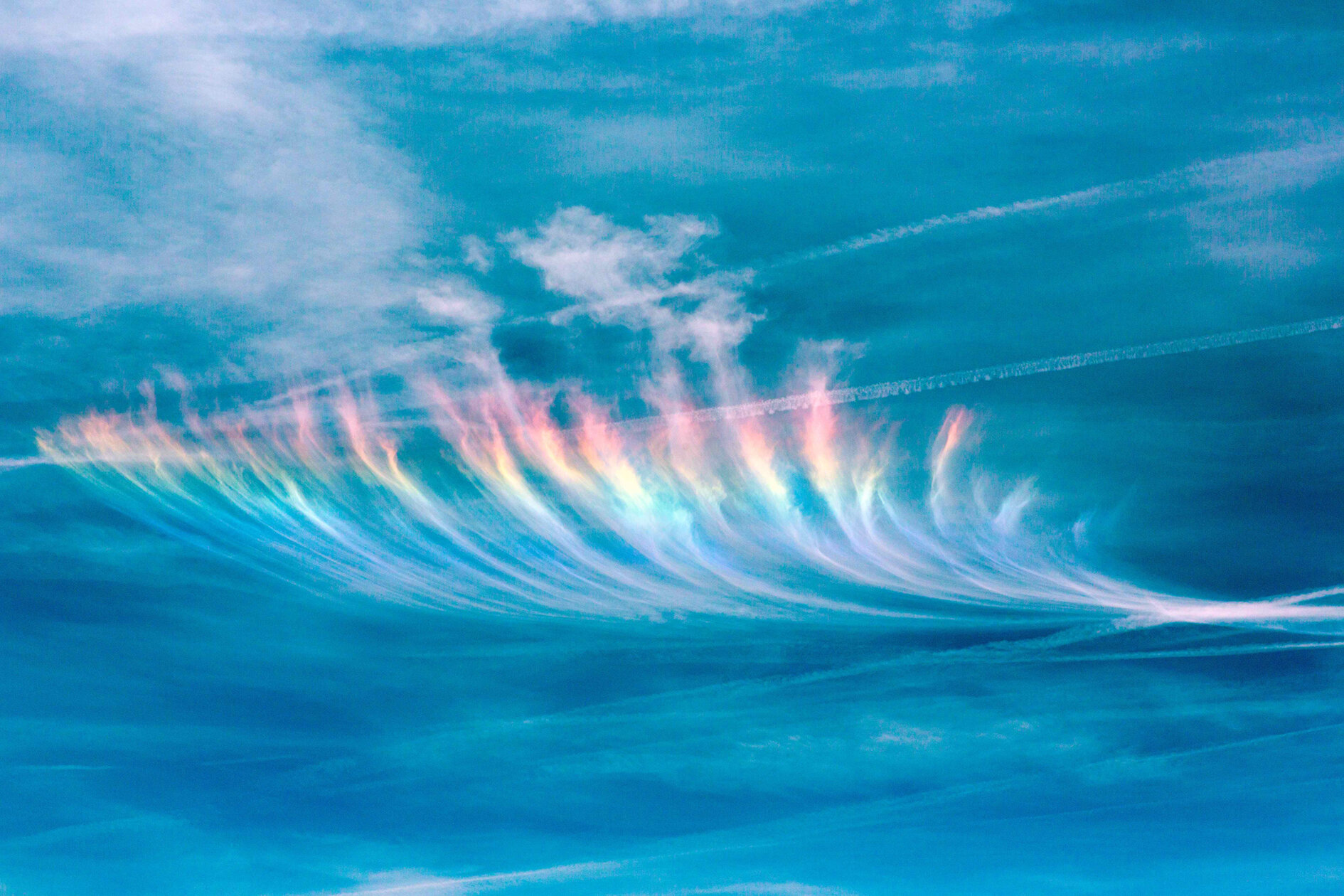
Circumhorizontal arc

When the circumhorizontal arc takes the shape shown in this photo it is wrongly called a "smiling rainbow", or a "fire rainbow", but it is NOT a rainbow.
Circumzenithal arc

Parelio

Rarest lunar halo phenomena

- 46° halo, similar to the 22° halo, but weaker and more diffuse.
- Halo circumscribed to the 22° halo: it is an overlaid ellipse-shaped ring, but slightly wider than the 22° halo. With the Sun higher than 40° the two halos overlap.
- Hevelius halo, a halo formed by an arc with a 90° radius from the Sun and drawn and observed only once by Hevelius in 1661. Probably the observed halo also had two 90° parhelia.
- Concentric circular halos, a very rare formation theorized in 1923 by Luis Besson.
- Vertical lunar elliptical halos, first photographed in 1987.
- Bottlinger ring, a bright ellipse surrounding the subhelion.
- Diffuse anthelic arcs of Greenler and Trankle, very bright X-shaped branches that may have been historically confused with crosses in the sky of divine origin.
- Anthelic arcs, a diffuse bright formation in the shape of a Saint Andrew’s Cross. These arcs too may have been confused over time with crosses of supernatural origin.
- Antisolar arcs, they are mirror arcs that cross the antisolar point forming an X when the Sun is low on the horizon.
- Hastings, Wegener and Tricker arcs are special anthelic arcs that vary depending on the angle of entry and exit of light in the ice crystals that act like kaleidoscopes.
- Moilanen arc, these are rare multiple halo formations.
- Supralateral and infralateral arcs. They are arcs superimposed on the main Halo, which detach from it when the Sun’s height is above 20°. As the elevation of the light source increases these arcs descend and detach from the Circle of Ission.
- Parry arcs and supralateral to infralateral Parry arcs, are V-shaped formations that can appear tangent to the supralateral or infralateral arcs (if these are low 15°-20°). They are named Parry because the ice follows the spatial orientation theorized by Parry.
- Heliac and subheliac arcs, Prof. Paolo Candy explains that they represent “e”-shaped formations with the intersection centered on the Sun. The upper part of the “e” is 30° minus the Sun’s height from the zenith, so if the Sun is 30° high, then the “e” is tangent to the zenith.
- Circumnadir arc, this formation develops around Nadir and has been studied only theoretically. No observations are reported.
- Kern arc, a very rare white arc that completes the circumzenithal arc at the zenith.
- Lowitz arcs (upper, middle or lower), arcs that join the parhelia and were first drawn in 1790 by Tobias Lowitz.
- Parhelic circle. This circle is a white halo that joins the parhelia parallel to the horizon.
- Subparhelic circle, these are arcs that join the subparhelia, i.e., parhelia that are at the same height as the subhelion.
- Various colorations of the anthelion,
- Double sun: sometimes a second solar disk may appear above, or below, the true Sun. It is generated by refraction, or by a part of the sun pillar that breaks.
- 120° parhelia (antisolar parhelia), very rare parhelia placed on the parhelic circle and a full 120° from the solar disk.
- 9° halo. It is the innermost of the halos and forms when pyramidal crystals have a central prism section. Sunlight passes between a central face and an opposite pyramidal face. These faces are inclined at only 28° and the deviation the light undergoes is 9°.


Circumzenithal arc in a fallstreak hole

Bibliografia nei testi consigliati