

Only 80–85% of the Sun’s photons manage to reach the ground directly without undergoing external interference. The remaining 20–15% instead undergoes the phenomenon of scattering (light diffusion) when it comes into contact with atmospheric molecules and aerosols. It is precisely this interaction that determines the colors of the sky. To understand the effects of this interaction, we must understand what happens in the particles that make up the atmosphere: it is composed of a mixture of gases that filters the light coming from the Sun, splitting it into individual wavelengths and polarizing it. Moreover, during polarization, molecules scatter photons in a way inversely proportional to the fourth power of their wavelength (Rayleigh scattering in “On the light from the sky, its polarization and color, Lord Rayleigh”: the shorter the wavelength, the greater the scattering intensity, and in particular blue is scattered a little more than three times as much as red). In other words, molecules, which on average have the same size as the photons’ wavelengths, scatter them in all directions, but with a decreasing amount from violet toward red. All colors reach the eye, but the clear sky appears “light blue” because the blue component is scattered more. However, in the atmosphere there are also other particles with sizes larger than the wavelength. These are precisely what reduce the vividness of the light blue, so at times the sky becomes reddish or pale. Instead, when dry winds drive these particles away and make the air clear, the color shifts from “pale light blue” to “deep blue”. Scattering occurs with very rarefied molecules, and this can also be observed with an everyday example: the same behavior of the atmosphere is visible with cigarette smoke, which at first, being very concentrated, is white, but then, as it expands, becomes blue.
As we have seen, the sky reddens during sunsets and sunrises, due to refraction, dispersion, and scattering. These factors affect the propagation of blue light, reducing it in favor of the red component and in some cases green. For these reasons, clouds just above the horizon redden even in the presence of a clear sky.
Depending on the shape and size of the molecules, there is a variable type of dispersion: in the presence of large and irregular molecules, such as dust and smoke, there is backscattering, that is, an irregular light diffusion coming from the rear side of the particles. There are also some types of air molecules that instead produce a symmetric three-hundred-sixty-degree diffusion with an omnidirectional light component. Finally, large water molecules generate strong forward and backward scattering, determining the vividness in rainbow arcs or anthelic phenomena. By anthelic phenomena we mean bright portions of sky located one hundred eighty degrees from the Sun.
An intuitive example of scattering variation is the Halo phenomenon. To understand it, you must observe the Sun and focus on the glare it produces: on some days there can be a stronger glare, and on others it may seem more point-like and stand out sharply from the sky background. The glare, i.e., the Halo, is caused by scattering from atmospheric particles such as dust, fumes, humidity, pollen, and water, which diffuse light to the sides of the solar disk. Large amounts of these molecules produce a very pronounced halo.
Other examples in photography are the golden hours and the blue hour. The first, also called magic hour, or golden hour, is the hour after sunrise and the first hour after sunset. During these periods the light has a very warm cast and makes photographic details notably soft, intense, and golden. The shades that can be photographed range from red to violet, shadows are very long, and shots turn out rather emphatic.
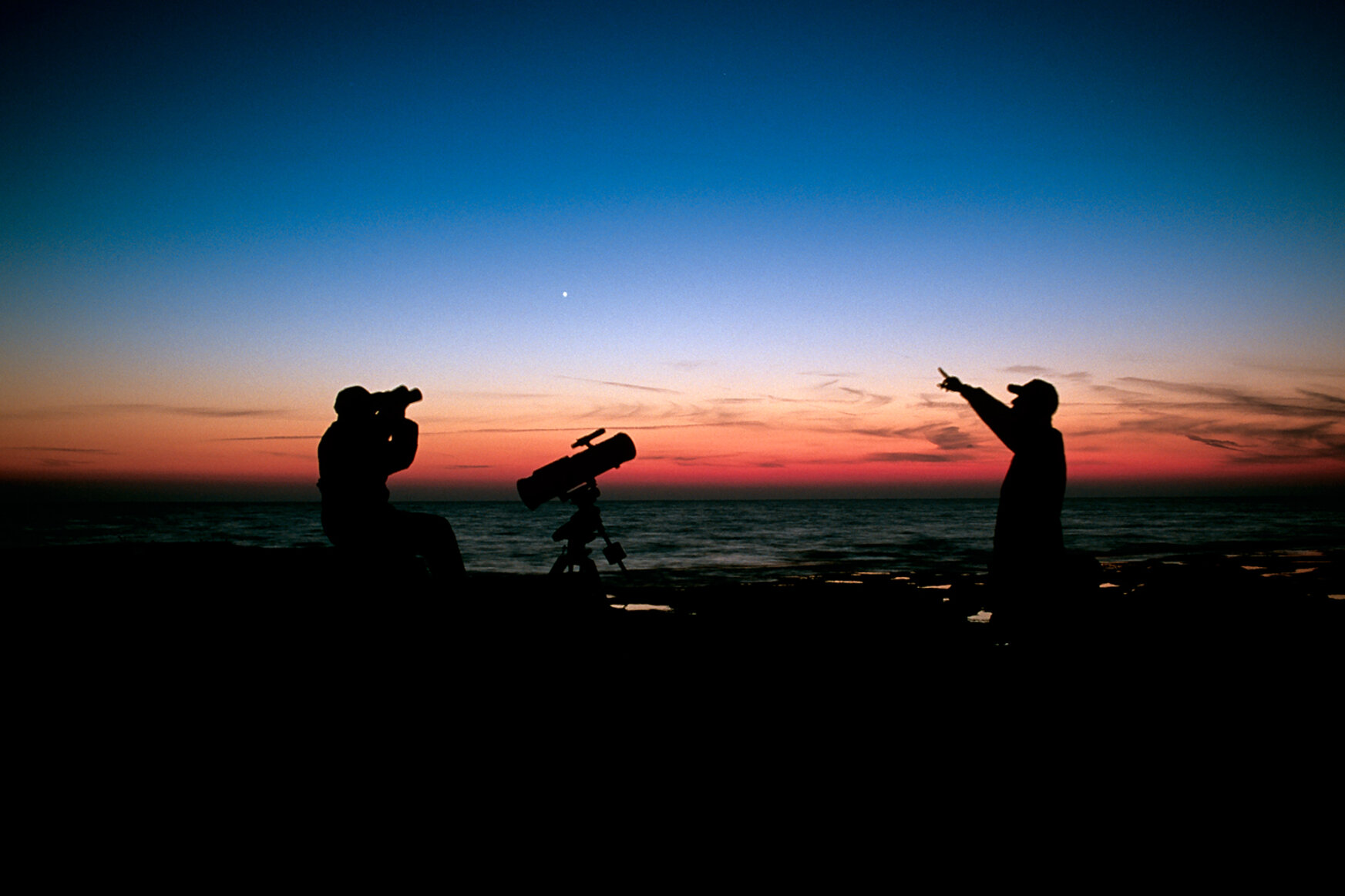
With the term “blue hour”, which comes from the French heure bleue, we mean the period of the day following twilight of about fifteen minutes in which the diffused light is cooler and therefore photographers can obtain images with more half-shadows, desaturated colors, a more intense sky, and cool casts.
Purple light and Enrosadira

When the Sun is about 4–6 degrees below the horizon, that is, thirty minutes after sunset, or before sunrise, you can see on the celestial vault a purple glow that reaches up to 45 degrees above the solar disk. This is the “Purple light” phenomenon. This phenomenon is not yet fully explained, but it is believed that the main cause is the scattering of light due to atmospheric dust found in the stratosphere. More mysterious remains the oval shape of the purplish glow. Some scholars believe that scattering by stratospheric gases is sufficient to determine the phenomenon even in the absence of dust, although the stratosphere is probably never free of dust.
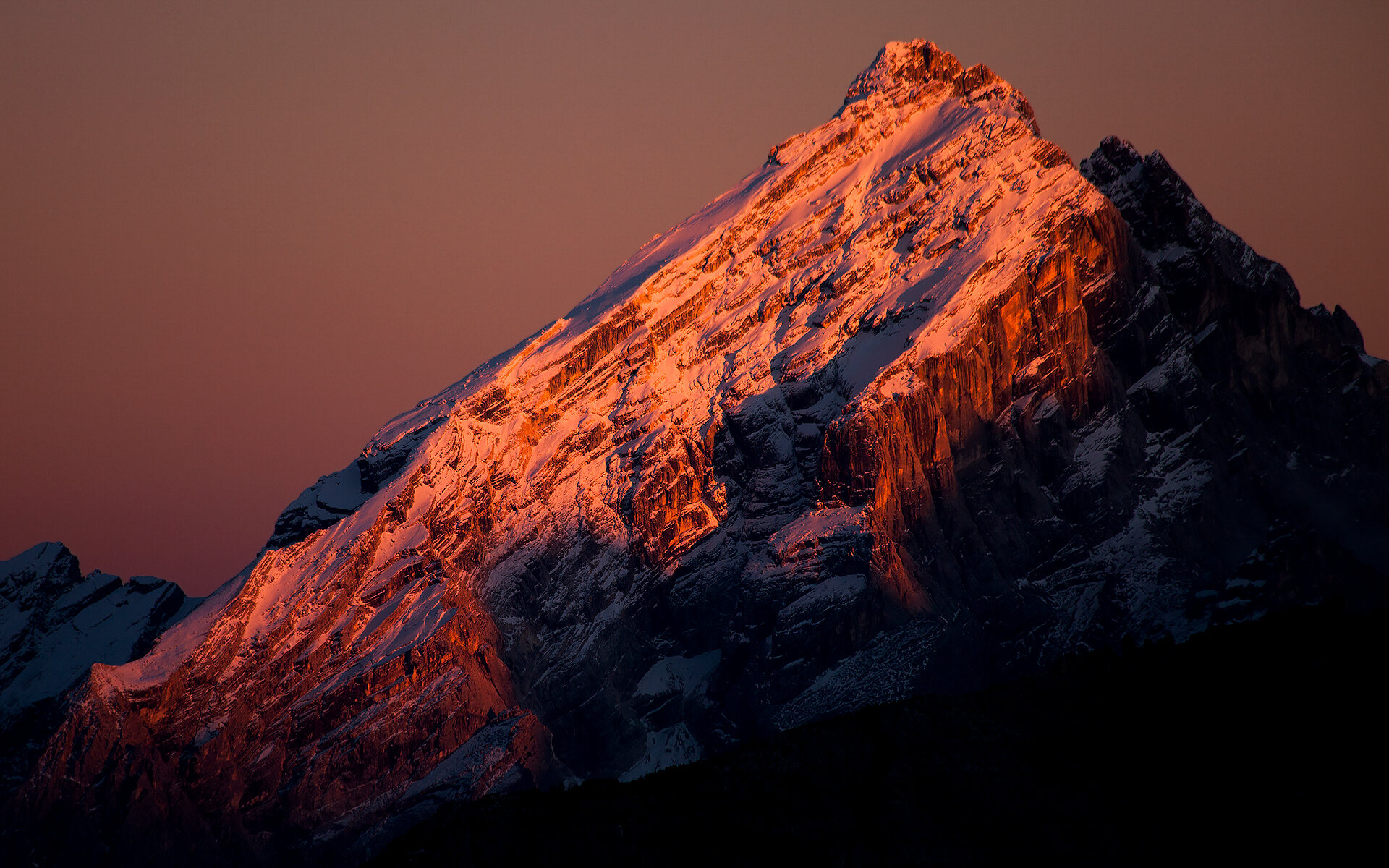
Enrosadira occurs when the highest mountain peaks are illuminated by sunlight after the Sun has already set for 30 minutes; they take on a pinkish coloration. This coloration becomes very evident when it contrasts with the blue sky and the Earth’s shadow cone. The phenomenon is also known as “alpenglow” or “alpenglühen“ and varies from day to day depending on weather conditions.
Colors of the Sun and the Moon
If we asked a child what the color of the Sun is, they would answer: white by day and red at sunset. The answer is not wrong, but only imprecise: our star emits mainly at the wavelength of 500 nm, so its true color is yellow-green. This is its real color that should be seen when it is high in the sky, but it is not perceived because of the strong light intensity. At sunset, instead, we see it red because Rayleigh scattering comes into play, i.e., atmospheric diffusion that filters it. Scattering is always present, but its effects are more visible when light rays travel obliquely through the atmosphere.
The color of the Moon is typically neutral gray, but it is perceived differently depending on the body’s elevation in the sky: when the disk is high in the sky the Moon is white-yellow because it reflects sunlight that is yellowish, but it is perceived whiter than it really is; when it is near the horizon the observable colors are red, orange, and golden yellow. These variations depend on Rayleigh scattering
, on the degree of humidity, and on the body’s elevation. At times it may appear “almost green” if observed among low purple clouds at twilight. In reality the green color derives from a cognitive process: the contrast between the red of twilight and the gray of the lunar disk tricks the brain, making the observer believe they see the Moon with a green cast.
During eclipses, the lunar disk is darkened and takes on a coppery coloration. The intensity of the color changes for each eclipse, depending on the physical-chemical state of the atmosphere, the solar sunspot cycle, and the trajectory with which the Moon enters the Earth’s shadow. The French astronomer Andrè Danjon devised a scale from 0 to 4, cataloging the chromatic type of total lunar eclipses: the colors range from “light orange-red” for value 4 to “dark red-almost black” for value 0.
Bibliografia nei testi consigliati.