
Introduction
“Atmospheric refraction” occurs when ordinary refraction is generated by atmospheric layers with different temperatures and densities. It is the main cause of the family of mirages and of stellar twinkling.
Refraction often also occurs underwater when fresh water from a spring mixes with seawater.
The first scientific study on mirages dates back to 1798 and is attributed to the French mathematician Gaspard Monge, who observed them during his scientific expeditions in Egypt. Monge, following Napoleon, observed that marching battalions, when seen from afar, seemed to float in the air and become distorted. When he returned home to describe the phenomenon, he coined the term se mirer which can be translated literally as it reflects. Mirages are produced by temperature differences between the various layers of air and between these and the Earth’s surface. Under particular conditions, objects and landscapes, located at a considerable distance from the observer, can produce virtual images and be seen distorted, doubled, or inverted.
Mirages can appear mainly by visually superimposing two images, one real and the other unreal: in these cases they are called “inferior mirages” and “superior mirages”. There are also rare cases of superpositions of three, or more images, such as the Fata Morgana, Mock Mirage, Alfred Wegener’s Late Mirage and the green flash family.
In the case of inferior mirages the lowest atmospheric layers, in direct contact with the ground, warm up more than the upper ones; as a result, a real carpet of unstable warm air forms over the ground and thus a vertical variation in air density that produces refraction and reflection phenomena. Light rays that meet this thickness of air do not propagate in a straight line, but curve upward, producing a virtual image inverted downward.
The most frequent example of an inferior mirage is the one that occurs in summer over asphalt stretches, where even 70°C can be reached in the first 15 cm above the ground. From afar, it seems that the road is “wet”: but what you see is the sky reflected by the layer of warm air above the asphalt. This type of mirage is called Shimmer.
The superior mirage, instead, is generated when the air layer is colder than the ground and denser than the higher air layers.
The Fata Morgana
Many call it “the mirage”, but it is only a particular case. The Fata Morgana is a rather complex phenomenon, the result of the combination or overlap between the superior mirage and the inferior one. Generally a first layer of warm air produces a downward distortion, while the second layer of cold air creates a marked upward distortion. The two different thermal inversion layers intertwine and mix, generating chaotic distortions. Refractive indices can change more than three times. It can often be observed on the sea or lake horizon, where strong temperature inversions cause misshapen, floating images or ones resembling castle towers. It differs from the simple mirage because of the huge visible distortion and its changeability; in fact one of its features is the speed with which the distortions change: sometimes appearing and disappearing within a few minutes. The name comes from an expression used by Italian sailors in the Mediterranean during the 15th century: legend tells of a king who, during the medieval invasions, upon reaching Calabria saw Sicily and, while preparing to cross the Strait, a woman appeared to him. At the same time the Sicilian shore appeared so close that he thought he could touch it with his hand. He dove in, but it was a deception and so he drowned. The woman was the Fairy Morgana, sister of King Arthur, who had learned the art of magic from her rival Merlin the Wizard. The Nordic mythology of the Knights of the Round Table had reached Southern Italy thanks to the Normans. Before the Fata Morgana the phenomenon was associated with the sirens of Greek mythology.
Photo by Royce Hutain taken from Huntington Beach (USA)
from the handbook Lights and colors of the Sky, Ronca Publisher

Refraction mechanism

The photo of the ship above the horizon is not a Fata Morgana, but simply an inferior mirage.

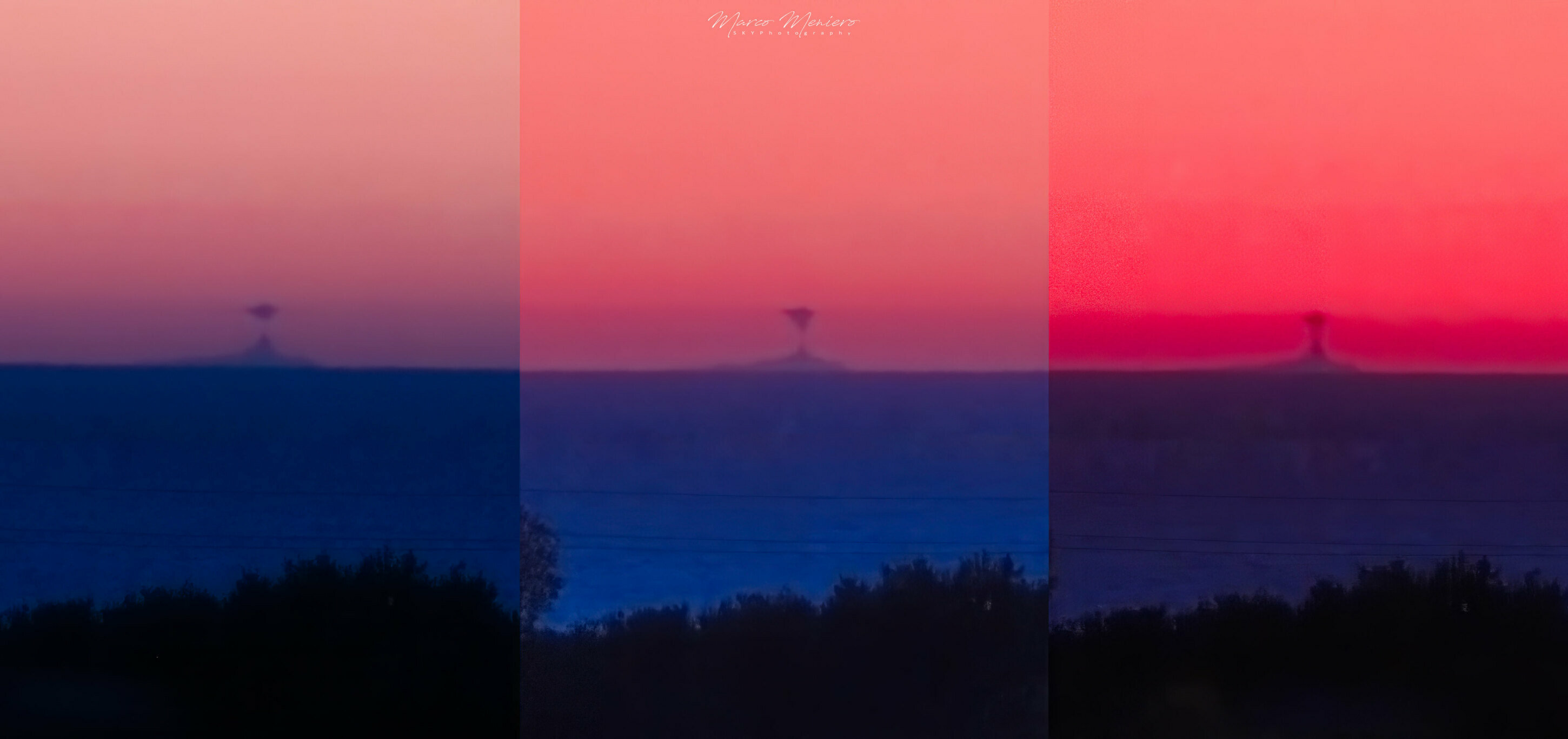
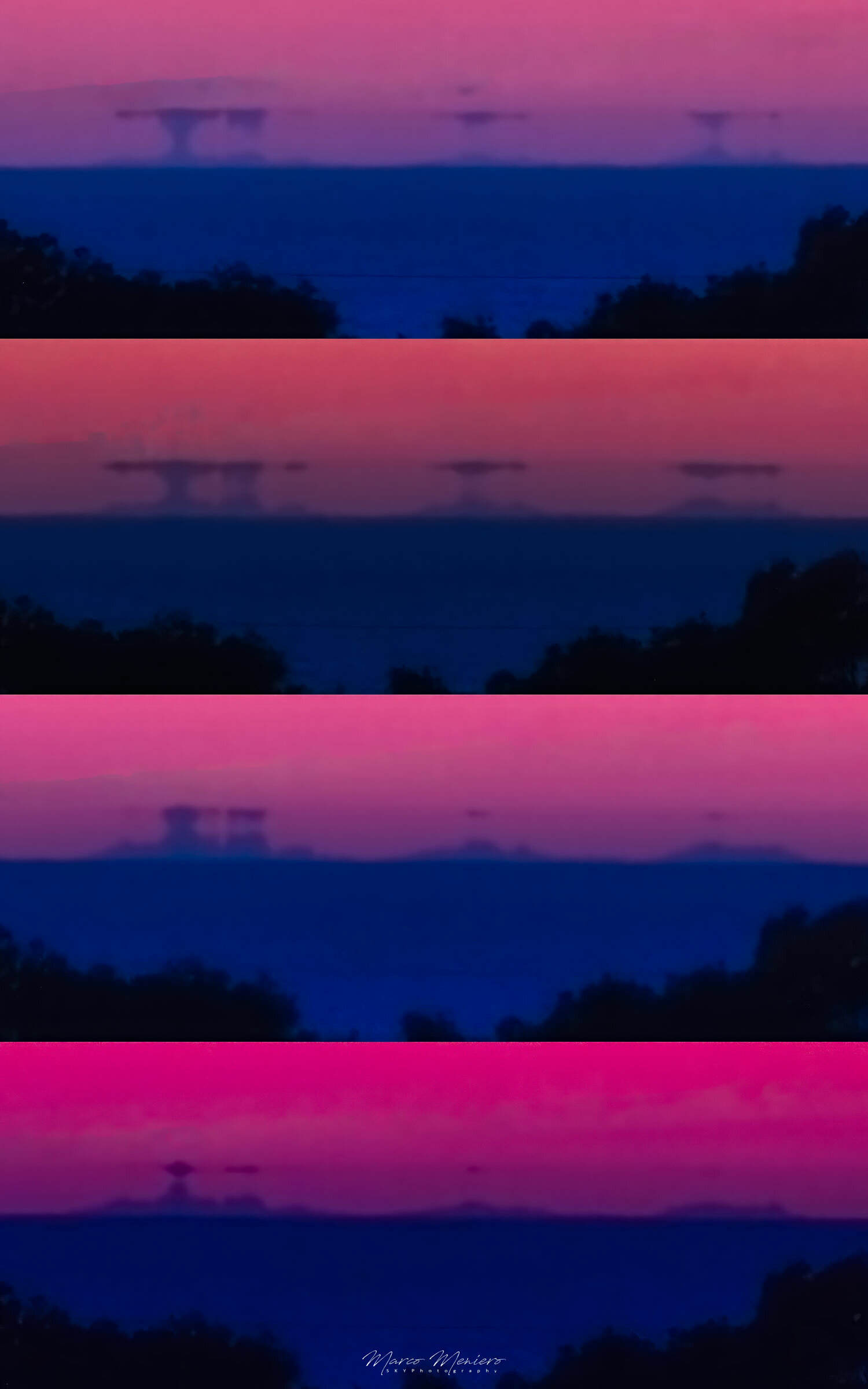
The following photos show the Fata Morgana on Corsica photographed from Civitavecchia (Author’s photos):

Bibliografia nei testi consigliati