

Please remember that to look at the Sun on the horizon you must wear good dark glasses, because the air mass between the observer and the Sun filters on average only 1/10,000 of its brightness, unlike commercial solar filters which absorb 10 times more, i.e. 1/100,000.
J. Verne describes it like this:
”… the deformation of the disk, altered by refraction, made itself felt little by little; it widened at the expense of its vertical diameter, and recalled the shape of an Etruscan vase, with bulging sides, whose foot dipped into the water”.
The “Omega” Sun illusion (or similar to an Etruscan vase) is an example of an inferior mirage, which consists in seeing the solar image taking the shape of the Greek letter Omega (Ω). It is made up of the true solar disk, which however is joined, in its lower part, to its virtual image reflected by the sea and by a layer of warm air just above the horizon. The physical principle of inferior mirages is identical to that of superior ones, with the difference that the thermal gradient is reversed, so the air temperature increases from bottom to top. In this case, distant objects and landscapes are projected into the sky, upright or inverted, where virtual images are observed, sometimes seemingly close together, produced once again by a curved path of light rays.
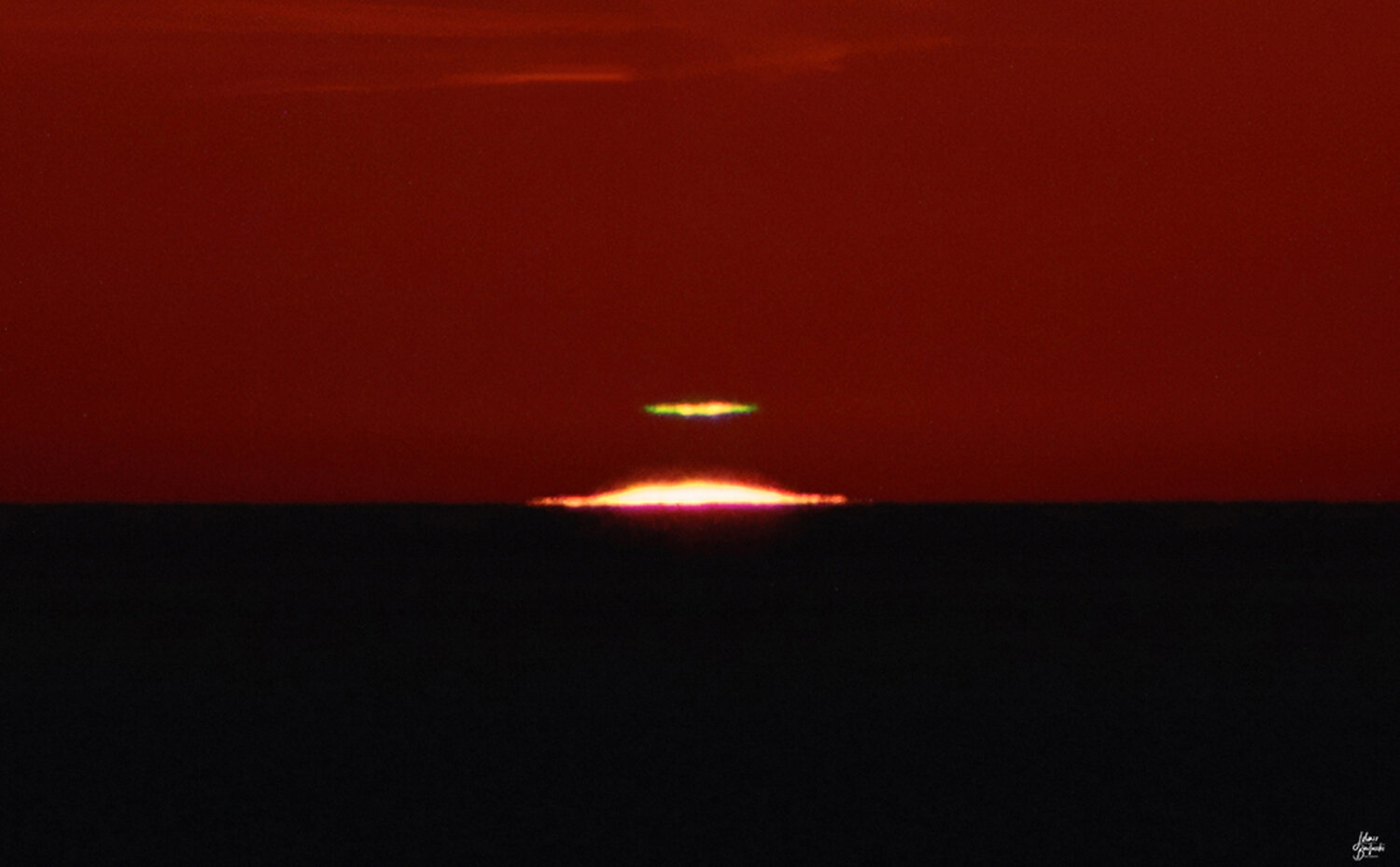
The deformations of the solar disk vary with its elevation and the number of adjacent air layers, characterized by different thermal and pressure gradients: the solar disk may appear as an inverted Omega if the thermal inversion occurs very far from the horizon (superior mirage); as a “cube” if the refracting air carpet cuts the solar disk in half and therefore reflects the upper part of the star upside down and flattened. If many air layers persist stacked on one another, one might notice the Sun deformed into a “pentagon”, or a “mushroom”, an “inverted mushroom”, a “drop”, a “pyramid”, or even with frayed outer edges, as if one were observing an abstract painting. If the air on the horizon is colder than the upper layer, then a blind band can form, i.e. a strip at the level of the warmer air in which the sun rays passing through do not reach the observer. This is the “blind strip” and it is visible as a dark streak in front of the Sun. Sometimes several strips can add up together as if the solar disk were deformed by a lens.
To admire and photograph these wonderful deformations, you must be able to observe the sea horizon from an elevated position free of obstacles; the sky must be clear as during cold winter days, when the north wind blows, or during dry summer anticyclones.
In general, the careful observer can distinguish inferior and superior mirages simply by noting where the virtual image is: if it is placed below the real figure and is flattened, then one is looking at an “inferior mirage”; otherwise, if the image is higher than the real figure, one is observing a “superior mirage”. In all cases, the extent of the phenomenon never exceeds half a degree around the horizon, i.e. it is less than the solar diameter.

Il Sole a Omega si forma quando, in prossimità della superficie marina, si instaura un profilo verticale della temperatura che determina una variazione dell’indice di rifrazione dell’aria con la quota.
Quando l’acqua del mare è più fredda dell’aria sovrastante, gli strati d’aria immediatamente a contatto con la superficie si raffreddano, mentre quelli superiori rimangono relativamente più caldi. Si crea così un’inversione termica, nella quale la temperatura aumenta con l’altezza. Poiché l’indice di rifrazione dell’aria dipende dalla sua densità, questa stratificazione produce una variazione dell’indice di rifrazione lungo il percorso dei raggi luminosi.
In queste condizioni, i raggi provenienti dalla parte inferiore del Sole possono subire una curvatura verso il basso e raggiungere l’osservatore seguendo percorsi che generano un miraggio inferiore. La sovrapposizione delle immagini dirette e riflesse per effetto della rifrazione atmosferica deforma il bordo inferiore del disco solare, creando una protuberanza allungata e arrotondata che ricorda il piede della lettera greca Ω.
La forma e la durata del fenomeno dipendono dalla struttura del profilo termico, dall’intensità del gradiente di temperatura e dalla geometria di osservazione. Il Sole a Omega è quindi una manifestazione della rifrazione atmosferica in presenza di una stratificazione termica favorevole, tipica delle osservazioni al sorgere o al tramontare del Sole sul mare.


Bibliografia nei testi consigliati