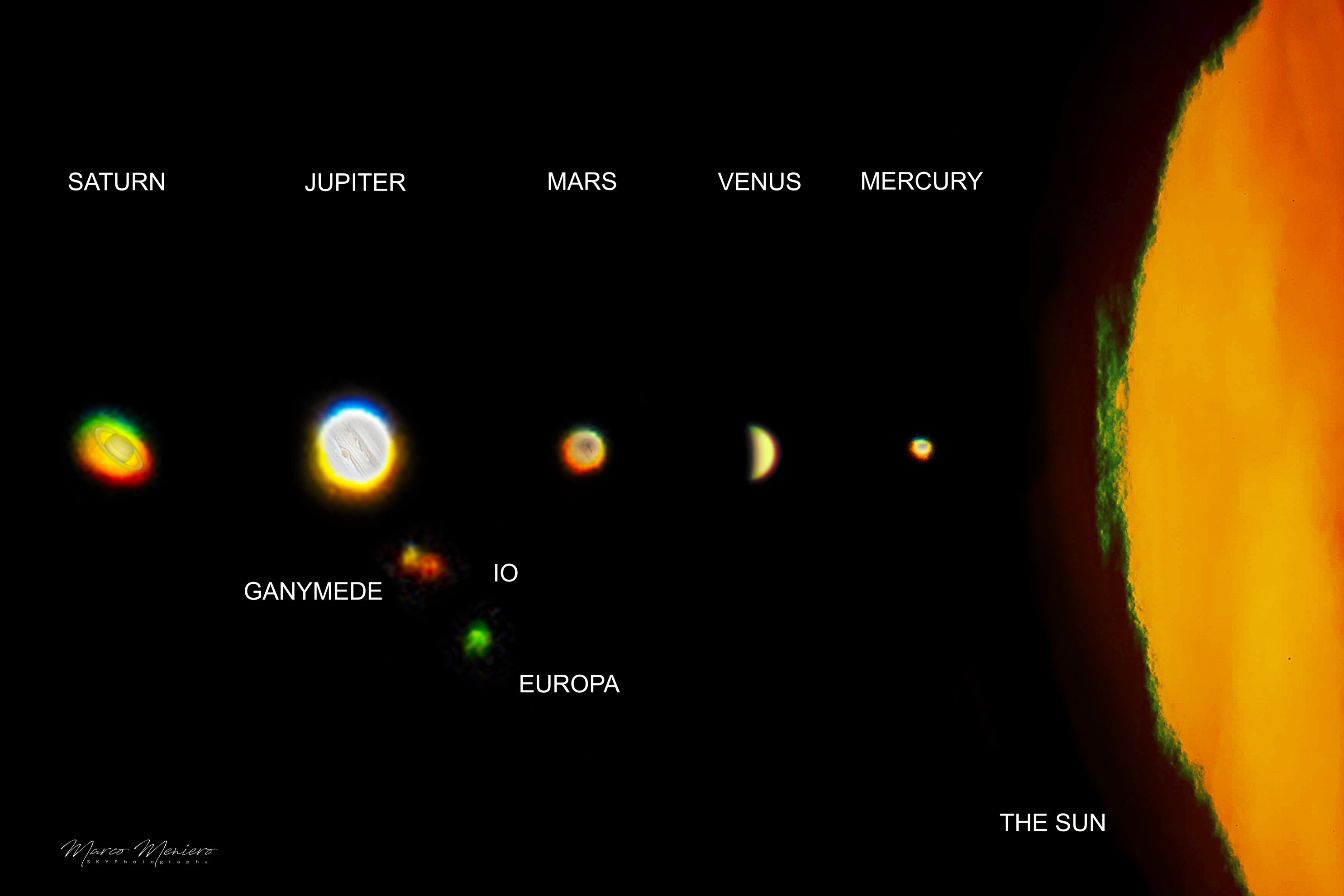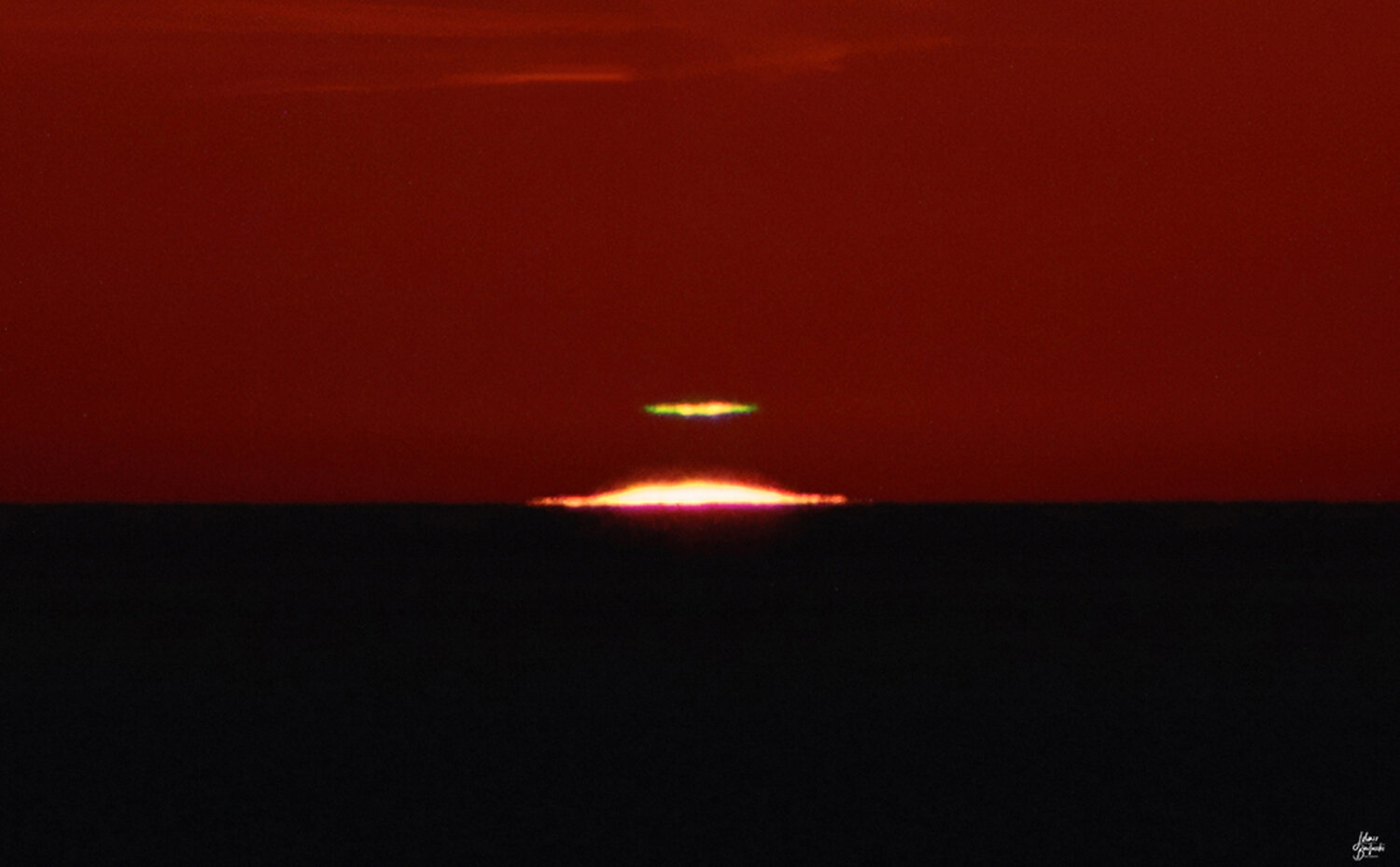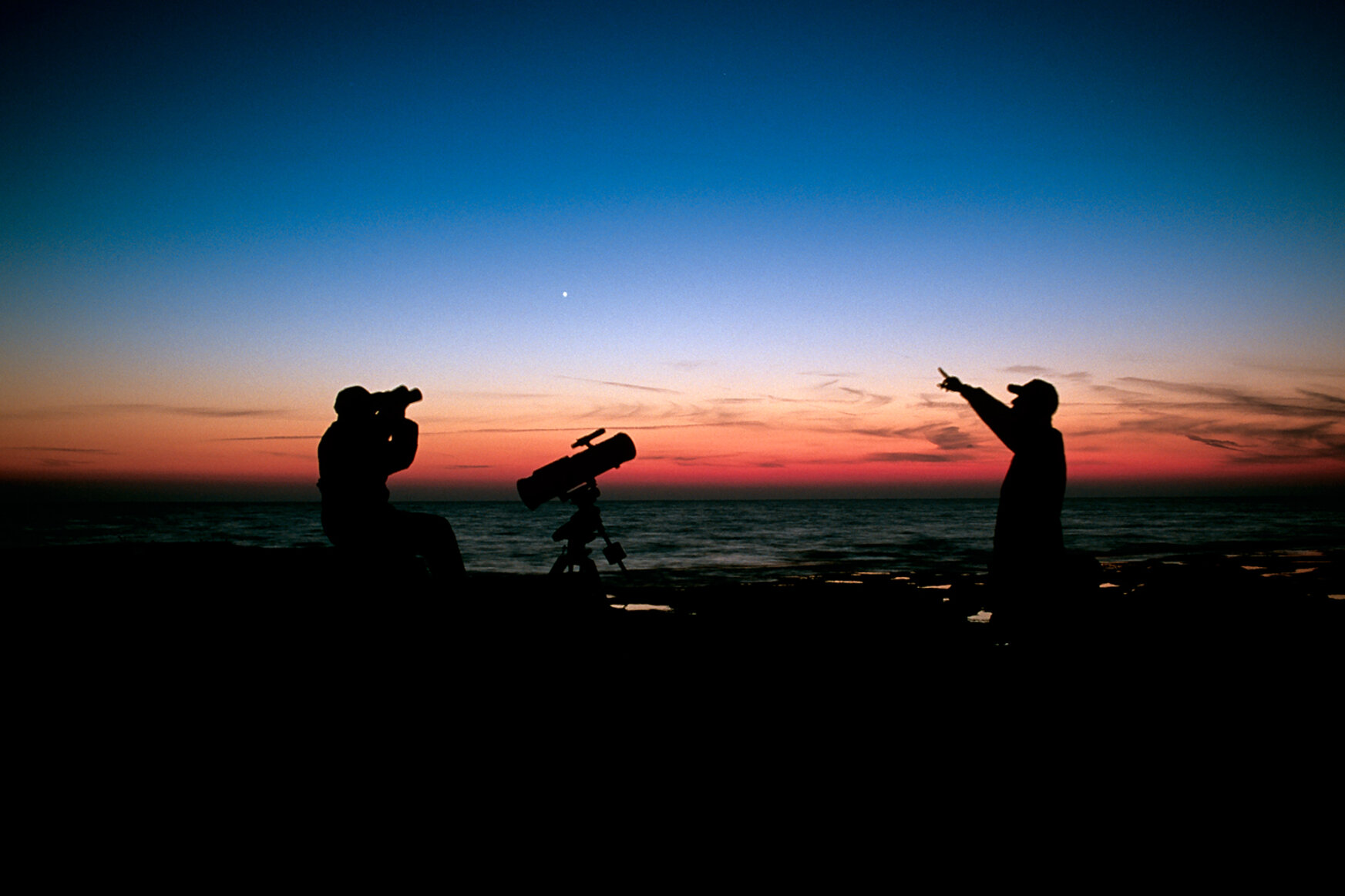

Please note that to look at the Sun on the horizon you must wear good dark glasses because the air mass between the observer and the Sun filters on average only 1/10,000 of its brightness, unlike commercial solar filters which absorb 10 times more, i.e. 1/100,000.

Chaldean, Babylonian and Egyptian astronomers were the first to record the phenomenon on some steles, without explaining it; later even Newton did not understand its physical origin, giving it a purely physiological and subjective interpretation.
In the scientific literature the first described observation was published in 1852 by P.G. Maggi in "On some appearances of the Sun near the horizon". However, Maggi describes the formation of a blue ray (and not green) above the solar disk and at the same time a red rim in the lower part of the Sun. A documented observation of the “green light of the Sun” seen by W. Swan dates to 1865. Later the physicists Joule in 1869 and Lord Kelvin in 1893 described the phenomenon in their notes, exciting the scientific community and fueling debates and studies on its interpretation. Many famous names devoted themselves to rigorous research such as: Righi, Kuiper, Airy and Pickering.
In 1918 Lloyd Sabaudo issued a painted postcard to advertise its fleet, with a boat in the foreground and the Sun with the green ray in the background.
In Photographie du rayon vert of 1925, we find the first published black-and-white photographs belonging to Lucien Rudaux; later, to see color prints, one had to wait until 1932 with La photographie, en couleurs, du rayon vert by Maurice de Kerolyr. However it seems the author retouched the plates with green paint. Many color prints were lost during the Great
War, so there were no other photos until 1951, when the work Green flash observed in the Antartic Ocean by M. Hanzawa was published. In 1958, O’Connell D.J.K. and C. Treusch published the first complete and detailed study of the phenomenon: The Green Flash and Other Low Sun Phenomena. The research also included a series of eighty high-resolution photos obtained with Zeiss instruments: a 60 cm Newtonian and a 40 cm refractor of the Vatican Observatory. It would seem that O’Connell D.J.K. and C. Treusch were the first to take shots from Italy, while the first Italian was the astronomer Paolo Candy in 1994. Currently the most complete bibliography on this phenomenon was compiled by the American astronomer Andrew T. Young, Astronomy Department, San Diego State University, while the most beautiful photos ever taken can be admired by visiting the website of the Finnish photographer Pekka Pairvainen.
Excerpt from "On some appearances of the Sun near the horizon", Maggi 1852


Postcard issued in 1918 by Lloyd Sabaudo to advertise its fleet

The first photograph of a Green Ray dates back to 8 September 1925 by Lucien Rudaux (La Nature, 7 November 1925, No 2692)

The novel: Le Rayon Vert, 1882, by Jules Verne
The Victorian novel tells the love story of the young Helena Campbell, and is based on a Scottish legend in which: the ray has the virtue of making it so that whoever has seen it cannot be mistaken in matters of the heart; whoever had the privilege of observing it would become skilled at seeing clearly into their own heart and that of others.

Jules Verne does not reveal his source in the novel. It is thought he was referring to an article in the London daily Morning Post :
“Have you ever watched the sun setting on the horizon of the sea? Yes! no doubt. Did you follow it up to the moment when, the upper part of its disk touching the waterline, it disappears? Very likely. But did you notice the phenomenon that occurs at the precise moment when the radiant star emits its last ray, if the sky, free of haze, is then perfectly pure? No! perhaps not. Well then, the first time you find the chance - it happens very rarely - to make this observation, it will not be, as one might think, a red ray that strikes the retina of your eye, it will be a "green" ray, but of a marvelous green, a green that no painter can obtain on his palette, a green whose shade nature, neither in the so varied tint of plants, nor in the color of the clearest seas, has ever reproduced! If there is green in Paradise, it can only be this green, which is, without doubt, the true green of Hope! "(Chapter III - Article from The Morning Post.)
Verne includes two possible explanations of the Green Ray (but the refraction one is ignored) in Chapter XV:
"This last ray that the sun throws when the upper edge of its disk touches the horizon, if it is green, perhaps it is so because when it passes through the thin layer of water it absorbs its color."
"Unless this green derives quite naturally from the red of the disk, which has suddenly disappeared, but of which our eye has retained the imprint, because, in optics, green is its complementary color!"
Jules Verne had already mentioned the Green Ray in a previous work, his other Scottish novel “Les Indes Noires” (1877). It should be noted that this green ray is observed at dawn: “At last, a first ray reached the girl's eye. It was that green ray which, evening or morning, emerges from the sea when the horizon is clear." (Chapter XVII - A dawn.)
The Green Ray is also suggested in "Robur the Conqueror" (written in 1885, published in 1886): “During the evenings of 16 and 17 July, at nightfall a curious phenomenon of twilight lights occurred. At a higher latitude one might have believed in the appearance of an aurora borealis. The sun, at sunset, projected multicolored rays, some of which were tinged with a fiery green color. (Chap. XIII).
The Green Ray is mentioned again in "The Amazing Adventures of Master Antifer", published in 1894: “At sunset as at dawn, refraction lets [the sun] still appear when it had already disappeared below the horizon. The luminous matter, projected obliquely on the surface of the waves, stretched like a long diameter, from west to east. The last ripples, like strips of fire, trembled in the dying breeze. This brilliance went out suddenly, when the upper edge of the disk, level with the waterline, launched its green ray. The hull of the brigantine schooner darkened, while its tall sails were purple in the last light." (Part 1, Chap. 1).
We also find the Green Ray in “En Magellanie” written in 1897-1898, but published in 1908 under the title “Naufragés du Jonathan” after substantial changes by Michel Verne: “The radiant star had just made contact with the horizon. Magnified by refraction, it was soon reduced to a hemisphere, whose last rays lit up the sky, then only a burning rim remained that was about to drown beneath the waters. And then there escaped from it a ray of a luminous green, the complementary color of the faded red."
The film: Le Rayon Vert by Eric Rhomer
Le Rayon Vert, 1985, Golden Lion at the Venice Film Festival.
Plot: Delphine, a lonely and sad Parisian girl, manages to find love and peace only when she comes to see the green ray with a young stranger. The film is inspired by J. Verne's Victorian novel.

Bibliografia nei testi consigliati