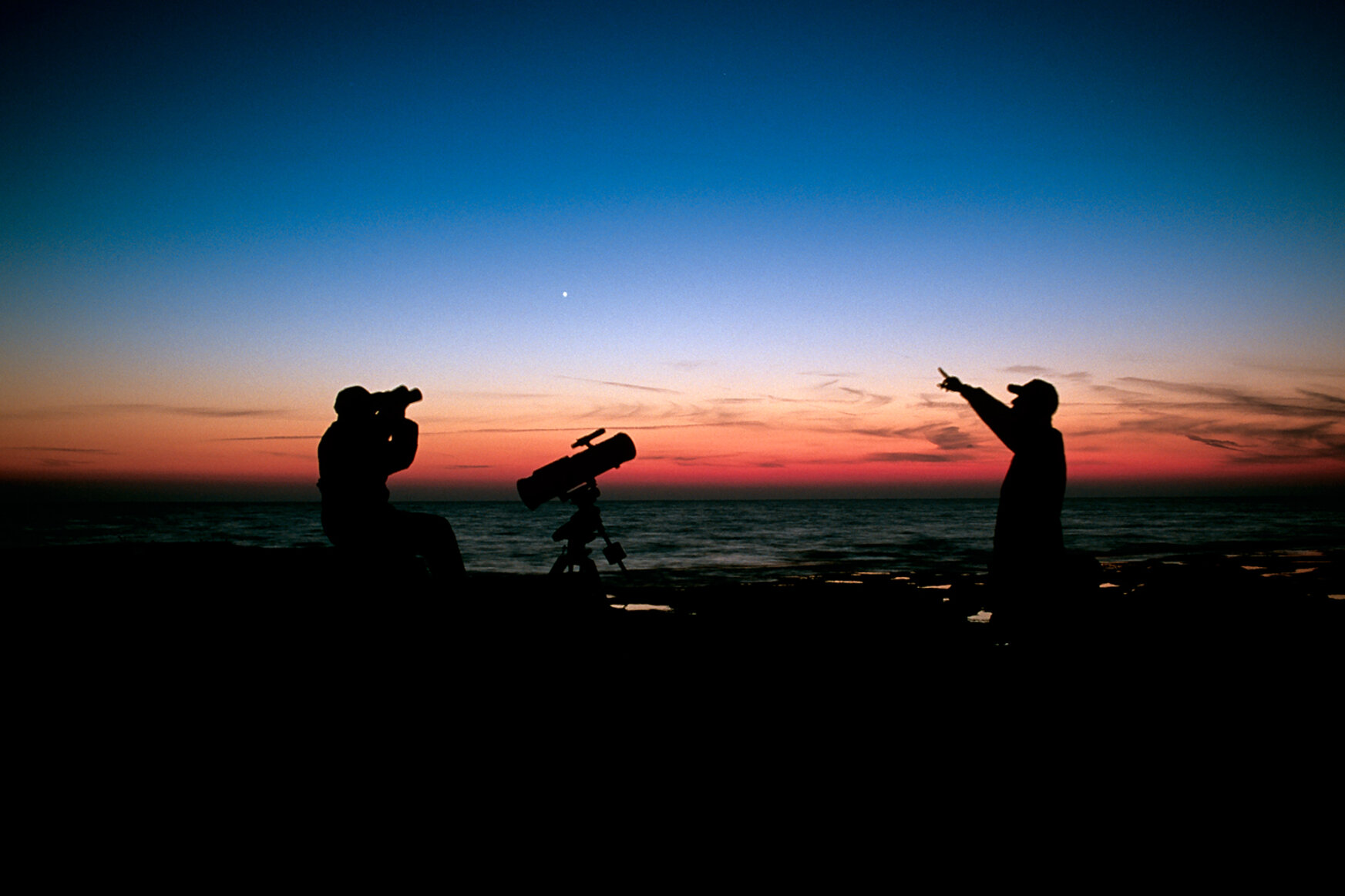


Please note that to observe the Sun on the horizon you must wear good dark glasses because the air mass between the observer and the Sun filters on average only 1/10,000 of its brightness, unlike commercial solar filters that absorb 10 times more, i.e. 1/100,000.
Introduction

The Green Ray is a photometeor and belongs to the family of mirages and can appear in two different ways:
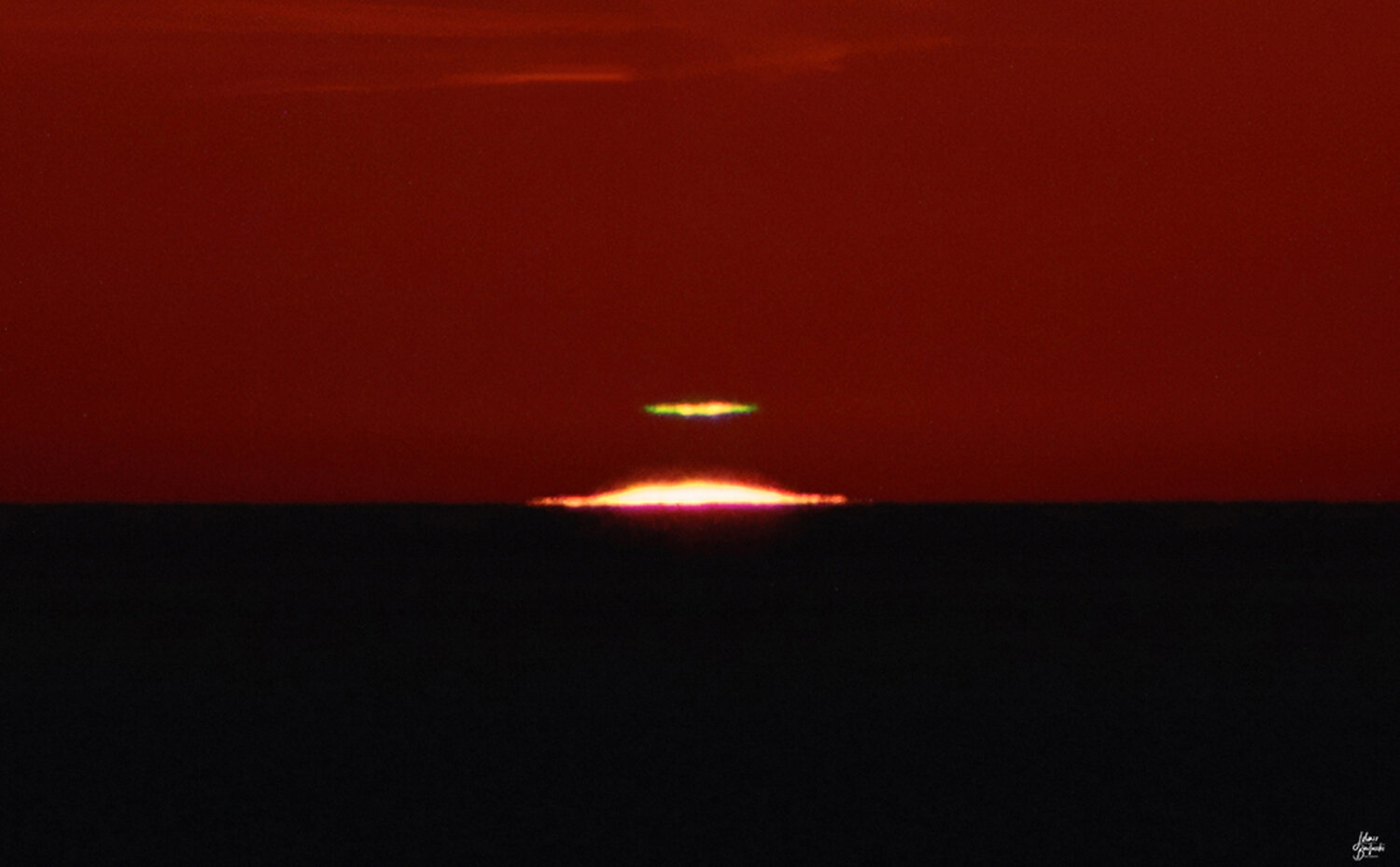
In the first case, when the solar disk is very flattened and clearly visible above the horizon, a very thin green arc can form for many seconds, detaching from the upper limb of the Sun and fraying into one or more overlapping green filaments (green rim). If this crosses a thermal inversion layer, then it lights up into a true green flash (green flash). In the scientific literature, when the Sun undergoes this set of deformations, it is said that one is in the presence of a “mock mirage”.
The second case is the most famous: when the Sun is almost completely below the horizon line, one can observe the almost instantaneous formation of the green rim without the prior formation of the green arc. Afterwards the green streaks merge, creating a single green beam (green flash). During its extinction one can also perceive a faint green glow coming from below the horizon (right where the Sun set) that lights up the sky for a few degrees upward, as if it were a lighthouse (green ray). The latter is Verne’s true green ray.
The duration of the event, from mid Italian latitudes, can vary from a fraction of a second for the green ray, up to about 2 seconds for the green flash; this mainly depends on the latitude of the observation site and on the speed of sunset during the year. For example Admiral Byrd in 1929, on his return from the Arctic camp of Little America (lat. 78°S), told of having observed a ray with the extraordinary duration of 35 minutes. And again, during the spring solstice of 2000, researcher R. Marks managed to photograph an extraordinary blue ray from the South Pole a full 48 hours after the Sun had begun to set.

Physical training

The astronomer Andrew T. Young of San Diego State University states: “Green flashes all arise from the effects of variations in astronomical refraction near the horizon. Although there are several types of green flash, each of these is a by-product of a corresponding mirage and each type is always a magnified part of the green rim produced by atmospheric dispersion. This means that a separate explanation is needed for each type of green flash, so understanding mirages is essential to understanding green flashes“.
Let us now see the main conditions under which the phenomenon occurs:
Atmospheric refraction: light rays change their direction of propagation when they cross the Earth’s atmosphere obliquely; the phenomenon changes with time and with the place of observation. Refraction is proportional to the increase in air density, therefore, when the Sun approaches the horizon, the deformation of its disk increases progressively.
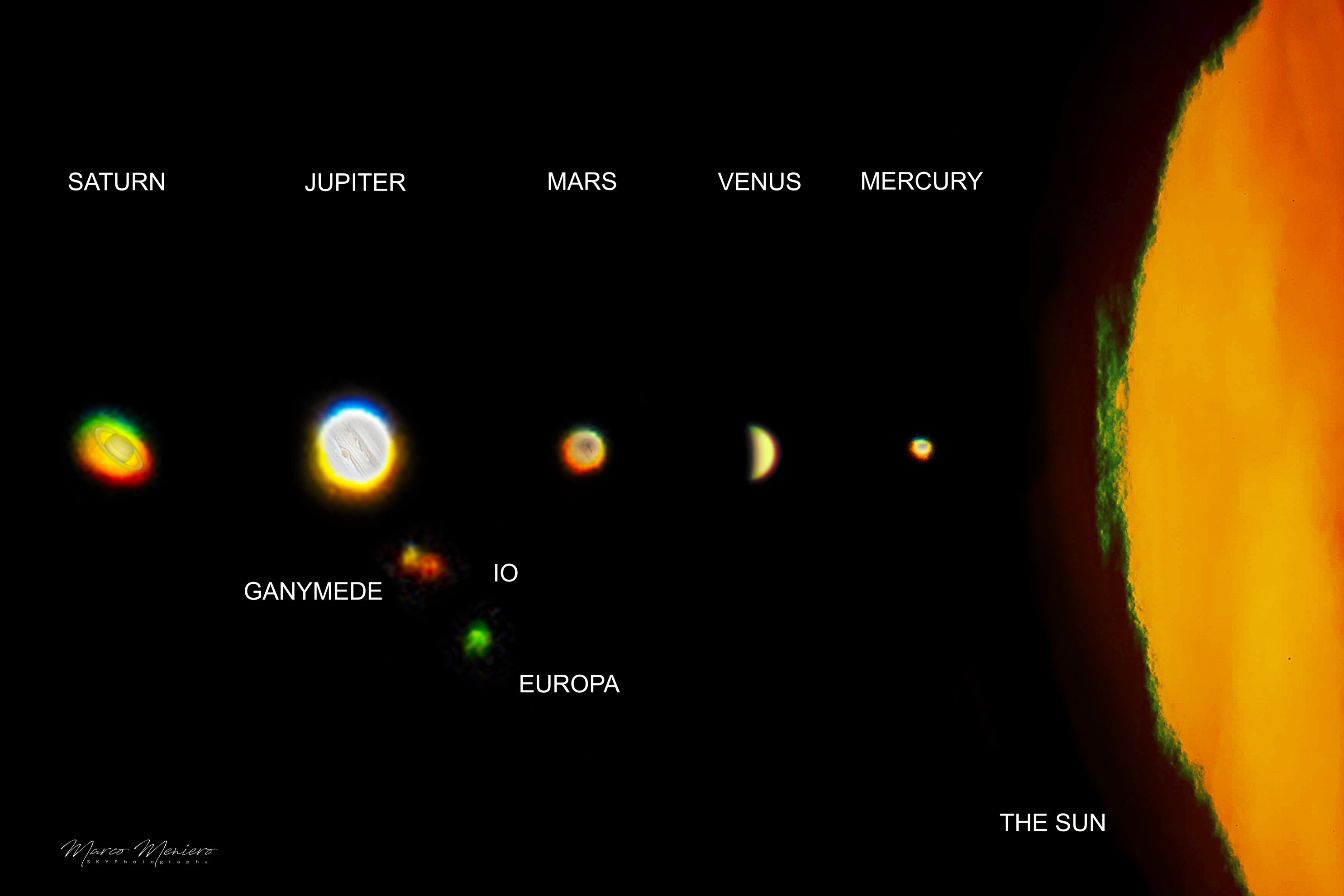
Atmospheric dispersion: this is the main cause and depends on the variation of the speed of light propagation as a function of its frequency and causes the separation of the visible spectrum. As we already mentioned in the chapter on scattering, refraction through air is greater at shorter wavelengths. Thus the refraction delay at sunset is usually a second or two longer for blue than for red. In general, therefore, the red image of the Sun disappears first, followed by yellow, green, blue and violet. This causes an apparent splitting of the solar disk into three different overlapping disks: at the bottom, a distorted and broadened red one, in the middle a yellow one, extending from 50% to over 95% of the disk, and at the top a green one.
Rayleigh scattering: as the observation altitude increases, the penetration ability of the visible spectrum at short wavelengths increases. This means that for an observer it is easier to perceive the blue flash while on a mountain than at the seaside, where only green can be perceived, because blue might be completely filtered out.
Selective absorption: some particles, such as oxygen and water vapour, can absorb certain colours such as red, favouring the passage of the other wavelengths. The Chappuis bands of ozone can absorb the orange colour, improving visibility of green; however this cause seems to produce only negligible effects.
Another cause is dispersion.
Other factors are turbulence caused by the random movements of the atmosphere and by jet streams, and strong thermal and baric inversions near the horizon.
All these phenomena reduce the definition of the solar disk and make colour perception less reliable. If to these factors we also added excellent air transparency, we could obtain the ideal conditions for the formation of the green ray.
According to O’Connell and Treusch, all the hypotheses examined can also lead to the formation of green edges on the Moon and on the brightest planets.
Non-physical causes
There are, however, non-physical factors that determine the sighting of the ray even when it does not physically appear: cognitive processes and the physiology of the human eye.
In the first case, the event does not occur, so the pupil does not see it, but the brain recreates it subjectively and deceives the observer, who sees it only because they are influenced by the desire to observe it.
In the second case, the deception is due to the red sensitivity of the cones in the retina, which produces a clearer view of the solar disk, making it appear greener than it really is. This physiological process misleads inexperienced observers; here is how: when observing the Sun at sunset with a telescope, the intense brightness dazzles the eye’s cones, which produce a false view of the green ray before it actually appears. For example, it may seem that the ray lasts 3 seconds, when in reality it lasts only 2 seconds. During the first second, only a virtual ray was seen. During the first second, only a virtual ray was seen. To verify this experience, photos must be taken; in this way the photographer can confirm that nothing was recorded during the first second.
Classification

Green segment: term once used by O’Connell (1958) to refer in general to the first formation of green on the horizon that precedes the final green flash (when the Sun disappears below the horizon). Later it fell out of use. The green segment appears as a small green “brick” a few seconds before the Sun vanishes.
Green rim: green streaks that detach from the upper limb of the Sun; their formation heralds the true green ray (visible only with binoculars or a telescope), it can last up to 15 seconds and is visible if the observer is in a layer of air with a strong thermal inversion. It can never turn blue or violet.
Blue rim: Andrew T. Young states that the blue rim does not exist; however there are differing opinions in the scientific community. From personal experience I can say that sometimes the green rim can appear partly bluish
Red rim: red streaks on the lower edge of the solar, or lunar, disk. It appears in a position symmetric to the green rim when the body is above the horizon.
Green spikes: a series of green rims that form simultaneously on the last visible limb of the solar disk. Easily recognized with binoculars if the Sun sets behind a jagged ridge such as that of a tree or clouds.
Green flash (the best known): It is a green rim that forms from the last visible limb of the solar disk, or when it crosses a layer of thermal inversion (visible to the naked eye from coastlines). It forms in hazy air if there are two air layers with different temperatures.
Green ray: faint green flash that radiates from the solar disk vertically for at least 10 degrees (very rare)
Blue flash: last visible solar limb with blue and indigo shades (visible to the naked eye from mountain peaks).
Most (about 2/3 or 3/4) of all observations come from an inferior mirage. The rest from a mock mirage. This is a type of inferior mirage that generates multiple false images that change shape and position over time. It differs from a simple inferior mirage because the latter produces only one false image below the real one.
Other types of flash exist, but they are rare and make up only 1% (of all reports). Not all types are named and there are also some not considered in this discussion, such as the cloud-top flash (which is usually seen when the Sun sinks into coastal fog, but sometimes also in distant cumulus), or Alistair Fraser’s flashes, which are seen in hilly countryside; these are a variant of the mock-mirage flash if strong inversions are present that climb up the hills.

Forecast
(Personally I carried out a series of observations of the phenomenon, with the aim of being able to predict the flash in advance and also calculate the photographic exposure time. The observations were based on a sample of over 1000 sunsets chosen at random among those with high pressure and a clear horizon over about twenty years of observations.
The statistical estimates extrapolated from the research say that each year you can see about 45–50 green rays even for two consecutive days, concentrated mostly in the months of May, June, September, October and November (about 60%–70% of the annual intensity). If instead we considered only the formation of the green rim, without the subsequent green flash, I believe the annual occurrences would rise to over 80–100. Obviously the estimates refer only to observability from the western Italian coast.
It is important, however, not to underestimate the impact of the cognitive process on the observer: this depends on the experience and emotionality of each person. Considering that on average its impact may be 20% on a suitably representative sample of expert observers, one could deduce that out of 45–50 green rays observable annually, only 36–40 are physically valid.
Forecast 30 minutes in advance:
The phenomenon can be forecast about 30 minutes in advance with a success probability of 2 times out of 3, by carefully observing the following weather events:
- an anticyclone must have just set in; if it has been present for more than 3 days, seeing the ray is unlikely;
- there must be moderate or fresh wind from N–NE, like the Tramontana;
- thin cirrus veils make it unlikely, but not impossible;
- the swell, far from the coast, can angularly amplify the ray, but an excessive one, or only close inshore, can smother it;
- high pressure on the horizon and clear sky at least 10° above the Sun; it has also occurred with small cirrostratus formations 2°/4° above it.
Forecast about 6 minutes in advance:
The chance of success in the forecast rises to over 90% by observing the shape and color of the Sun about 6 minutes before sunset and taking into account the following features:
- when the Sun is very distorted and shimmering, but bright and white, the phenomenon is enhanced and visible to the naked eye. The formation of the green ray is very likely;
- the presence of the pedestal under the solar disk means conditions are optimal; the formations of the green rim and the green flash are certain, while that of the green ray is only likely. When the Sun is deformed into an Omega, you should expect a green ray about 2–3 minutes after the pedestal forms.
- when the Sun is very flattened, with variable brightness (white–yellow in the upper part of the disk and red in the lower) you observe with binoculars first the green rim, then the green flash.
- if the Sun is heavily filtered and dull red, only the green rim is visible with binoculars.
- if the sky is clear and at least one of the above hypotheses occurs, but the solar disk passes behind a cumulonimbus right as it grazes the horizon, then more than one green rim could form between the cloud crests (not visible to the naked eye).
If at least one of the above conditions occurred on a land horizon, low and jagged, then several green rays could appear simultaneously. (same mechanism as the formation of Baily’s Beads during eclipses).
In cases where the sunset is observed from a mountain peak, the ignition of the ray is faster, the colors are more contrasted and, contrary to what is believed, it becomes easier to observe the blue flash than the green flash. This peculiarity is caused by Rayleigh scattering.
Researcher B. E. Schaefer of the Goddard Space Flight Center (NASA) devised a simple software useful for forecasting the green flash from anywhere on Earth. By entering into the algorithm some data such as the elevation and latitude of the observation site, atmospheric extinction and other details, you can know the duration of the solar flash, its visual magnitude and the approximate color: red, orange, yellow, green or blue.
Never observe the Sun without proper protection such as dedicated solar filters and sunglasses.

Bibliografia nei testi consigliati.