
Article inspired by time spent in Alta Versilia and by reading the book "The Secret Apuane” by Marco Lapi and Fiorenzo Ramacciotti

The day with two dawns
We left the Azzurra motorway at the Versilia exit and find ourselves on the Via Aurelia at the entrance to Forte dei Marmi. We stop by the Forte Lorenese, witness to the defence of the Tyrrhenian Coast from corsair raids, but this time our destination is not the famed seaside resort. We set off again, travelling up the Vezza valley which, in just a few kilometres, links the beaches to the peaks of the Panie rising above 1,500 metres. The valley has an ancient metallurgical vocation: already in the 1800s it counted many workshops for working metals coming from the Island of Elba. Today the workshops have been converted into marble sawmills. Skirting on the right is Vallecchia, a medieval stronghold of Flaminga defence, with the parish church of S. Stefano which inside preserves rich marble decorations. The first town we meet is Seravezza, where we admire the confluence of the Serra and Vezza streams, where they give birth to the Versilia river. The streams take their names from the ancient Lombard village Sala Vetitia and not the other way round. Seravezza is known for its marble quarries at the foot of Monte Altissimo, where Michelangelo lived between 1517 and 1520 to choose blocks for his works. Leaving the town we immediately come upon a UNESCO World Heritage building: the Medici Palace of Seravezza, built in 1550 by Bartolomeo Ammannati for Cosimo I; it was the summer residence of the Grand Dukes of Tuscany. Leaving Pontestazzemese behind us, we continue climbing towards Cardoso, where we visit the Benti baptismal font dated 1528. Cardoso is framed by sheer marble walls and clear streams; we have reached the green heart of the southern Apuan Alps. An enchanted place between the marble Panie and the sky. We are at the foot of Monte Forato in the small village of Pruno. The hamlet shows a clearly medieval urban layout, even if it is of probable Roman or pre-Roman origin and the name comes from the Latin term prunulus, “thorny plum tree”. Arriving in the village we immediately discover that it houses the Romanesque parish church of S. Nicolò from the 13th century, placed at the most visible southern end, with a bell tower a full 22 metres high in visual contact with the parish church of nearby Volegno. The church preserves a late-17th-century altar with an elegant Eucharistic tabernacle in the style of Lorenzo Stagi. We have reached our destination and, without neglecting the architectural beauties, we get ready to contemplate a truly special dawn on an equally singular day: it is a double dawn that occurs during the summer solstice. Monte Forato, also known as Pania Forata, has two peaks, respectively 1,204 and 1,230 m high; the summits are joined by an extraordinary natural arch 8 metres thick that creates between them a hole of about 30 m, and it is precisely this limestone formation that makes the Sun seem to rise twice: first inside the hole, then, after hiding for a few seconds behind the arch, above the higher peak. Stopping in the small village, we discover that the event is accompanied by a series of folk add-ons that make the dawn even more evocative. With other travellers we await the morning aurora, captivated by folk dances and theatrical performances. The birth of the Sun lights up the lush woods, accompanied by melodious sounds of flute and violin and by poetry readings. The people of Pruno, in fact, in the week that culminates on 21 June welcome this natural phenomenon with a village festival with ethnic and mystical tones, a fair with an ancient rural flavour, which draws many spectators. To make the dawn even more striking, a team of climbers, during the night, stretches a sail-shaped curtain over the arch, closing the natural hole. Then, a few moments before sunrise, to the sound of a Jobel horn and a viola, the curtain drops and the first rays of light begin to illuminate the whole valley, giving life to the double dawn. Lit by the sun’s rays, Pascoli’s verses come back to mind in his description of the Pania seen from the Garfagnana side (from I Canti di Castelvecchio):”O mountain, that reigns amid the smoke of the storm-cloud, and amid the light of the stars, …”.

Guardian angels of the event are the volunteers of the Opera Pia Mazzucchi, who provide travellers with disabilities with a special wheelchair able to move along mountain paths.
The “Summer Solstice” event was born in 1997 after the flood of the previous year that had devastated the valley. The people of Pruno, to react to the catastrophe, thought about how to enhance the area. They remembered that the Liguri Apuani populations considered the Monte Forato phenomenon a mystical event, so they decided to create the initiative of observing the double dawn to promote the Alta Versilia area, in order to create a project bringing together the inhabitants of the flooded valley.
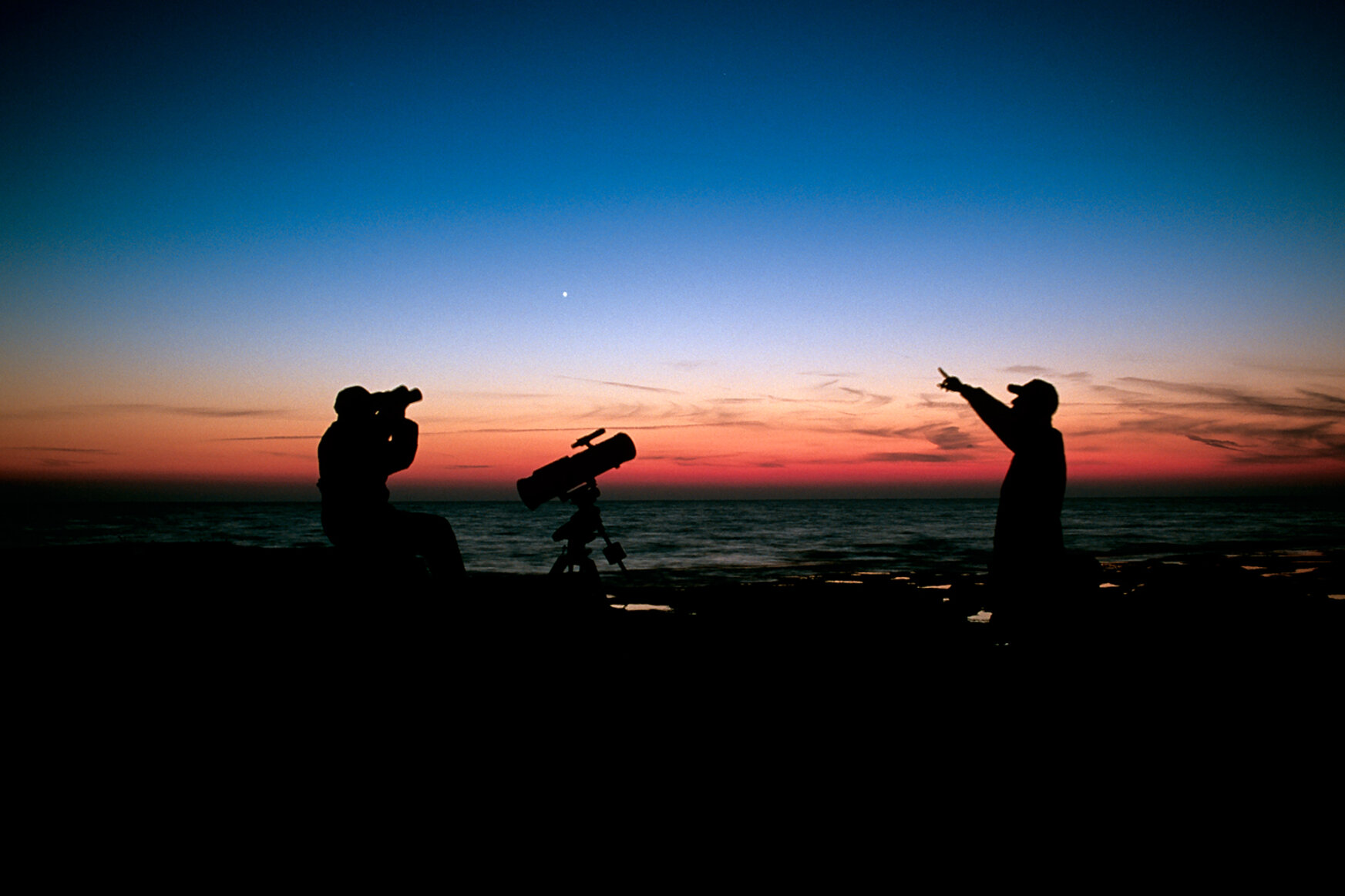
On this occasion, many astronomy enthusiasts, including foreigners, who for years have come to Italy to photograph the dawn, say they have also observed through the Forato arch other astronomical events such as the passages of the Moon and the Pleiades. The presence of the arch on the mountain is in fact a draw for those who try their hand at photographing the celestial bodies that appear to pass behind the hole throughout the year.
To capture the event at its best, the most experienced photographers suggest simulating the passage of the solar disk inside the arch with some planetarium software, considering that the centre of the hole has coordinates on the celestial sphere equal to Alt.16°00’00” and Azimuth 073°42’00”, and that the best site for shooting is the plateau above the Locanda Il Poveromo, which has GPS coordinates: 44°00’38.29”N, 10°18’37.82”E.
You can also witness the double dawn in periods far from the summer solstice, but this time lying comfortably on the beaches of Versilia. There is in fact a series of beach establishments, listed below, between Forte dei Marmi and Massa Cinquale, from which it is possible to observe the Sun in the Forato arch about twenty minutes after sunrise time:
Bagno Apuana Mileto: 10 May and 4 August;
Bagno Boma: 9 May and 5 August;
Bagno Giuliana: 8 May and 6 August;
Bagni Angelo Ponente and San Camillo: 7 May and 7 August;
Bagno Alba: 6 May and 8 August;
Bagni Pennone and Capri: 5 May and 9 August;
Bagno Salvatori: 4 May and 10 August;
Bagni Solemar and Belmare: 29 April and 15 August;
Bagno Cinquale: 28 April and 16 August;
Ristorante Max E Bagno Galliano: 27 April and 17 August;
Bagni Berna and L’approdo: 26 April and 18 August;
Bagno Eden: 25 April and 19 August;
Bagni Alpemare and Spiaggia Comunale: 24 April and 20 August;
Bagni Henderson and Girasole: 23 April and 21 August;
Bagni Ivo and Spiaggia Comunale: 22 April and 22 August;
Bagno Nedy: 21 April and 23 August;
Bagni Chiramaia and Jungla: 17 April and 27 August;
Bagni Monia and Sorriso: 16 April and 28 August.
For further information we refer the reader to the publication: “The Secret Apuane” by Marco Lapi and Fiorenzo Ramacciotti, “Il Labirinto” editions, which can be considered a real “bible” not only on the Forato but on the whole southern Apuan Alps. Folk events are reported year by year on the website: http://www.iraggidibelen.it/.
To sleep:
B&B La Giunchiglia, lovely apartment a few metres from the plateau where the double dawn is observed, 0584777998
Ostello La Pania, 05841780261, www.ostellolapania.it
To eat:
Locanda Il Poveromo, where you can enjoy local seasonal dishes, such as fresh nettle strips with walnut pesto, as well as Piedmontese fassona tartare, Chianina steak, apple pastry, mandarin millefeuille and chocolate drops with custard sauce, 0584777021.
Marco Meniero