

Green formations can also be observed on the lower edges of large sunspots, as these are much darker than the Sun. In these cases one should not consider the green ray on the lower part of the spot, but on the upper part of the Sun below the spot.
On the evening of July 11, 2023, from Viterbo I tried to capture the green ray on the large sunspot AR3363 and I succeeded.

In the image I propose, you can mainly see four effects:
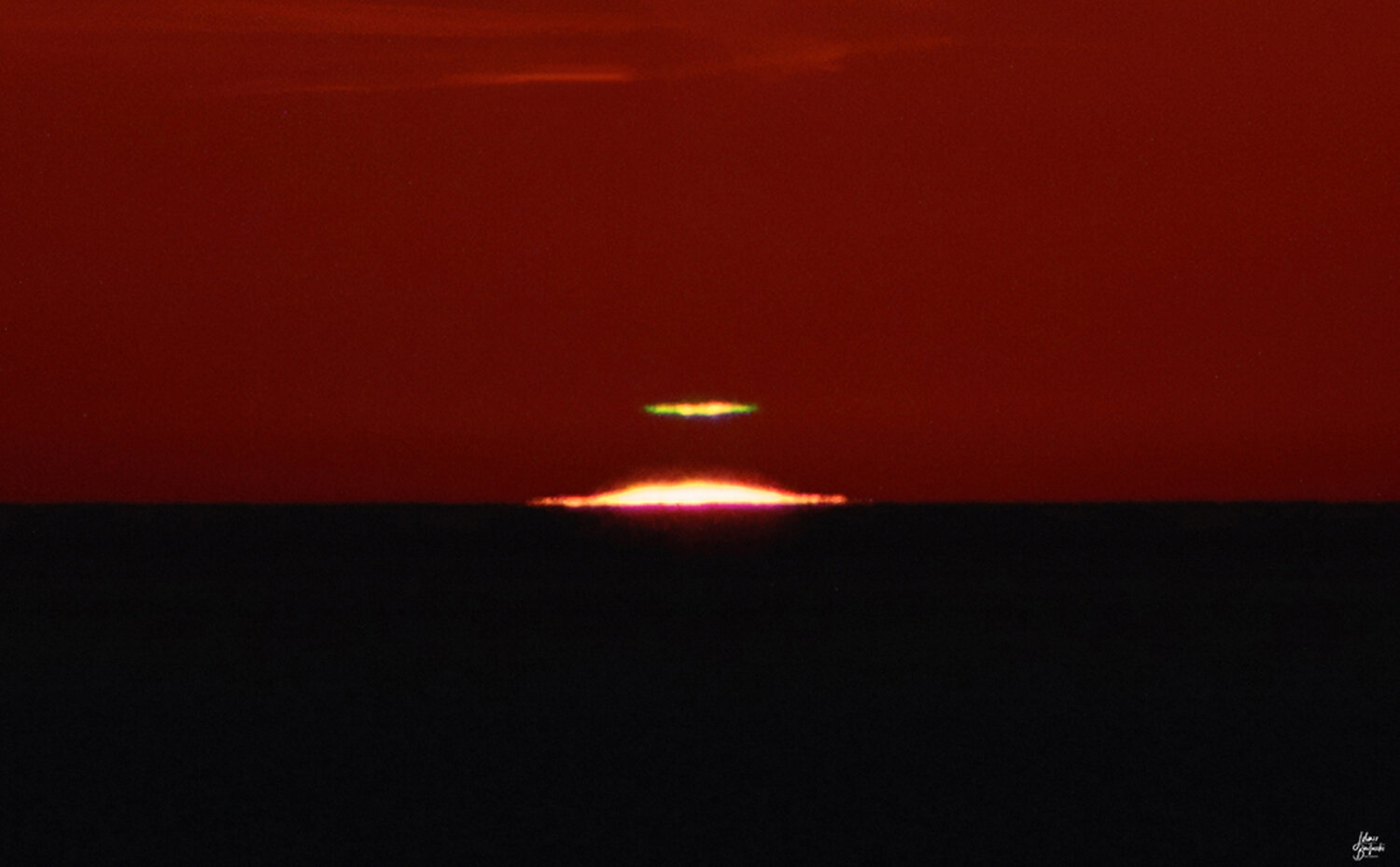
The refraction that flattened the solar disk, atmospheric absorption with dispersion that made the solar disk redder, the Green flash on almost all sunspots and finally the Green segment on the upper edge of the solar disk in both shots.
Here are the shooting data: Nikon Z9 in APS-C mode with Nikon Z 400/4.5 plus 2X teleconverter (equivalent focal length of 1200mm) and exposure times of 1/32,000 f/20 at 18:35TU for the first solar disk, 1/32,000, f/11, 400Iso at 18:41TU for the second solar disk, 1/28,000 f/14 at 100Iso at 18:36TU for the enlargement of the sunspots with the green ray.

Green flashes can also be observed on the lower edges of large sunspots as these are much darker than the Sun. In these cases one should not consider the green ray on the lower part of the spot, but on the upper part of the Sun below the spot.
On the evening of July 11 2023 I tried to take the green ray on the large sunspot AR3363 and I succeeded. From Viterbo, Italy
In the image I propose you can see mainly four effects:
The refraction that flattened the solar disk, atmospheric absorption with scattering that made the solar disk redder, the Green flash on almost all sunspots and finally the Green segment on the upper edge of the solar disk in both shots.
Here are the shooting data: Nikon Z9 in APS-C mode with Nikon Z 400/4.5 plus 2X doubler (equivalent focal length of 1200mm) and exposure times of 1/32,000 f/20 at 18:35TU for the first solar disc , 1/32,000, f/11, 400Iso at 18:41TU for the second solar disk, 1/28,000 f/14 at 100Iso at 18:36TU for the enlargement of the sunspots with the green beam.
Green ray on the sunspot 1200mm focal length f/14, 80 ISO t: 1/8000

Green flash on the other formations


Biographical reference

Bibliografia nei testi consigliati