
Rainbows are undoubtedly one of the optical manifestations of the atmosphere that most strikes the imagination and fantasy of humankind.
Scientifically they were first studied by the mathematician Descartes in 1637, who understood the mechanism of light passing through water droplets and mathematically calculated the angular position of the primary rainbow (about 42° from the antisolar point). Thirty years later, the physicist Isaac Newton realized that the reflection of light occurs at different angles depending on the different wavelengths of the visible spectrum: red at 42° and violet at 40° from the center of the arc.
Today we know that rainbows consist of an arc with the colors of the iris, with the variable radius of the primary arc from 39° to 43° and with its center at the antisolar point, called the anthelion, i.e. 180° away from the solar disk (anthelic point), therefore never visible to any observer on the Earth's surface.
They form through internal reflection of sunlight, or moonlight, in water droplets: when the beam of light passes into a drop it is refracted, reflected and then refracted again, just as happens in a prism. If two reflections occur in the drop, instead of only one, a second (secondary) arc forms with colors symmetric to the first and with a variable radius from 50° to 57°. In that case the second arc will have a thickness equal to twice the first, but a brightness reduced by 43%.
Rainbows of order higher than the second can also form, whose order number is determined by the number of internal reflections inside the water droplet.
In the optical formation process, the wavefront, as Isaac Newton had rightly sensed, is split so that the individual spectra (infrared, visible colors and ultraviolet) separately form their own monochromatic arcs with radii different from one another; however for the observer it is impossible to distinguish them separately, so they can only be seen joined in a single colored arc whose thickness is the sum of the many individual spectra.
Let us see the different reflection angles at the different wavelengths, according to a study by David K. Lynch and William Livingston published in 1995 (Cambridge University):


Visibility and growth


Rainbows are visible during or after thunderstorms only if the Sun has an elevation below 42°; from this it follows that, on average, they are not visible in the central hours of the day.
They can form more easily in summer during violent and isolated thunderstorms or during the rest of the year after the passage of a cold front. When you look at a rainbow, it is certainly raining between the observer and the photometeor; conversely, on the opposite side, the sky clears; in fact, the presence of a rainbow, most of the time, indicates that the rain is about to end. Considering that in Italy thunderstorms are more frequent in the afternoon, it follows that most rainbows can be seen to the North–East, with the Sun to the South–West. In these cases it seems that the rainbow is born right from the cardinal point North to end at the cardinal point East.
Fogbow - white rainbow

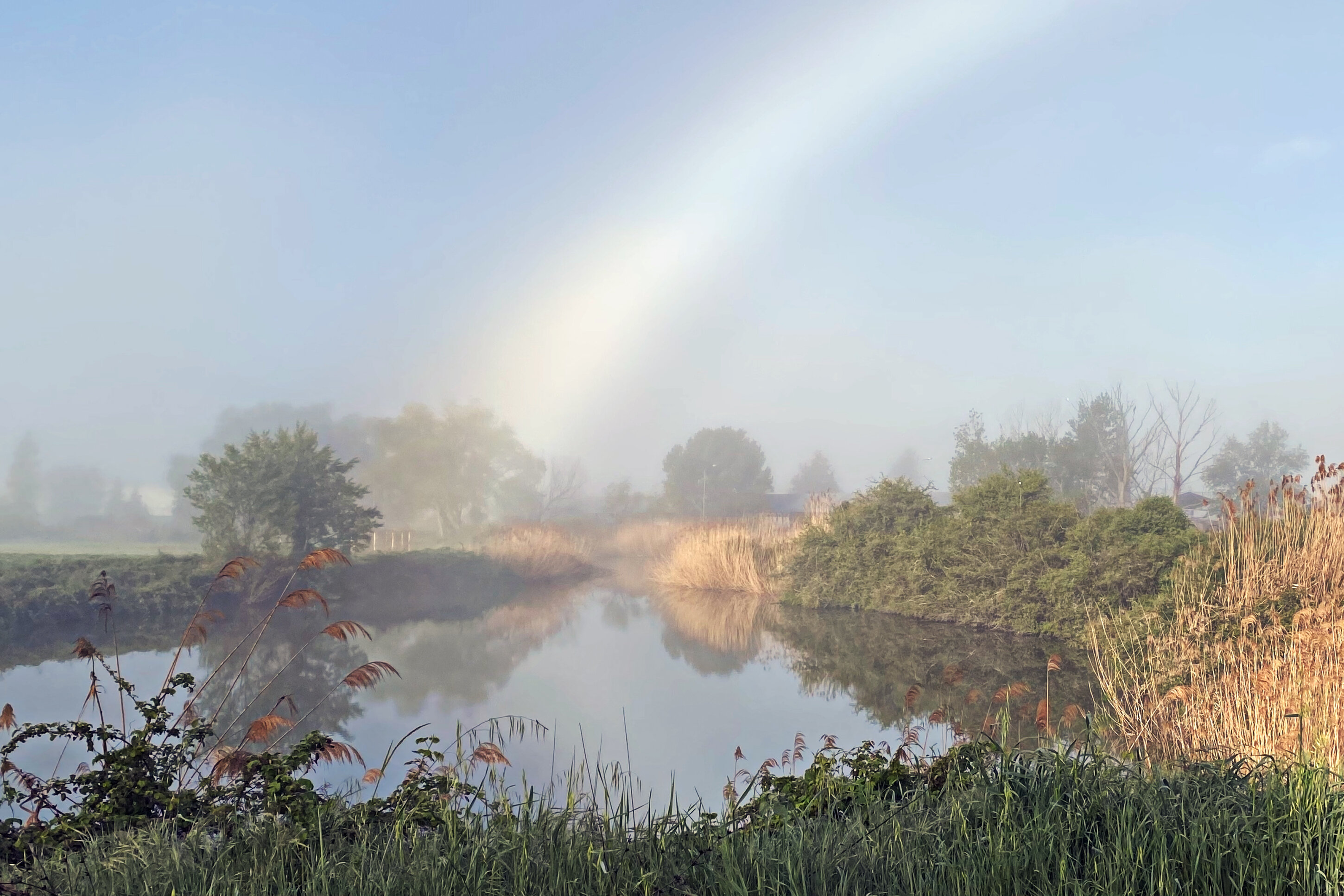
The chromatic intensity of the iris is determined by the diameter of the water droplets: large sizes on the order of 1.5 mm, or more, create very contrasting colours, with clearly visible supernumerary arcs, while smaller diameters down to 0.1 mm make the rainbow pale and evanescent; if, instead, the drops are smaller than 0.05 mm, the primary arc appears whitish and barely visible amid the haze of fogs. In this case one no longer speaks of the common rainbow (rainbow), but of the rare “white arc” of fog (fogbow). This arc appears only with the tiny water droplets of fogs or mists and takes on the same angular size and the same luminous intensity as the secondary rainbow.


Supernumerary arches

Extra arcs can also form, namely faint parallel indigo-colored filaments that develop in the lower part of the primary arc. For simplicity we can assume that their origin is due to spurious internal reflections within large water drops when these contain pollen grains, atmospheric dust, or simply oscillate and change shape in the fast and random rotations during precipitation.
To learn more:

Lunar rainbow
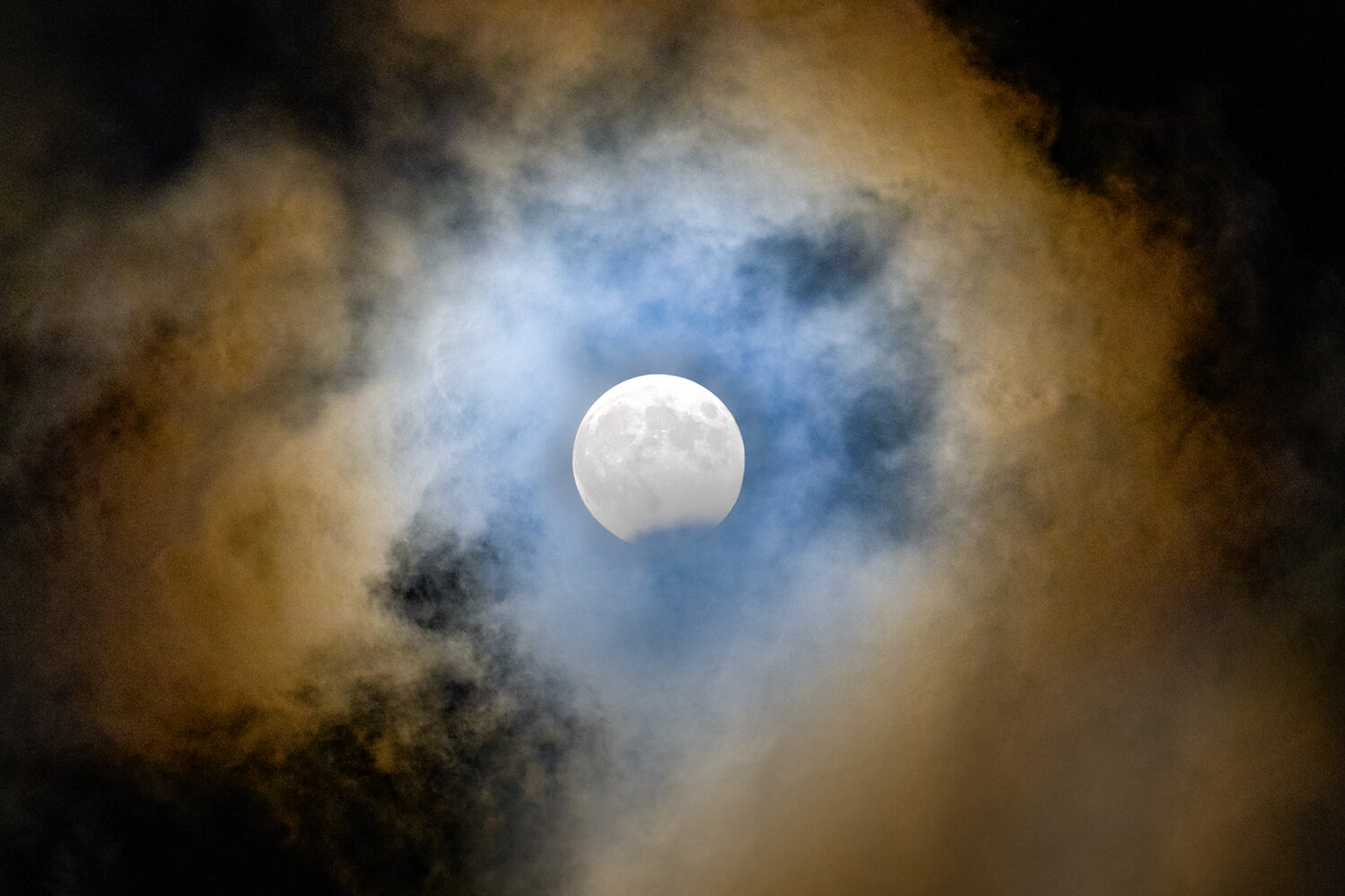
The lunar rainbow is a rather unusual and rare photometeor, due to the peculiarity of the individual events that must occur simultaneously: brief and violent night storms (typical of the Tropics) and strong illumination coming from the Moon, which must be full or almost full. Lunar rainbows appear pale and weakly saturated because moonlight is about a million times weaker than sunlight.
Red rainbow
Sunlight, or moonlight, at sunset travels long paths through the lower atmosphere where it is scattered by dust and air molecules. It follows that scattering filters blue and green more than yellow and red because they have a shorter wavelength. The result is that during purple sunsets and sunrises rainbows become red.

Alessandro's Band
The “Alexander’s Band” consists of a dark strip between the primary and the secondary arc; it is named after Alexander of Aphrodisias, a Greek philosopher, who in 200 AD first described the phenomenon in his “Chronicles”. The strip generally appears darker than the regions outside the arcs because the light in that area is polarized by water droplets and directed toward the outer parts. In rare cases you can notice bluish streaks; they belong to the fifth-order arc that forms right along the upper edge of the band.

Reflected rainbows

Sometimes one can observe rainbows mirrored on the water, or, in very rare cases, doubled rainbows caused by sunlight reflected by the sea. In the latter case two rainbows form, offset by a few degrees: the first with its center at the antisolar point below the horizon and produced by direct sunlight, and the second produced by sunlight reflected by the water, with its center no longer antisolar but above the horizon, and with the primary arc projected between the Zenith and the first rainbow.
Under these rare conditions the two arcs appear identical and partially overlap each other, almost forming a single arc with a double iris. Moreover, their respective supernumerary arcs merge with each other.
When observing this phenomenon, note also that the red arcs of the rainbows are parallel to each other, not mirror images and rather close. This means that one arc cannot be considered the secondary of the other.
Tips for photography
Often rainbows appear with very vivid colors; however, to capture even the faint hues of supernumerary arcs and of arcs of order higher than the first, you must use the precautions and techniques described for the other photometeors. It is therefore unquestionable that it is advisable to use well-corrected optics that do not suffer from chromatic aberration, such as those with very low-dispersion lenses.
Considering that the primary bow has an outer radius of about 42°, to photograph it completely in its full extent it will be necessary to use a lens with an apparent field greater than 84°. If instead we wanted to photograph the secondary bow as well, with the radius reaching 56°, then the lens will need a field of a full 112°. Lenses with these features are ultra-wide angles such as the 18 mm and 20 mm for the first case, and fisheyes for the second case. A good choice could be Venus Laowa optics, or the Irix 11 f/4 and 15 f/2.4 which have, respectively, a framed field of 124° and 110°.
To capture only details, such as supernumerary arcs, bright medium telephotos are recommended instead for their high resolving power. According to recent MTF tests, among the best mid-range lenses on the market stand out the Sigma 135 f/1.8 Art with very high sharpness both at the edges and at the center; moreover distortion and vignetting are nonexistent.
The use of optical filters is harmful except for the Skylight one, useful only to protect the lens from water droplets present in the air during shooting.
As for exposure times, it is advisable to take a series of three “bracketed” shots as for the aforementioned photometeors.
Finally, for the very rare lunar rainbow the most suitable sensitivities are 400-800Iso.
Exposure metering: spot or semi-spot.

Bibliografia nei testi consigliati